Summarise With AI


The National Testing Agency has successfully conducted the Day 2 shift 1 of the Session 1 on January 22, 2026, and now the JEE Main Paper analysis is also out. The first shift 1 was conducted starting from 09:00 to 12:00 P.M. JEE Mains Today Paper Analysis Shift 1, the overall question paper today was easier than the previous shifts. Maths was easy, Physics was moderate to difficult, and Chemistry was similarly rated moderate. Read the complete blog for a detailed subject-wise JEE Mains 2026 Paper Analysis, January 22 2026, Shift 1, student reviews, and expert perspectives on Today’s Papers.
Check the subject-wise difficulty level for all shifts of the JEE Main exam below.
Where To Check JEE Mains Paper Analysis 2026?
Checking the JEE Main Paper Analysis for every shift will help the students in guessing the paper pattern, difficulty level, and the important topics. For all these, the expert academic team of CollegeDost prepares a detailed JEE Mains paper analysis of every shift, including how to prepare for the upcoming shifts.
We’ve covered shift-wise and subject-wise difficulty, subject-specific important subjects, and student reactions all in one place.
Check the link below for a complete JEE Mains 2026 paper analysis, including the previous day’s analysis:
JEE Mains Paper Analysis 2026 on CollegeDost
How Can Students Prepare For The Upcoming JEE Mains 2026 Shifts?
For the upcoming JEE Mains 2026 exams, students can quickly appear for a small mock test. CollegeDost even has subject-wise and topic-wise JEE Mains Mock Test, which have clusters of 10 to 20 questions. Students can easily use this to get their quick revision, which will take 30 to 40 mins and will also include questions from 12+ years of JEE Mains PYQs.
Just practising the JEE Mains mock test and not checking the answer will prevent them from any unnecessary anxiety, but also will make them confident by quickly revising everything. The score of the mock test for JEE Mains doesn’t matter much before the exam, but the confidence boost and exam hall simulation test will help them in the JEE Mains exam the next day.
Recommended for JEE Mains 2026 aspirants 👇

JEE Main Paper Analysis Jan 22 Shift 1
The JEE Main exam analysis 2026 Jan 22 Shift 1 suggested that the overall paper was moderate. As per the JEE Main Students Reaction shift 1, they feel this was the simplest and easiest when compared to the previous shifts.
Coming to the JEE Main 2025 exam difficulty level analysis, Chemistry and Physics were rated as easy and moderate, respectively. JEE Main Jan 22 Shift 1 Mathematics section was doable and easy compared to physics.
JEE Main Analysis 2025 Jan 22 Shift 1 for Mathematics
Many students have felt that the JEE Mains Mathematics paper was ‘doable’ and moderate, with some questions being lengthier or calculative rather than conceptually difficult. However, coordinate geometry questions were standard that rely on the basic formulas like eccentricity and latus rectum; it was suggested that students weak in geometry should at least study the formulas. Moreover, questions on relations used direct formulas rather than requiring manual checking of properties. Some problems, particularly in Sequence & Series and Binomial Theorem, were noted as calculative.
| Difficulty Level | Key Topics | Question Types |
| Moderate to Doable | Calculus | Definite integration involving modulus functions and properties of odd/even functions |
| Differential equations (Linear and Variable Separable forms). | ||
| Algebra | Matrices and Determinants (Characteristic equations, trace, and finding determinant values) | |
| Quadratic equations involving modulus. Complex numbers (properties of cube roots of unity, ω) | ||
| Sequence and Series (GP calculations) | ||
| Binomial Theorem (Coefficients of multiple variables) | ||
| Permutation & Combination (Strictly increasing functions) | ||
| Coordinate Geometry | Ellipse and Hyperbola (Confocal properties, eccentricity, and latus rectum) | |
| Circles (Locus of the point of intersection) | ||
| Straight lines (Equilateral triangle between parallel lines) | ||
| Others | Trigonometry (Simplification). Relations (Reflexive and Symmetric relations formula) | |
| Inverse Trigonometric Functions (Domain). |
JEE Mains Paper Analysis Shift 1 for Physics Section
According to many students’ feedback, the paper was considered balanced and easy to moderate, with questions often being formula-based. However, there was a significant weightage on standard topics like Logic Gates, Rotation (Moment of Inertia), and Current Electricity, which appear in almost every shift. Moreover, there are many questions regarding instruments (Venturi meter, Microscope) and practical topics (Errors, Optical path shift) were prominent.
Most of the students are advised to revise basic formulas for topics like EM waves and the Centre of Mass, as the questions were direct for the upcoming JEE Mains 2026 shifts.
| Difficulty Level | Chapters Name | Key Topics |
| Easy to Moderate | Electrodynamics | Electrostatics (Work done moving a charge). |
| Current Electricity (Wheatstone bridge, nodal analysis). | ||
| Capacitance (Dielectric insertion). | ||
| Magnetism (Force on a charge in a solenoid) | ||
| Mechanics | Impulse-momentum theorem. | |
| Rotational motion (Moment of Inertia of T-shape, string cutting problems). | ||
| Gravitation (Energy required to change orbit). | ||
| Fluid Dynamics (Venturi meter/Bernoulli’s principle). | ||
| Modern Physics & Optics | Optical Instruments (Microscope magnification). | |
| Photoelectric effect (Max kinetic energy dependency on frequency). | ||
| EM Waves (Direction of propagation E×B) | ||
| Wave Optics (Shift due to mica sheet) | ||
| Logic Gates (NAND/OR combinations). | ||
| General Physics | Error Analysis (Series/Parallel spring constants). | |
| Units and Dimensions. | ||
| Thermal expansion |
JEE Main Paper Analysis Jan 22 2026 Shift 1 for Chemistry Section
Most of the students were happy as the paper was NCERT-based, particularly for Organic reactions. As per the students’ report, questions from Physical Chemistry were standard, while some questions were calculation-intensive (e.g., combustion analysis and practical organic chemistry using Barium Sulphate for Sulphur estimation). Also from the Inorganic Chemistry, questions were very direct and taught repeatedly in classes, such as the ‘Butterfly structure’ of chromium peroxide and specific hybridisation cases like [Ni(CN)4 ]2− vs [Ni(CO)4 ]. Moreover, practical Organic Chemistry (POC) appeared in the form of the Carius method, linking mole concepts with practical estimation.
| Difficulty Level | Sections | Key Topics |
| Moderate | Organic Chemistry | Reactions: Hydrogenation, KMnO₄ oxidation (benzilic hydrogen), Hoffmann Bromamide degradation |
| Organic Tests: Iodoform test, Tollen’s test | ||
| Biomolecules: Amino acids – Arginine, Tryptophan, Glycine | ||
| Physical Chemistry | Combustion analysis to determine hydrocarbon formula | |
| Chemical Kinetics: Arrhenius equation | ||
| Solutions: Freezing point depression | ||
| Electrochemistry: pH and conductance relationship | ||
| Atomic Structure: Emission spectrum comparison of H vs He⁺ | ||
| Inorganic Chemistry | Qualitative Analysis: Chromyl chloride test, peroxide linkages in CrO₅ | |
| Periodic Trends: Ionisation energy, basic nature of oxides | ||
| Coordination Compounds: Hybridisation, paramagnetism, crystal field theory (CFT) | ||
| d-Block Elements: Disproportionation of MnO₄²⁻ |
Weightage Of Chapters In JEE Mains 2026
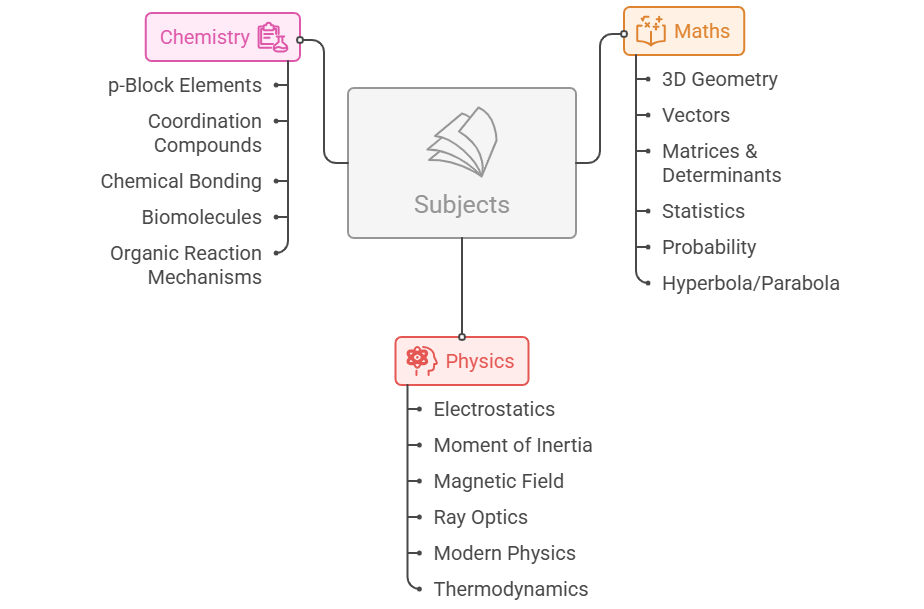
On the basis of JEE Mains 2026 paper analysis, we have shared the complete chapter-wise weightage of physics, chemistry, and maths in the table below.
Physics
Check out the question-wise weightage of chapters in JEE Mains physics asked in Jan 22 Shift 1.
| Physics High-weightage chapters for JEE Mains 2026 | |
| Topic | Type of Questions |
| Gravitation | 2 questions (Escape Velocity) |
| Ray Optics | 3 questions |
| Fluid Mechanics | Statement-based questions |
| Moment of Inertia (MOI) | 1 question |
| Electrostatics | 2 questions |
| Newton’s Laws of Motion (NLM) | 1 question |
| Logic Gates | 1 question |
| Magnetic Effect of Current | 1 question |
Chemistry
The following are the chemistry high-weightage chapters for JEE Mains 2026 Day 2 Shift 1.
| Chemistry High-weightage chapters for JEE Mains 2026 | |
| Topic | Number of Questions |
| General Organic Chemistry | 2 questions (Reagent-based) |
| Some Basic Concepts of Chemistry | 1 question (Mole Concept) |
| Coordination Chemistry | 1 question (Ion-based) |
| Chemical Bonding & Molecular Structure | 1 question |
| p-Block Elements | 2 questions |
| Ionic Equilibrium | 1 question |
| Chemical Kinetics | 2 questions |
| Salt Analysis | 1 question |
| d-Block Elements (3d Series) | 1 question |
| Biomolecules | 1 question |
| Chemical Thermodynamics | 1 question |
Mathematics
Students should refer to the Maths chapter-wise JEE Mains weightage of Jan 22 shift 1 given in the table below.
| High-Weightage of chapters in JEE Mains Maths | |
| Topic | Number of Questions |
| Functions | 1 question |
| Matrices | 1 question |
| Vector Algebra & 3D Geometry | 3 questions |
| Integral Calculus | 3 questions |
| Coordinate Geometry | 3–4 questions |
| Hyperbola | 1 question |
| Straight Line | 1 question (Shortest Distance) |
| Differential Equations | 1 question |
| Applications of Derivatives | 1 question (Area under Curve) |
| Probability | 1 question |
| Sequence & Series | 1 question |
JEE Mains Paper Analysis: 2026 vs 2025
To make the analysis more efficient, we have provided a comparative JEE Main 2025 exam difficulty level analysis with the current year.
| Feature | JEE Main 2025 Analysis | JEE Main 2026 Analysis |
| Overall Difficulty | Generally moderate, with Mathematics consistently rated as the most difficult and lengthy subject. | Rated moderate to difficult, comparable to 2025 trends, though some 2026 shifts showed surprising variances in subject difficulty. |
| Exam Pattern | Consisted of MCQs and Numerical Value Questions with Section B (Numerical) often having optionality in earlier sessions. | Section B is now compulsory; students must attempt all 5 numerical questions per subject with no optional choices. |
| Mathematics Trend | Consistently difficult and lengthy across almost all shifts. | Remained tough in early shifts (Jan 21), but was surprisingly rated as “Easy” or manageable in some later shifts (Jan 22). |
| Physics Trend | Generally easy to moderate, focusing on electromagnetism and mechanics. | Primarily formula-based and conceptual; rated as the “easiest” subject in several 2026 shifts. |
| Chemistry Trend | Mostly easy to moderate; shifted between being theory-heavy and calculative. | Strong focus on NCERT textbooks; Inorganic Chemistry often had direct fact-based questions |
Students’ Reaction For JEE Main Paper Analysis Jan 22nd 2026 Shift 2
Students have left the exam hall and have provided crucial details about the exam, such as the difficulty level, the most frequently questioned topics, whether the paper was lengthy, and advice that will be very useful to candidates for the next shifts.
According to the first student reactions and question paper analysis of JEE Main 2026 Jan 22 shift 1, the overall paper today was easy and doable within the time frame given.
- Monisha, who appeared in shift 1 of Jan 22, stated that the class 12 syllabus weighed 65% and the class 11 syllabus weighed 35%.
- Shivani, who took JEE Mains for the first time, reported that the Physics part on the 22nd January morning shift was more difficult than the 21st January evening shift, but easier than the morning shift. Rest two sections are manageable.
- Krishna, who appeared in today’s exam, rated the question paper as moderate. The physics paper was moderate, with more focus on conceptual clarity than on extensive calculations. Chemistry had a balanced distribution of physical, organic, and inorganic questions, whereas the mathematics section was time-consuming.
JEE Mains Answer Key Response Sheet
The National Testing Agency will release the NTA JEE Mains Provisional Answer key along with the Individual responses sheet via the candidate’s dashboard, available at jeemain.nic.in.
Along with the release of the answer key, the JEE Main answer key challenge window is also opened on the same day and opens until the next two days. Within this period, those students who are not satisfied with the responses are allowed to raise their objections with proper documentation.
JEE Mains 22nd Shift 1 Answer Key
How to Check JEE Mains 2026 Answer key?
Follow the steps in order to download the JEE Mains nta nic answer key pdf and responses sheet in a hassle-free way.
- Visit the official JEE Mains 2026 website at jeemain.nta.nic.in.
- Look for the link to the JEE Main 2026 answer key and candidate responses, which is highlighted on the homepage.
- After clicking on the link, the JEE Main login page will appear. To log in, enter your JEE Main 2026 application number, password, and date of birth.
- After logging in, applicants can view their JEE Main answer key and response sheets 2026 on their computer screen.
- Download and save the document on your device for future reference.
JEE Mains 2026 Percentile Predictor
After assessing your expected marks using the JEE Main answer key 2026, you will be able to determine your probable score. Additionally, you can use CollegeDost’s Exclusive JEE Mains 2026 Percentile Predictor Tool to better understand your exam performance. This will help you in predicting your percentile, followed by ranks with the CollegeDost’s JEE Mains Rank Predictor.
Students will get an idea of where they stand and which colleges they are going to get into before the main results are out. It will help them by getting them prepared for the results and JoSAA Counselling beforehand, thus limiting the anxiety.
Click here to Predict your JEE Mains 2026 Percentile Score
Official NTA Guidelines for JEE Mains 2026 Session 1 Exams
All the students who are now going to appear in the Shift 2 of the January 22 exam should carefully go through the crucial NTA guidelines mentioned hereunder.
- Unlock Aadhaar Biometrics: Candidates who intend to present their Aadhaar for entrance must ensure that their biometrics are unlocked before arriving at the facility.
- Appear at Exam Centre 1 hour before: Candidates who did not register using Aadhaar must arrive early on the exam day to have their biometrics recorded at the exam centre.
- Dress Code: Although there is no official dress code for JEE Mains, the NTA advises against wearing shoes with heavy soles or clothing with many buttons. Sikh candidates may carry religious or customary artefacts, such as a Kara or Kirpan.
- Things to Carry: Students were only allowed to bring a translucent, simple ballpoint pen and a clear water bottle. Diabetic patients can bring their food and medicines to the exam hall
- Prohibited items: Electronic devices, pencil cases, and even some types of jewellery were restricted.
Conclusion
Till now, the JEE Mains January 22 Shift 1 is the easiest compared to the last ones. The JEE Main exam analysis helps aspirants to know the expected difficulty level and important topics from where questions might be asked in the forthcoming shifts. Stay tuned with us to get the JEE Main exam analysis for all shifts with unofficial answer keys.r.
Frequently Asked Questions
1. Was the JEE Mains 2026 Shift 1 tough?
2. How was Jan 22 shift 1 2026?
3. What is the difficulty level of JEE Mains 2026?
As the JEE Mains is a national-level entrance test, the average difficulty level of all shifts ranges between easy and moderate levels.