Summarise With AI


The National Testing Agency conducted the JEE Mains 2026 Day 2 Shift 2 successfully at 6:00 P.M. The detailed JEE Main Paper Analysis Jan 22 2026 for physics, chemistry, and maths, along with the unofficial answer key, is prepared by CollegeDost’s in-house experts.
According to the JEE Main 2026 Jan 22 paper analysis (Shift 2), the overall shift 2 exam was moderate to difficult. In fact, some students equated the JEE Main 2026 Jan 22 shift 2 exam difficulty to the JEE Advanced level. All the questions are asked from the NTA prescribed JEE Mains 2026 syllabus, but a tricky one. Read this complete post to learn about the detailed JEE Main Exam Analysis 2026 January 22 Shift 2 by experts, subject-wise high-weightage topics, and student reactions.
Where To Check JEE Main Paper Analysis 2026?
As the JEE Mains Examination is one of the most competitive exams, test-takers are quite anxious about their performance in their shifts. We at CollegeDost offer you the most detailed and subject-wise JEE Main Paper analysis from Day 1 as soon as the shift is over.
The JEE Main Exam Analysis helps those students who are going to appear in the upcoming shifts by acquainting themselves with the expected difficulty level, high-weightage chapters for JEE Mains where they might encounter questions and make their approach plan.
JEE Mains Paper Analysis 2026 on CollegeDost
JEE Main Paper Analysis Jan 22 Shift 2
The JEE Main 2026 Jan 22 shift 2 was successfully ended at 6:00 PM, and the JEE Mains paper analysis for the DAY 2 2nd shift is now out. As per the JEE Main question paper Analysis 22 Jan shift 2, Mathematics was the most difficult and time-consuming subject, with long calculations using vectors and 3D geometry, as well as conic sections. Physics was moderate, with formula-based questions. where as Chemistry was moderate and NCERT-focused, with a healthy mix of inorganic and physical chemistry.
Recommended for JEE Mains 2026 aspirants 👇

JEE Main 2026 Jan 22 Shift 2 Physics Analysis
Based on the students’ feedback, the Physics section of the JEE Main question paper included a mix of direct formula-based questions and more conceptual Assertion-Reasoning types. Take a quick look at the physics questions asked in 2nd shift.
| Chapters | Types of questions asked |
| Unit and Dimensions | A question involving the dimensions of ϵ0 E/t (where ϵ0 is permittivity, E is the electric field, and t is time). Another question on Unit and Dimension was specifically mentioned as being potentially difficult for students compared to earlier shifts. |
| Oscillations and Waves | Analysis of an open organ pipe, specifically the frequency difference between the 3rd and 6th harmonics, to find the pipe’s length |
| Rigid Body Dynamics | A problem involving angular momentum conservation where two particles collide with and stick to a rotating rod, requiring the calculation of the final angular velocity |
| Semiconductors | A problem on Logic Gates, requiring the identification of the output function for a combination of AND, OR, and NOT gates. |
JEE Main 2026 Shift 2 Chemistry Analysis
The Chemistry section included organic, inorganic, and physical chemistry. It is found that Inorganic Chemistry had fewer questions, but Organic and Physical Chemistry were approximately equally weighted. Take a quick look at the JEE Mains weightage physics questions asked in the 2nd shift.
| Sections | Types of questions asked |
| Organic Chemistry | Hydrocarbons & Halogen Derivatives: Elimination reactions using sodamide (NaNH2) on geminal dihalides to form terminal alkynes, followed by SN2 reactions.Amines: Reaction of an aliphatic amine with benzoyl chloride (PhCOCl) in the presence of pyridine, followed by reduction using LiAlH4.Biomolecules: Identification of products when Glucose reacts with various reagents such as Hydroxyl amine (forming an oxime), Bromine water (forming gluconic acid), Acetic anhydride, and concentrated HNO3(forming saccharic acid)Ozonolysis: Reductive ozonolysis of alkenes to produce methanal. IUPAC Nomenclature: Naming of esters. |
| Physical Chemistry | Solutions: Calculating the mole fraction of H2SO4 in a mixture of two solutions with different weight percentages. Ionic Equilibrium: Identification of basic buffer solutions (e.g., NH4 OH+NH4 Cl) and pH/pOH calculations.Thermodynamics: Application of the Born-Haber cycle to determine the Lattice Energy of NaCl |
| Inorganic Chemistry | Periodic Table: Trends in electron gain enthalpy (specifically for Group 16 elements like Oxygen and Sulfur) and ionisation enthalpy (comparing Fluorine, Chlorine, and their ions)D & F Block / P-Block: Identification of mixed oxides (such as Pb3O4 and Fe3O4) and their oxidation states.Coordination Compounds: General questions were noted from this chapter. |
JEE Main Paper Analysis of Shift 2 Mathematics
The JEE Mains 2026 Jan 22 shift 2 exam for the Maths portion was challenging. According to student feedback, the lengthy assignment with multiple questions required careful calculation. Take a quick look at the Weightage of chapters in JEE Mains Maths given in the table below.
| Chapters | Types of questions asked |
| Complex Numbers | Finding the sum of the squares of the magnitudes of the roots for a given complex equation involving z and its conjugate (zˉ). |
| Calculus | Finding the area enclosed between a vertical ellipse (4x2+y2≤8) and a parabola (y2≤4x). |
| Statistics | Calculating mean deviation about the median for a series of terms (k,2k,…,1000k) to find the value of k. |
| Coordinate Geometry: | Determining the number of integral ordered pairs (x,y) that satisfy an elliptical inequality (4x2+y2≤52), |
| Algebra (Determinants & Probability) | A problem combining a system of linear equations (requiring a unique solution, so Δ=0) with the probability of outcomes when a die is rolled |
JEE Main 2026 Exam Difficulty Level Analysis
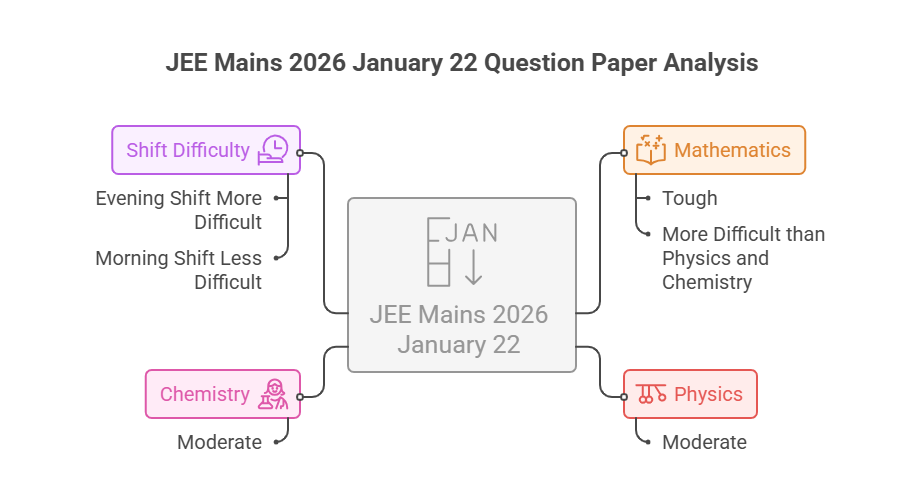
The overall difficulty level of the JEE Mains 2026 January 22 Question paper was moderate. Talking to the section-wise JEE mains paper analysis, the Mathematics paper in the JEE Mains 2026 shift 2 was tough; it was more difficult than physics and chemistry. The evening shift was more difficult than the morning shift.
JEE Main Paper Analysis 2026: What Students Say on Jan 22 Shift 2
Apart from taking the expert opinion on JEE Mains Exam analysis 2026 22 Jan Shift 2 Exam, we also reached out to test takers to know their initial reactions. When we asked about the JEE Main paper analysis shift 2, most of the students rated the paper as Moderate to Tough.
- Most of the students rated the math section as tough, whereas some said Math was lengthy. The Questions asked from the topics covered were sequence, vector & 3D, integration, functions, sets, and probability.
- Compared to maths, the Chemistry and physics section was moderate in difficulty level.
- In the January Shift 2, Physics was easy to moderate. Questions are asked from Ray optics, fluid mechanics, rotation, inertia, semiconductors, logic gates, and thermodynamics.
- Chemistry was modest and highly conceptual. A good number of questions are asked from Organic, and there were several statement-based questions. Coordination compounds, d-block, p-block, ionic, buffer, entropy, and chemical kinetics all prompted a question.
- Physics was easy to moderate. Questions are asked from Ray optics, fluid mechanics, rotation, inertia, semiconductors, logic gates, and thermodynamics.
JEE Mains Answer Key 2026
The JEE Main Answer key offers the proper responses to the exam questions. Candidates can use the JEE Main 2026 solution key with questions to estimate their probable marks. NTA will release the JEE Main Answer Key responses sheet in February 2026. Just after the exam completion, coaching institutes release the unofficial JEE Mains 2026 Jan 22 answer key for shifts 1 & 2. You can refer to the same to access your exam performance.
How to Check the NTA JEE Mains Answer Key 2026?
NTA will issue the JEE Mains NTA NIC answer key along with individual response sheets in online mode. Students can obtain the session 1 JEE Mains Answer Key response sheet in a few simple steps, as detailed below.
- Step 1: Visit the official JEE Main website at jeemain.nta.nic.in.
- Step 2: In this window, click the answer key for JEE Mains 2026.
- Step 3: On the login page, enter your JEE login credentials. Main application number and password.
- Step 4: Once you click submit, the preliminary JEE Mains 2026 answer key will appear on the screen.
- Step 5: For your convenience, you can download the official NTA JEE Mains answer key 2026 for future reference.
What is JEE Main Answer Key Challenge Window?
The JEE Main answer key challenge enables students to challenge provisional answers by entering into the NTA portal (jeemain.nta.ac.in), selecting questions, and paying a non-refundable cost of ₹200 per question. Follow the steps below to challenge the tentative JEE Main answer key 2026.
- Visit the official website at jeemain.nta.nic.in.
- Click the link labelled as ‘Challenges Regarding JEE Mains Answer Key 2026’.
- Candidates must log in using their application number and password.
- The JEE Main answer key must include the question ID and the ID with the correct option for both examinations 1 and 2.
- In the event of an error, candidates may challenge the question by selecting one or more IDs.
- Now, select ‘Save your claim’ and then Next.
- The question ID so challenged will display on the screen.
- Candidates must provide the essential papers to substantiate their claim.
- They must upload the document in pdf format and then click the ‘Choose file’ option on the screen.
- After objecting to a question, candidates must pay a processing charge of Rs 200.
- It should be noted that the payment can be made via credit card, debit card, or net banking.
NTA JEE Mains Results 2026 Release Date
In the information brochure, the NTA also published the official JEE Main result dates for both sessions. The Session 1 (January try) result will be proclaimed on 12 February 2026, while the Session 2 (April attempt) result is expected to be released on April 20, 2026. The Final JEE Mains 2026 answer key will also be released along with the JEE Main Results on the same day.
JEE Main 2026 Jan 22 Shift 2 Comparison with Previous Shifts
On the basis of the JEE Mains Exam Analysis of four shifts, we have shared a detailed comparison with the January Shift 2.
| Factors | JEE Main Jan 21 Shift 1 | JEE Main Jan 21 Shift 2 | JEE Main Jan 22 Shift 1 | JEE Main Jan 22 Shift 2 |
| Overall Difficulty Level | Moderate to Difficult | Moderate | Moderate | Moderate to Difficult (Toughest Shift) |
| Physics Difficulty | Easy to Moderate | Moderate | Moderate | Moderate |
| Chemistry Difficulty | Moderate, Concept-Based | Easy to Moderate (NCERT-focused) | Easy to Moderate | Easy to Moderate |
| Mathematics Difficulty | Lengthy and Tough | Tough and Time-Consuming | Moderate but Lengthy | Very Lengthy and Most Difficult |
| Most Difficult Subject | Mathematics | Mathematics | Mathematics | Mathematics |
| Most Scoring Subject | Physics | Chemistry | Chemistry & Physics | Chemistry |
| Time Management Level | High Time Pressure | High Time Pressure | Moderate Time Pressure | Very High Time Pressure |
| Overall Attempt Level | Good Attempts Possible | Average to Good Attempts | Good Attempts Possible | Average Attempts |
| Student Reaction | Tricky Paper | Slightly Tougher than Shift 1 | Balanced Paper | Toughest Paper of JEE Main 2026 (So Far) |
JEE Main 2025 Exam Difficulty Level Analysis Vs Jan Main 2026 Jan 22 Shift 2
For a better understanding, we have also shared a JEE Main 2025 Exam difficulty level Analysis with Jan Main 2026 Jan 22 Shift 2 difficulty level below.
| Comparison Factors | JEE Main 2025 (Overall Analysis) | JEE Main 2026 Jan 22 Shift 2 |
| Overall Difficulty Level | Moderate to Difficult across most shifts | Moderate to Difficult (One of the Toughest Shifts) |
| Mathematics Difficulty | Tough and lengthy in many shifts, but balanced overall | Very lengthy, calculation-heavy, and toughest section |
| Physics Difficulty | Moderate, mostly formula-based and manageable | Moderate with mixed conceptual and numerical questions |
| Chemistry Difficulty | Easy to Moderate, largely NCERT-based and scoring | Easy to Moderate, NCERT-focused and scoring |
| Shift Consistency | Difficulty varied across shifts but remained balanced | Stood out as tougher than average due to Maths pressure |
JEE Main Analysis 2026: Marks vs Percentile
With the help of the unofficial JEE Main answer key and paper analysis, you can calculate a raw score on the spot before the result announcement. The relationship between JEE Main marks, percentiles, and ranks in 2026, based on the previous year’s trends. Using the marks vs percentile vs rank statistics, JEE Main 2026 applicants can determine which marks will get them what percentile and position.
| JEE Main Marks | JEE Main Percentile |
| 300-291 | 100-99.999 |
| 292-280 | 99.99890732 – 99.99617561 |
| 279-271 | 99.99417236 – 99.99153171 |
| 268-259 | 99.99034797 – 99.97687156 |
| 258-250 | 99.97413985 – 99.95228621 |
| 249-240 | 99.95028296 – 99.91549924 |
| 239-230 | 99.91395128 – 99.87060821 |
| 229-220 | 99.86150253 – 99.78191884 |
| 219-210 | 99.77499852 – 99.69159044 |
| 209- 200 | 99.68494329 – 99.57503767 |
| 199-190 | 99.56019541 – 99.40858575 |
| 189- 180 | 99.39319714 – 99.17311273 |
| 179-170 | 99.1567225 – 98.87981861 |
| 169-160 | 98.85149993 – 98.52824811 |
| 159-150 | 98.49801724 -98.09290531 |
| 149-140 | 98.07460288 – 97.54301298 |
| 139-130 | 97.4927496 – 96.87838902 |
| 129-120 | 96.80927687 – 96.0687115 |
| 119-110 | 95.983027 – 95.05625037 |
| 109-100 | 94.96737888 – 93.8020333 |
| 99-90 | 93.67910655 – 92.21882783 |
| 89-80 | 92.05811248 – 90.27631202 |
| 79-70 | 90.0448455 – 87.51810893 |
| 69-60 | 87.33654157 – 83.89085926 |
| 59-50 | 83.5119717 – 78.35114254 |
| 49-40 | 77.81927947 – 69.5797271 |
| 39-30 | 68.80219265 – 56.09102043 |
| 29-20 | 54.01037138 – 36.58463962 |
| 19-10 | 35.2885364 – 18.16647924 |
| 9-0 | 17.14582299 -5.71472799 |
JEE Mains Percentile Predictor
CollegeDost brings you an exclusive feature that can give you your probable percentile before the result is published. The JEE Percentile Predictor tool forecasts the projected percentile using a variety of parameters, including the number of questions attempted, previous year cutoffs etc. Click on the link below to learn about your percentile and plan your college pick appropriately.
Click here to predict your JEE Mains 2026 Percentile
NTA Guidelines on Dress Code for JEE Mains
The National Testing Agency has issued special guidelines on the JEE Mains 2026 dress code guidelines for the upcoming shifts, which are as follows
- Students can wear jackets, sweaters, or full-sleeved clothing without any metal pieces.
- Male applicants are allowed to wear slacks, jeans, or shirts without metal buttons or zippers.
- Female candidates should dress comfortably for security checks, such as a salwar-kameez.
- Sikh candidates can wear and carry religious objects such as the Kara and Kirpan.
- To avoid security issues, footwear should be simple and free of metal.
- Shoes with heavy soles are to be avoided. Closed-toed sandals should also be avoided.
- Watches, jewellery, belts, and other accessories are not permitted within the exam hall.
JEE Main 2026 Paper Analysis: Key Takeaways for April Attempt
After reviewing the JEE Main Analysis of January 22, it was found that the questions are mostly based on NCERT (60-80%), with a highly calculative nature. Solving the tricky questions requires more conceptual clarity. It is highly suggested that students complete the whole JEE Mains 2026 syllabus before the April session.
For the JEE Mains 2026 April Session, you should focus on practising mock tests, revising the NCERT a couple of times, and practising moderate to tough-level questions. You may also refer to the CollegeDost’s JEE Mains Mock Tests, which are exclusively designed in line with the latest JEE Main question paper trends.

Importance of Practising JEE Main PYQ
Practising previous years’ question papers (PYQs) is one of the most effective ways to prepare smartly for JEE Main. It offers multiple strategic benefits:
- Builds strong JEE Main Exam pattern familiarity with real paper structure and marking scheme
- Improves time management through real exam-level pressure practice
- Helps identify recurring question trends and high-weightage topics
- Simulates real exam scenarios, reducing surprise elements on exam day
- Supports structured strategy development for section-wise attempts
- Enables early error identification and concept-gap correction
- Provides authentic practice with real NTA-style question framing
- Strengthens confidence building by reducing fear and uncertainty
Conclusion
The JEE Mains Session 1 tests for 2026 are planned to take place from January 21 to January 29, 2026. After taking the exam, students are concerned about their performance throughout their shift. To assist students, we have uploaded the JEE Mains 2026 Paper Analysis for all Shifts, along with the unofficial answer key, on the CollegeDost website shortly after each shift ends. Stay tuned to us.