Summarise With AI


The National Testing Agency conducted the JEE Mains 2026 Day 2 Shift 2 successfully at 6:00 P.M. The detailed JEE Main Paper Analysis Jan 22 2026 for physics, chemistry, and maths, along with the unofficial answer key, is prepared by CollegeDost’s in-house experts.
According to the JEE Main 2026 Jan 22 paper analysis (Shift 2), the overall shift 2 exam was moderate to difficult. In fact, some students equated the JEE Main 2026 Jan 22 shift 2 exam difficulty to the JEE Advanced level. All the questions are asked from the NTA prescribed JEE Mains 2026 syllabus, but a tricky one. Read this complete post to learn about the detailed JEE Main Exam Analysis 2026 January 22 Shift 2 by experts, subject-wise high-weightage topics, and student reactions.
Where to get JEE Main Last 10 years Analysis pdf?
If you are planning to appear in the upcoming shifts or in the April session, then you must visit the CollegeDost’s official website for the most accurate JEE Main analysis for previous shifts as well as the future shifts.
This JEE Mains 2026 Paper Analysis clearly highlights class-specific questions and difficulty levels, offering critical information for future tests. Understanding these characteristics allows you to refine your study strategy, focus on crucial areas, and dramatically increase your performance.
JEE Mains Paper Analysis 2026 on CollegeDost
JEE Mains 2026 23 Jan shift 1 Paper Analysis
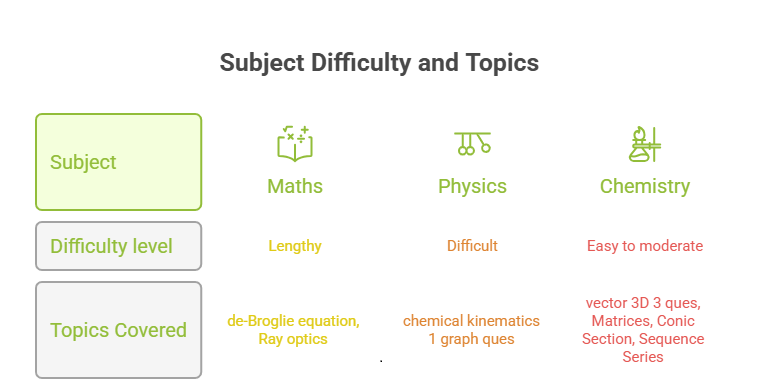
Today, BE/BTech applicants will take the JEE Mains 23 Jan Exam in the first shift. The JEE Main 2026 Paper analysis, Jan 23 shift 1, suggests that this shift was difficult and time-consuming. Mathematics was difficult, Physics was moderate, and the Chemistry section’s questions combined concepts from two different disciplines. These types of questions are typically asked in JEE Advanced.
Physics subjects covered in the shift 1 Jan 23 exam were de Broglie, ray optics, contemporary physics, electrostatics, magnetic effects of current, wave optics, capacitors, and semiconductors. Math questions covered topics such as vectors and 3D, matrices, conic sections, and series.
Recommended for JEE Mains 2026 aspirants 👇

JEE Main 2026 Exam Difficulty Level Analysis
As per the JEE Main analysis 2026 23 Jan Shift 1, the overall difficulty level of the JEE Main question paper is moderate and easy in comparison to yesterday’s exam. The difficulty level of Shift 1 of the January 23 JEE Main Question Paper was moderate. Physics is the most challenging, with only a few questions from the syllabus. Maths was, as usual, lengthy but manageable, while Chemistry was moderate
JEE Main Analysis 23 Jan 2026 Shift 1 by Students’ Reaction
After the shift is over, we have talked to the students to know their point of view on the JEE Mains today paper analysis shift 1 (January 23, 2026)
- Students routinely claimed that the paper was “tougher” than the first shift of the day.
- One student stated directly, “I felt the paper was difficult.” Another student, Sidhu, agreed.
- Students reported a high frequency of statement-type questions (between seven and eight), with three to four appearing in Physics alone. They referred to these as “tricky” since they required extensive knowledge to solve effectively.
- The chemistry section produced some of the most intense reactions. One youngster stated, “Chemistry made me cry”. Students often felt that the Chemistry questions were “twisted” rather than simple, especially in the D and F Blocks.
JEE Mains 2026 Analysis for Physics, Chemistry & Maths
The JEE Main analysis for 23rd January, 1st Shift reveals the Overall question paper was of moderate difficulty level, with Mathematics being the most challenging and Chemistry remaining largely consistent with previous years’ trends. Take a quick look at the subject-wise JEE Main paper analysis below.
JEE Main Analysis Jan 23 Shift 1 for Physics
The Physics section was generally considered moderate in difficulty. A notable feature of this shift was that it covered almost all chapters rather than focusing heavily on just one or two. Check out the JEE Mains 2026 23 Jan shift 1 Analysis for chemistry below:
| Chapter | JEE Main Physics Analysis |
| Mechanics | This was a significant portion. Topics included Moment of Inertia, which has appeared in nearly every shift. Other topics featured were Projectile Motion (speed ratios at different points), Rotational Motion (angular momentum of a system), Elasticity (identifying Young’s Modulus from graphs), and Springs (energy stored ratios) |
| Electrodynamics | Questions were asked on Electric Flux through a cube with charges at different positions, which was a departure from previous shifts. Zener Diodes (calculating resistance), LCR circuits (finding peak current/capacitance), and Induced EMF in a falling rod were also covered. |
| Optics | The paper touched upon “corner topics” like Thin Prisms (dispersion without deviation) and Wave Optics (YDSE fringe width), which were less frequent in earlier sessions. |
| Modern Physics & Others | Questions appeared on Energy Levels in Hydrogen-like atoms and Error Analysis (calculating relative error from measured values),. |
JEE Mains 2026 Analysis for Chemistry
The JEE Mains analysis for the Chemistry Section of January 23 shift 1 is given below.
| Chapter | JEE Main Chemistry Analysis |
| Organic Chemistry | There was a strong focus on Periodic Table trends, particularly Ionization Energy (specifically 3rd-period exceptions like Phosphorus and Sulfur),. Coordination Compounds featured questions on Crystal Field Splitting Energy (CFSE) and specific complexes like Ni-DMG. |
| Inorganic Chemistry | This section was prominent, with many questions derived straight from the NCERT. Key themes included Aniline reactions (which have appeared in almost every shift), GOC (acidic strength and nitration rates), and Aldol Condensation. Tests for functional groups, such as the Tollens test and FeCl3 test, were also included. |
| Physical Chemistry | Topics included Depression in Freezing Point, Zero-order reactions in Kinetics, and the Nernst Equation in Electrochemistry. Thermodynamics questions focused on phase changes and work done during expansion. |
JEE Main 2026 Analysis 23 Jan shift 1 for Maths
Maths was consistently rated as the most difficult and lengthy subject in this shift. While the concepts were often standard, the calculations were time-consuming. Take a look at the JEE Mains Maths Analysis for Jan 23 shift 1 give in the table below
| Chapter | JEE Mains Maths Analysis |
| Algebra | This was a major area, featuring Relations (calculating the number of elements to make a relation symmetric/reflexive), Permutations and Combinations (word formation), and Binomial Theorem. Statistics (Mean and Variance) remained a staple topic |
| Calculus | Questions included Definite Integration using properties to simplify “unusual” limits, Indefinite Integration using the ex[f(x)+f (x)] form, and Differential Equations. The Area Under the Curve was tested through a “Max of sin x and cos x” function. |
| Coordinate Geometry & Vectors | A common problem involved a Rectangle divided into equal parts by a line, requiring the line to pass through the center. Vectors and 3D Geometry were also covered, including the distance of a point from a line and scalar triple products |
| Trigonometry | Quadratic equations involving cosθ were used to determine the number of solutions in a given range |
JEE Main Analysis: High weightage of chapters in JEE Mains
On the basis of the JEE Main Exam Analysis, we have shared a list of high- weightage of chapters in JEE Mains 2026. While covering the JEE Mains syllabus 2026, students should review these chapters having high JEE Mains weightage with great focus.
| Subject | Difficulty Level | Key Topics & High Weightage Chapters |
| Physics | Moderate | Mechanics: Moment of Inertia, Projectile Motion, Rotational Motion, Elasticity, and Springs. |
| Electrodynamics: Electric Flux through a cube, Current Electricity, LCR circuits, and Induced EMF. | ||
| Optics & Modern Physics: Thin Prisms (dispersion), YDSE, and Ground State Energy levels. | ||
| Chemistry | Easy to Moderate | Organic (9 Questions): Aniline reactions, GOC (acidic strength and nitration), Aldol Condensation, and Biomolecules. |
| Physical (6 Questions): Depression in Freezing Point, Zero-order Kinetics, Thermodynamics (work/expansion), and Nernst Equation. | ||
| Inorganic (4 Questions): Ionization Energy trends (3rd period), Group 13 elements, and Coordination Compounds (CFSE and Ni-DMG). | ||
| Maths | Difficult & Lengthy | Algebra (6 Questions): Relations (symmetric/reflexive), Statistics (Mean/Variance), Binomial Theorem, and Permutations & Combinations. |
| Vectors & 3D (2 Questions): Scalar Triple Product and distance of a point from a line. | ||
| Calculus (6 Questions): Definite/Indefinite Integration, Differential Equations, and Area Under the Curve (Max of sin/cos functions) |
JEE Mains Today Paper Analysis Shift 2
The Second shift of the JEE Mains 2026, 23 January Exam is scheduled from 0300 to 6:00 P.M The JEE Mains Paper Analysis of Jan 23 2nd shift can be accessed via the collegeDost’s official website. Take a quick look at the timings of the second shift below.
| Session | Afternoon Shift (3 pm to 6 pm) |
| Timing of examination | 3 PM to 6 PM |
| Duration of examination | 3 Hours |
| Entry in the Examination Centre/Hall/Room, frisking, biometric registration/record of manual attendance by Invigilator, document verification/crosschecking of Admit Card, signature, and photo match to be completed by Invigilator, etc | 02.00 PM to 2.30 PM |
| Instructions by the invigilator(s) | 2.30 PM to 2.50 PM |
| Candidates log in to read instructions | 2.50 PM |
| Test commences | 3.00 PM |
JEE Mains 2025 Analysis vs JEE Mains 2026 Jan 23 shift 1 paper Analysis
The table below compares the 23rd Jan 2026 Shift 1 document to the overall JEE Main previous year analysis Trends as mentioned to guide aspirants for upcoming shifts
| Feature | jee mains 2026 23 jan shift 1 paper analysis | JEE Main previous year analysis |
| Overall Difficulty | Moderate; Physics and Chemistry were scoring, while Maths was the rank-decider. | Followed the standard “Mains level” for Chemistry and Maths, but Physics was more balanced. |
| Physics Focus | Balanced coverage across almost all chapters; no single chapter dominated. | Previously, some chapters were heavily emphasized while others were ignored. |
| Physics Topics | Included “Corner Topics” like Elasticity (Young’s Modulus) and Thin Prisms. | These subtopics were often missing or less frequent in previous sessions. |
| Chemistry Trend | High weightage on Organic Chemistry (9 questions). | Consistently follows NCERT and PYQ (Previous Year Question) trends. |
| Maths Nature | Lengthy and calculation-intensive; required fast calculation speed. | Remained consistent with the typical “Mains level,” which is often described as lengthy. |
| Maths Weightage | Slightly more focused on the 12th-grade syllabus (10 questions) vs. 11th (7 questions). | Generally maintains a moderate to difficult level with standard recurring themes. |
| High Yield Topics | Included specific recurring themes like Moment of Inertia, Ionization Energy, and Statistics. | These topics remain staples that appear in almost every session |
JEE Mains 2026 Analysis and Minimum Cutoff Marks
The JEE Main 2026 Paper analysis shows a moderate to challenging overall difficulty level, with considerable variation between shifts. Due to a few tougher shifts, such as January 22 Shift 2, the overall paper level was slightly higher than in ordinary sessions, which may have influenced normalisation. Based on difficulty patterns, shift-wise toughness, and previous years’ statistics, the JEE Mains 2026 analysis and minimum cutoff marks will most likely be in the following range:
- General (UR): 88–92 percentile
- EWS: 78–82 percentile.
- OBC-NCL: 72-76%;
- SC: 50-55%;
- ST: 38-42%.
JEE Percentile Predictor tool
CollegeDost offers an exclusive function that predicts your likely percentile score for JEE Mains before the official results are revealed. The JEE Percentile Predictor tool anticipates projected ranks based on a number of factors, including the number of questions tried, previous year cutoffs, seat availability, and category-specific quotas. Click on the link below to learn about your ranking and plan your college selection accordingly.
Click here to determine your percentile in JEE Mains 2026.
When NTA JEE Main Answer Keys be released?
The official JEE Main answer key 2026 for session 1 will be released by the National Testing Agency in the first week of February 2026. The individual response sheet, along with the JEE Mains Answer key, will be made available on the candidate’s dashboard at jeemain.nic.in.
The NTA JEE Mains answer key allows students to cross-check their answers against the official solutions. Candidates can use the JEE Main question paper with solutions to estimate their expected scores.
Access JEE Mains 2026 Answer key for 23 Jan shift 2
How to check JEE Main answer key
- Go to the official JEE Main website (jeemain.nta.nic.in).
- In this box, select the answer key for JEE Mains 2026.
- On the login page, enter your JEE credentials. Main application number and password.
- Once you’ve clicked submit, the preliminary JEE Mains 2026 answer key will show on the screen.
- You can download the official NTA JEE Main answer keys 2026 for future use.
How to calculate JEE Main Score using Answer key?
Follow the steps below to get your score using the JEE Main answer key.
- Use the JEE Main question paper answer key pdf to compare your answers to those provided.
- Count the number of correct and incorrect answers.
- Once you have the numbers, enter them into the formula below:
Probable Scores = 4 x the number of correct answers minus 1 x the number of wrong responses.
JEE Main Result 2026
Upon completion of session 1, the NTA JEE Mains result 2026 is going to be announced on February 12, 2026. JEE Main Results 2026 for session 1 will be available on the official website, jeemain.nta.nic.in. The NTA JEE Result PDF will include candidate data, scores, and percentiles. To see the JEE Main 2026 result, candidates must provide their login credentials, including their application number and password.
How to prepare for JEE Main 2026 for the April Session
Preparing for the upcoming JEE Main 2026 April session necessitates a planned approach based on the most recent patterns identified in the JEE Main January analysis. Based on an experienced evaluation of the most recent JEE Main 2026 paper analysis (23rd January, 1st Shift), here’s how you can improve your preparation using the JEE Main syllabus 2026, PYQs, and JEE Main Mock tests.
Pro Tips for Physics Prep
According to the JEE Main January analysis, Physics is currently moderate, covering practically all chapters without focusing too much on a handful.
- Heavy-weightage of chapters in JEE Mains: Concentrate on mechanics (moment of inertia, projectile motion), electrodynamics, and modern physics.
- Focus of Corner Topics: The “Corner Topic” Trend: Recent shifts have begun to touch on issues that were previously overlooked, such as elasticity (Young’s Modulus graphs), thin prisms (dispersion without deviation), and capacitance.
Pro Tips for Chemistry Prep
Chemistry remains the top-scoring subject, as long as you adhere to the JEE Mains syllabus 2026 for chemistry. Reviewing JEE Main PYQs is important because the themes and question styles are frequently repeated.
- Organic Chemistry Dominance: This subject received the most weightage (about 9 questions) during the recent change. Aniline reactions, GOC (acidic strength), and biomolecules are common themes. •
- Inorganic & Physical: Emphasis on Periodic Table trends (Ionisation Energy exceptions), Coordination Compounds (CFSE), and Chemical Kinetics (Zero-order reactions).
Pro Tips for Mathematics Preparation
As the questions are often standard but need a lot of calculation, your performance is determined by your calculation speed. Mathematics is frequently described as lengthy and complex.
- Syllabus Focus: There is a balanced distribution of Calculus and Algebra, with a little bias towards the 12th-grade syllabus (about 10 questions from 12th vs. 7 from 11th).
- Statistics (mean and variance) and Relations (symmetric/reflexive elements) are recurring high-yield topics that emerge in practically every shift. Vectors and 3D Geometry are also important.
Bonas tips for JEE Mains April Session
To excel in the forthcoming shifts, your preparation must be in line with the JEE Main January analysis. Some crucial preparation tips are shared below
- Analyse Memory-Based JEE Main PYQs: If you are unable to watch lengthy solution videos, look through the PDFs of memory-based papers from recent shifts to see which sub-topics are trending.
- Mock Test Practice: Use JEE Main mock Tests to recreate the pressure of long calculations, particularly in the Mathematics section.
- Recognise Shift Patterns: Topics that are lacking in the morning shift frequently appear in the evening shift of the same day. Use the JEE Main previous year analysis and current session trends to anticipate potential question types in the April session.

Conclusion
The National Testing Agency set the JEE Main Question paper for Jan 23 shift 1 was moderate. As per the JEE Mains 2026 analysis, NTA asked questions from the corner chapters instead of high weightage of chapters in jee mains one. Students must carefully review the JEE Main Paper Analysis for Physics, Chemistry & Maths for better preparation the unofficial answer key, on the CollegeDost website shortly after each shift ends. Stay tuned to us.