Summarise With AI


The National Testing Agency has concluded the Day 4 shift 2 of the JEE Mains 2026 Session 1 on January 24, 2026. As per the JEE Mains 24 Jan Shift 2 Paper Analysis, the overall paper was moderate in difficulty level and challenging while comparing the shift 1 paper. Based on the JEE main paper analysis over four days, it is observed that the evening shifts are more tougher sight compare to the morning shift.
If your exam is scheduled on January 28, students must go through the JEE Mains 2026 24 Jan shift 2 paper analysis in detail to know the Subject wise high- weightage of chapters in JEE Mains and expected difficulty level of their shifts. To make the evaluation process, we have shared the JEE Mains 24 Jan shift 2 answer key on this page.
Also Check:
- JEE Mains 2026 Jan 21 Shift 1 Exam Analysis
- JEE Mains Jan 21 Shift 2 Paper Analysis 2026
- JEE Main January 22 2026, Shift 1 Paper Analysis
- JEE Main January 22, 2026 Shift 2 Paper Analysis
- JEE Main January 23, 2026 Shift 1 Paper Analysis
- JEE Main January 23 2026, Shift 2 Paper Analysis
- JEE Main January 24 2026, Shift 1 Paper Analysis
Where To Check JEE Mains Paper Analysis 2026?
Regularly checking the JEE Main shift-wise paper analysis helps students understand the changing exam pattern, difficulty level, and the topics that matter most. To make this easier, the academic team at CollegeDost prepares a detailed JEE Main paper analysis for every shift, helping students not only review the paper but also plan better for the upcoming exams.
All the major insights are available in one place, including subject-wise difficulty levels, important topics from each section, and genuine student feedback. You can explore the complete JEE Main 2026 paper analysis through the link below, along with detailed reviews of previous exam days.
JEE Mains Mock Test: How Can Students Prepare For The Upcoming Shifts?
For the upcoming sessions of JEE Main 2026 exams, students can benefit from taking short, quick mock tests for fast revision. CollegeDost offers subject-wise and topic-wise JEE Main mock tests, each with small sets of 10-20 questions, making them easy to attempt in one sitting. These mini tests are perfect for 30-40 minutes of focused revision and include questions based on more than 12 years of JEE Main question paper.
Even practising a mock test without stressing over the score can be helpful. The real value lies in the revision, confidence boost, and exam-like experience it provides. At this stage, marks matter less than building mental readiness and calmness. These quick mock sessions help students feel more prepared and comfortable, which can make a big difference in the actual JEE Main exam the next day.
Recommended for JEE Mains 2026 aspirants 👇

JEE Mains 24 Jan Shift 2 Paper Analysis
The JEE Mains 24 Jan Shift 2 was scheduled from 03:00 to 6:00 P.M. After the conclusion of the exam, all the test takers are keenly looking for the JEE Mains Paper Analysis and JEE Main answer key to evaluate their exam performance.
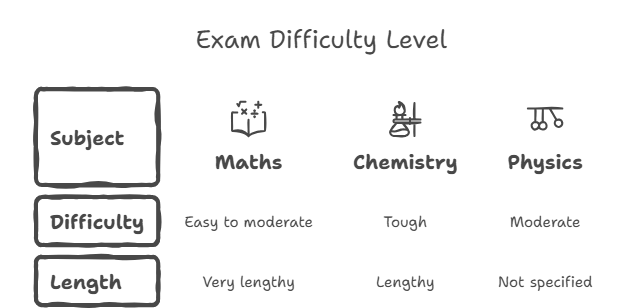
As per the JEE Main 2026 exam difficulty level analysis, the overall JEE Main paper of Jan 24 shift 2 was moderate but lengthy, and Chemistry was the most challenging section, followed by Maths and Physics. As per the given feedback, Chemistry and Mathematics in the JEE Mains Question Paper were lengthy, whereas Physics was more formula-based and manageable.
Subject-wise JEE Mains Paper Analysis & High Weightage Topics
The JEE Mains Paper Analysis 2026 Jan 24 Shift 2, Physics Section was usually regarded as simple to moderate; several sections proved time-consuming and calculative. Interestingly, student attitudes on chemistry were divided, with many finding it surprisingly difficult. Mathematics kept its reputation for being both moderate and extraordinarily lengthy.
JEE Mains 2026 Jan 24 Shift 2 Chemistry Paper analysis
Many students have reported that the numerical sections have increased the difficulty. However, the chemistry paper also has calculation-based questions (e.g., mass of precipitate). Also, according to a few students, there are several questions that were repeated or similar to previous shifts.
| Difficulty Level | Class Distribution | Key Topics Covered | |
| Medium: 57% Difficult: 10% Easy: Balance (implied) | Class 12: 62% Class 11: 38% | Physical | Atomic Structure (Li2+ spectra), Thermodynamics (Atomization), Chemical Kinetics (1st Order), Solutions (Dalton’s Law), Electrochemistry (Conductance), Chemical Equilibrium. |
| Organic | Alcohol/Phenol identification, Biomolecules (Tripeptide), Aldehydes/Ketones (Aldol, Chemical tests), GOC (Resonance). | ||
JEE Mains 2026 Jan 24 Shift 2 Physics Paper analysis
According to the students’ report, Physics Paper is categorised as moderate to difficult overall. However, many questions were standard or from modules/previous years, while a few other questions were calculation-intensive.
| Difficulty Level | Class Distribution | Key Topics Covered | |
| Easy: 43%Medium: 38%–40%Difficult: 18%–20% | Class 12: 62% | Mechanics | Tension/Equilibrium, Kinematics, Vertical Circular Motion, Fluid Mechanics (Soap bubble work, Buoyancy), Rotation (MOI), Units (Vernier Caliper). |
| Electromagnetism | Electrostatics, Current Electricity (Meter Bridge, Circuits), Magnetism (Coaxial loops), RC Circuits. | ||
| Modern Physics | Photoelectric Effect, Nuclear Stability, Logic Gates. | ||
| Class 11: 38% | Optics & Heat | Lens formula, Thermodynamics (Heat at constant volume). | |
JEE Mains 2026 Jan 24 2nd Shift Maths Paper analysis
In the Maths Paper, many students have reported that it was a standard paper with no major surprises. While a few students have pointed out some mistakes, like ambiguity in the spelling of “Udaipur” (vs Udaypur), which affected the answer for the rank question. There were a few questions where concepts were mixed in single questions (e.g., Matrix + Integration).
| Difficulty Level | Class Distribution | Key Topics Covered | |
| Medium: 56%Easy: 31%Difficult: 13% | Class 12: 70% | Algebra | Permutations (Rank of ‘Udaipur’), Complex Numbers, Matrices (Adjoint/Determinants), Number Theory, Set Theory, Sequence & Series. |
| Calculus | Integration, Limits, Functions (Domain, Increasing/Decreasing). | ||
| Class 11: 30% | |||
| Coordinate Geometry | Parabola (Image), Ellipse/Circle (Eccentricity), Inequalities. | ||
| Statistics | Mean and Variance | ||
How do students rate the JEE Main Jan 24 Shift 2 Question paper?
Just like the previous shifts, we do conversion with the students who are just coming out of the examination hall to know their Point of view on JEE Mains 2026 24 Jan shift 2 paper analysis. The JEE Mains 2026 paper analysis for the January 24th second shift examination highlighted different student perceptions on course difficulty.
- Ridhi, who attempted the 40-45 questions, described the JEE Main Paper as considerably easier than the previous day’s exam. She stated that, while her questions went well and she felt she might have tried more, and intend to refine their tactics for Session 2.
- Ajay, who attempted 46 questions adid, said JEE Mains 24 Jan shift 2 paper was categorised as simple to moderate but lengthy. They found Chemistry to be extremely conceptual, with considerable calculations that took longer than expected (30-40 minutes), reducing the time available for Mathematics
- Sanjeev Sharma, a first-time JEE Aspirant emphasised that Chemistry was “very tough” across all branches (physical, inorganic, and organic). He saw that the Organic section was overflowing with compound names that were difficult to recall. He also described Physics as calculative; nonetheless, they deemed Mathematics feasible.
JEE Mains 2026 Jan 24 Shift 2 Marks vs Percentile
The JEE Mains Jan 24 shift 2 marks versus percentile is based on how students responded to the exam and the JEE Main 2026 exam difficulty level analysis. As per the JEE Main Paper analysis, Jan 24 Shift 2, the overall difficulty level of jee main question paper was moderate, thus the highest percentile score lies around 190.
However It should be noted that the JEE Main Mark vs Percentile of a certain shift varies depending on the difficulty level. In the event of the hardest shift for JEE Main 2026, the marks necessary for a 99.9th percentile will be significantly lower than in other shifts.
JEE Mains Question Paper Difficulty Level vs Percentage
After the JEE Main 2026 exam difficulty level analysis over eight shifts, we have calculated and shared the Predicted Marks for 99 Percentile for all shifts to provide students with a rough idea.
| Date & Shift | Difficulty Level | Predicted Marks for 99 Percentile |
| Jan 21, Shift 1 | Moderate to Difficult (Chemistry was toughest) | 160 – 165 |
| Jan 21, Shift 2 | Easy to Moderate (Easiest shift so far) | 185 – 200 |
| Jan 22, Shift 1 | Moderate | 170 – 180 |
| Jan 22, Shift 2 | Moderate to Difficult (Sliding towards Difficult) | 165 – 175 |
| Jan 23, Shift 1 | Easy to Moderate | 180 – 195 |
| Jan 23, Shift 2 | Toughest Shift (Physics was an advanced level) | 148 – 156 |
| Jan 24, Shift 1 | Moderate | 170 – 185 |
| Jan 24, Shift 1 | Moderate | 180 – 190 |
JEE Mains 2026 Percentile Predictor
If you appeared in the JEE Main Jan 24 shift 2 and want to know your percentile score, then CollegeDost brings you the exclusive JEE Mains Percentile Score Predictor. This tools prediects your expected percentile score before the announcement of the NTA JEE Main Results 2026.
JEE Mains 24 Jan Shift 2 Answer Key 2026
All the students who are searching for the JEE Main answer key are informed that the official answer key for all the shifts will be released altogether. The NTA JEE Mains Answer key includes all the correct answers along with the JEE Main question paper. This helps students to cross-check their responses and calculated a projected scores.
To help the Test -takers of the JEE Main 24 Jan Shift 2, CollegeDost brings the unofficial answer key, which can be obtained by simply clicking the direct link shared below.
Frequently Asked Chapters in JEE Mains 2026 Session 1 All Shifts
On the basis of the JEE Main Analysis from 21st to 24, we have prepared a list of frequently Asked Chapters in JEE Mains 2026 Session 1. Those who are going to appear in the April session must focus on those high weightage topics for JEE Mains.
| Shift | JEE Mains Physics Key Topics | JEE Mains Chemistry High weightage Topics | JEE Main Maths Key Topics |
| Jan 21 Shift 1 | Current Electricity, Optics (Prism/Wave), Rotation, Fluids, Thermodynamics, Electrostatics | Balanced with Organic + Inorganic + statement-based bits; topics like Coordination & Bonding appeared | Vectors & 3D Geometry, Coordinate Geometry, Relations & Functions, Binomial, Calculus, Statistics |
| Jan 21 Shift 2 | Capacitor/Electrostatics, Optics, Modern Physics | More Inorganic focus: Coordination, Bonding; statement-based questions in Chemistry | Lengthy & calculation-heavy questions in Matrix, 3D Geometry, Calculus |
| Jan 22 Shift 1 | Physics moderate — Electrostatics, Optics/Waves, Mechanics elements | Chemistry included statement-based items, with moderate coverage across NCERT topics | Maths had lengthy questions — Calculus, Vectors, Coordinate Geometry |
| Jan 22 Shift 2 | Physics moderate; similar syllabus mix (Electrostatics, Current, Mechanics) | Chemistry dominated by Organic basics and statement-based conceptual questions (Coordination, p-Block) | Calculation-intensive Algebra & Coordinate/Vector/3D topics |
| Jan 23 Shift 1 | Physics moderate (formula-based & conceptual blend) | Chemistry balanced, NCERT-aligned | Maths — strong emphasis on Trigonometry, Conic sections, Vectors, Differential & Integral Calculus |
| Jan 23 Shift 2 | Physics moderate-to-tough with varied conceptual + time intensity | Chemistry conceptual + longer questions; NCERT basis strong | Maths is comparatively tougher with time pressure — similar core topics repeated |
| Shift 1 | Ray Optics/Microscope, Fluids & Buoyancy, Magnetic Effects, Semiconductors | Physical Chemistry weightage, Chemical Bonding, Thermodynamics, Electrochemistry | 3D Geometry & Vectors, Calculus, Coordinate Geometry (Straight/Conic), Permutation & Combination, Sequence & Series |
| Shift 2 | Similar moderate Physics topics (Optics, Fluids, Electromagnetism, Semiconductors) | Chemistry similar moderate trend (Bonding, Solutions, Electrochemistry, Equilibrium) | Maths: Vector/3D, Conics, Permutations, Calculus, Matrix, Complex numbers |
Conclusion
The JEE Main analysis provides a comprehensive picture of the exam schedule, difficulty level, and key topics asked across shifts. If you are appearing in upcoming shifts, reviewing shift-specific JEE Mains 2026 paper analysis on a regular basis can help you revise more effectively, manage your time better, and approach the exam with more confidence.