Summarise With AI


WBJEE Syllabus 2026 is available at https://wbjeeb.nic.in/. Candidates appearing for the exam should check the syllabus carefully to understand the topics included in the entrance test. WBJEE syllabus is mainly based on the Class 11 and Class 12 curriculum of Physics, Chemistry, and Mathematics. It covers important topics such as Calculus, mechanics, equilibrium and more. According to the official WBJEE syllabus, the exam includes:
- Around 22 chapters from Physics
- 27 chapters from Chemistry
- And 19 chapters from Mathematics
Candidates should go through the complete syllabus along with the exam pattern to prepare effectively for the WBJEE 2026 exam.
WBJEE Syllabus 2026: Overview
WBJEEB has designed the syllabus based on the WBCHSE and NCERT Curriculum. The curriculum covers the Class 11 and Class 12 Syllabus. Some important details related to WBJEE Syllabus 2026 have been presented through the picture below:
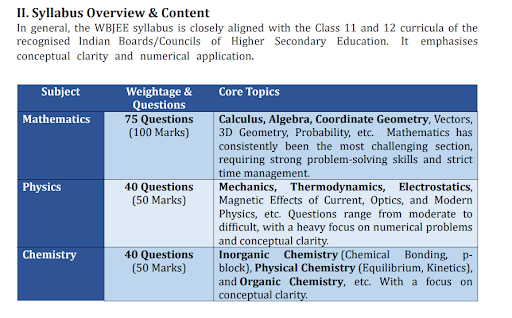
WBJEE Syllabus: A Detailed Breakdown
To prepare well for WBJEE 2026, it’s important to understand what topics are included in each subject. The syllabus is divided into three parts, i.e., i)Physics, ii) Chemistry, and iii) Mathematics, based on Class 11 and 12 concepts. Going through the subject-wise syllabus will help you plan your studies better and focus on the right areas. A detailed breakdown of WBJEE Syllabus has been shared below:
WBJEE Physics Syllabus 2026
The Physics section of WBJEE focuses on fundamental concepts such as mechanics, thermodynamics, electricity, magnetism, optics, and modern physics. Questions in this section often involve both conceptual understanding and numerical problem solving.
| S.No. | Topics |
| 1 | Physical World, Units, Measurements and Dimensions |
| 2 | Kinematics |
| 3 | Laws of Motion |
| 4 | Centre of Mass, Connected Systems and Friction |
| 5 | Gravitation |
| 6 | Properties of Matter |
| 7 | Viscosity |
| 8 | Thermodynamics |
| 9 | Kinetic Theory of Gases |
| 10 | Oscillations and Waves |
| 11 | Electrostatics |
| 12 | Current Electricity |
| 13 | Magnetic Effects of Current |
| 14 | Magnetism |
| 15 | Electromagnetic Induction and Alternating Current |
| 16 | Electromagnetic Waves |
| 17 | Ray Optics |
| 18 | Wave Optics |
| 19 | Wave–Particle Dual Nature of Matter |
| 20 | Atomic Physics |
| 21 | Nuclear Physics |
| 22 | Solid State Electronics |
WBJEE Chemistry Syllabus 2026
The Chemistry syllabus includes topics from physical chemistry, organic chemistry, and inorganic chemistry. Questions in this section may involve theoretical understanding, chemical reactions, and numerical calculations.
| S.No. | Topics |
| 1 | Atoms, Molecules and Chemical Arithmetic |
| 2 | Atomic Structure |
| 3 | Radioactivity and Nuclear Chemistry |
| 4 | Periodic Table and Chemical Families |
| 5 | Chemical Bonding and Molecular Structure |
| 6 | Coordination Compounds |
| 7 | Solid State |
| 8 | Liquid State |
| 9 | Gaseous State |
| 10 | Chemical Energetics and Chemical Dynamics |
| 11 | Physical Chemistry of Solutions |
| 12 | Ionic and Redox Equilibria |
| 13 | Hydrogen |
| 14 | Chemistry of Non-Metallic Elements |
| 15 | Chemistry of Metals |
| 16 | Chemistry in Industry |
| 17 | Polymers |
| 18 | Surface Chemistry |
| 19 | Environmental Chemistry |
| 20 | Chemistry of Carbon Compounds |
| 21 | Haloalkanes and Haloarenes |
| 22 | Alcohols and Related Compounds |
| 23 | Aromatic Compounds |
| 24 | Biomolecules |
| 25 | Principles of Qualitative Analysis |
WBJEE Mathematics Syllabus 2026
Mathematics is considered one of the most important sections in the WBJEE exam. It mainly focuses on problem-solving and numerical concepts from algebra, calculus, coordinate geometry, and vectors.
| S.No. | Topics |
| 1 | Algebra |
| 2 | Arithmetic Progression, Geometric Progression, Harmonic Progression |
| 3 | Sets, Relations and Mappings |
| 4 | Logarithms |
| 5 | Complex Numbers |
| 6 | Permutations and Combinations |
| 7 | Polynomial Equations |
| 8 | Mathematical Induction |
| 9 | Matrices |
| 10 | Binomial Theorem |
| 11 | Statistics and Probability |
| 12 | Trigonometry |
| 13 | Coordinate Geometry (2D) |
| 14 | Coordinate Geometry (3D) |
| 15 | Differential Calculus |
| 16 | Integral Calculus |
| 17 | Application of Calculus |
| 18 | Differential Equations |
| 19 | Vectors |
WBJEE Syllabus 2026: Topic-Wise Weightage
Not all topics in the WBJEE syllabus are equally important. Some chapters are asked more frequently and carry higher marks in the exam. Knowing the topic-wise weightage helps you focus on the right areas and plan your preparation more effectively. Let’s have a look:
WBJEE Syllabus 2026 Physics Weightage
Mechanics, Electrostatics and Thermodynamics are of high weightage and require a good grasp of the concepts. Scoring well means balancing preparation of all subjects with a focus on numerical problem-solving.
| Topic / Chapter | Estimated Weightage (%) |
| Mechanics & Laws of Motion | 10% |
| Thermodynamics & Kinetic Theory | 8-10% |
| Electrostatics | 8-10% |
| Current Electricity | 7-8% |
| Magnetism & Electromagnetic Induction | 8-9% |
| Oscillations & Waves | 6-7% |
| Optics | 8-9% |
| Modern Physics | 8% |
| Solid State, Semiconductors & Electronics | 5% |
| Gravitation & Properties of Matter | 6-7% |
WBJEE Syllabus 2026 Chemistry Weightage
Chemistry section in WBJEE includes questions from Physical, Organic, and Inorganic Chemistry. Chapters like Chemical Kinetics, Thermodynamics, Chemical Bonding, and Organic Chemistry frequently appear in the exam and often carry higher weightage.
| Topic / Chapter | Estimated Weightage (%) |
| Chemical Kinetics & Thermodynamics | 10% |
| Chemical Bonding & Molecular Structure | 8% |
| Inorganic Chemistry (s‑block, p‑block, d‑block, f‑block) | 10-12% |
| Organic Chemistry (Hydrocarbons, Functional Groups, Reaction Mechanisms) | 10% |
| Equilibria, Redox & Ionic Equilibria | 8% |
| States of Matter, Surface Chemistry, Polymers | 6% |
| Atomic Structure & Periodicity | 7% |
| Electrochemistry | 6% |
| Coordination Compounds | 5% |
| Biomolecules & Environmental Chemistry | 5% |
WBJEE Syllabus 2026 Maths Weightage
Mathematics is one of the most important sections in the WBJEE exam and needs strong problem-solving skills. Topics like Calculus, Algebra, and Coordinate Geometry usually carry more weight and can help you score higher. To do well, it’s important to practice plenty of numerical questions and understand the basic concepts clearly. The table below shows the approximate chapter-wise weightage for Mathematics in WBJEE 2026.
| Topic / Chapter | Estimated Weightage (%) |
| Algebra (Polynomials, Complex Numbers, Sequences & Series, Binomial Theorem) | 10-12% |
| Calculus (Limits, Differentiation, Integration, Differential Equations) | 16-18% |
| Coordinate Geometry (Straight Lines, Circles, Parabola, Ellipse, Hyperbola) | 10% |
| Trigonometry (Identities, Equations, Inverse Functions) | 8% |
| Matrices, Determinants & Theory of Equations | 7-8% |
| Probability & Statistics (Probability Rules, Mean, Median, Mode, Variance) | 6% |
| Vectors & 3‑D Geometry | 5-6% |
| Sets, Relations & Functions | 4-5% |
Important Topics for WBJEE 2026
After understanding the full syllabus, candidates should also focus on topics that frequently appear in previous year question papers.
Important Physics Topics
- Laws of Motion
- Electrostatics
- Current Electricity
- Thermodynamics
- Wave Motion
- Nuclear Physics
- Work, Energy and Power
Important Chemistry Topics
- Chemical Bonding
- Chemical Thermodynamics
- Chemical Kinetics
- Coordination Compounds
- Redox Reactions
- Organic Chemistry Fundamentals
Important Mathematics Topics
- Vectors
- Probability
- Matrices and Determinants
- Limits and Integration
- Complex Numbers
- Three-Dimensional Geometry
Focusing on these topics can help candidates strengthen their preparation and improve their chances of scoring well in the exam.
WBJEE Exam Pattern 2026
WBJEEB will administer the exam in offline mode. Candidates will be given an OMR sheet to mark the right option. To get a more detailed insight, candidates can refer to the table below:
| Particulars | Details |
| Examination Mode | Offline (OMR-based) |
| Total Duration | 4 hours (2 hours for each paper) |
| Papers | Paper 1 – Mathematics Paper 2 – Physics & Chemistry |
| Subjects Covered | Physics, Chemistry, Mathematics |
| Total Questions | 155 Questions |
| Subject-wise Questions | Mathematics – 75, Physics – 40, Chemistry – 40 |
| Question Type | Multiple Choice Questions (MCQs) |
| Answer Mode | Four options per question (One correct answer to be marked on OMR sheet using blue/black pen) |
| Total Marks | 200 Marks |
| Marking Scheme | Category 1: 1 mark per correct answer (-1/4 negative) Category 2: 2 marks per correct answer (-1/2 negative) Category 3: 2 marks per correct answer (No negative marking) |
| Category-wise Distribution | Category 1: Maths – 50, Physics – 30, Chemistry – 30 Category 2: Maths – 15, Physics – 5, Chemistry – 5 Category 3: Maths – 10, Physics – 5, Chemistry – 5 |
WBJEE 2026 Preparation Tips
Preparing for WBJEE doesn’t mean studying everything at once. It’s more about staying consistent and focusing on what actually matters.
Understand what to study
Start by going through the syllabus and exam pattern. This helps you know what topics are important and how the paper is structured.
Clear your basics first
Make sure you understand the basic concepts, especially in Maths and Physics. If your basics are clear, solving questions becomes much easier.
Focus on important chapters
Some topics are asked more often than others. Chapters like Calculus, Algebra, Mechanics, and Chemical Bonding should be given extra attention.
Practice every day
WBJEE includes a lot of numerical questions. Try to solve questions daily to improve your speed and accuracy.
Solve previous year papers
WBJEE Syllabus 2026: Subject-Wise Topics for Physics, Chemistry, and Mathematics WBJEE Previous Years’ Question papers help you understand the type of questions asked in the exam. They also give you a better idea of important topics.
Take mock tests
WBJEE Mock tests help you get used to the exam environment. They also show you where you are making mistakes so you can improve.
Keep revising
Revision is very important. Go over formulas, reactions, and key concepts regularly so you don’t forget them.
Manage your time well
Don’t spend too much time on one question. If you get stuck, move on and come back later if you have time.
Avoid guessing answers
Since there is negative marking, guessing can reduce your score. Try to answer only when you are sure.
Use limited study material
Stick to a few good books instead of using too many sources. This will help you stay clear and focused.acy. Regular revision and clear understanding of concepts can also help candidates perform better in WBJEE 2026.