
Summarise With AI



The JEE Mains 2026 Session 2 is currently underway. NTA has successfully conducted Day 1 on April 2, 2026, in two shifts. The Afternoon shift runs from 03:00 P.M to 06:00 P.M As the shift is over now, test takers are keenly looking for the JEE Mains 2026 April 2 Shift 2 Paper Analysis and JEE Mains Answer key for the said shift.
As per the initial reaction of the students, the JEE Mains 2026 April 2 Shift 2 Question Paper was moderate. As expected in the Shift 2 JEE Mains Exam Analysis, the Maths section was rated as moderate to tough. While Physics was moderate and Chemistry was easy.
All the future aspirants who have the exam scheduled on the April 4-7 exam dates should carefully review the JEE Mains Paper Analysis for 2 April Shift 2 and High weightage chapters for JEE Mains discussed on this page.
Where to find JEE Mains Paper Analysis 2026 for All Shifts?
If you are looking for a reliable JEE Mains Paper Analysis 2026 for all shifts, Collegedost is the place for you. We at Collegedost have shared a detailed and accurate JEE Mains Paper Analysis for each shift of the April examination. Our expert-driven JEE Main April Analysis includes information on the difficulty level of the paper, weightage of each subject, important topics covered, and how the students reacted to the paper.
Our comprehensive JEE Mains Paper Analysis for the April examination ensures that the students are able to analyze themselves accordingly. For more information on the shifts and the most reliable JEE Mains Paper Analysis, stay updated with Collegedost.
JEE Mains 2026 April 2 Shift 2 Paper Analysis
JEE Mains 2026 April 2 Shift 2 Paper Analysis suggests the overall JEE Mains Question paper was moderate. Mathematics remained lengthy, but Chemistry focused heavily on inorganic compounds. Based on the review, the Physics section is being more difficult than Shift 1. However, the JEE Mains Question paper was easier than the January session, allowing for more attempts and accuracy through simplified computations and balanced subject coverage.
| Subject | Difficulty Level | Key Highlights |
| Physics | Moderate | Concept-based questions with a mix of numerical and theory; some questions were tricky but manageable |
| Chemistry | Easy to Moderate | Mostly NCERT-based; Organic and Inorganic were straightforward, making it easy to score |
| Mathematics | Moderate to Tough | Lengthy and time-consuming; required strong problem-solving skills and accuracy |
JEE Mains 2 April Shift 2 Analysis Based on Student Review
To capture the initial reaction, our team talked to some of the test takers outside the examination center. Some of the students’ reactions to the JEE Mains April 2 Shift 2 paper are given below
- Rohit Agarwal from Delhi had attempted 52 questions. He found the questions moderate in nature. Physics questions demanded strong conceptual understanding, whereas Chemistry was the easiest section for him. However, Mathematics was very lengthy. His key takeaway was that Maths was tough but could be managed with proper practice.
- Ananya Singh from Lucknow had attempted 48 questions. She mentioned that Chemistry was very scoring and based mainly on the NCERT. Physics had a few tough questions. However, Mathematics was very time-consuming for her. She also mentioned that good accuracy in Chemistry helped her balance.
- Arjun Das from Kolkata had attempted 50 questions. Physics was moderate but demanded a strong understanding. He mentioned that Mathematics was the toughest section for him as it demanded heavy calculations. His key takeaway was that accuracy was more important than the number of questions attempted.
- Aman Verma from Kota had attempted 55 questions. He mentioned that Shift 2 was tougher compared to Shift 1. Mathematics had questions based on multiple concepts, whereas Physics had many questions based on numbers. He mentioned that to achieve a high number of attempts, strong time management is required.
JEE Mains Exam Analysis for Day 1: Shift 1 vs Shift 2
According to the JEE Main Shift 1 Paper Analysis, day one was more student-friendly, with direct and predictable questions. In contrast, the JEE Main Analysis reveals that Shift 2 required more conceptual clarity, particularly in Physics and Maths. See below for a detailed comparison of JEE Main Analysis of Shift 1 and Shift 2 of Day 1 (April 2, 2026)
| Parameter | JEE Main Shift 1 Analysis | JEE Main Shift 2 Analysis |
| Overall Difficulty | Easy to Moderate (Student-Friendly) | Moderate to Tough |
| Physics | Easy to Moderate (Formula-based) | Moderate (Conceptual, multi-step) |
| Chemistry | Easy (NCERT-based, Inorganic heavy) | Easy to Moderate (Balanced, tricky) |
| Mathematics | Moderate (Lengthy, calculative) | Moderate to Tough (Multi-concept, lengthy) |
| Question Style | Direct & formula-driven | Conceptual + multi-step problems |
| Time Management | Manageable | Challenging due to lengthy Maths |
| Scoring Level | Higher scoring potential | Slightly lower scoring |
| Percentile vs Marks | Higher marks needed | Lower marks can fetch the same percentile |
Subject Wise JEE Mains Shift 2 Analysis 2026 (Day 2)
The JEE Mains Paper 1 Question paper has three sections: Physics, Chemistry, and Maths. Using the Subject-wise JEE Main Paper analysis, future aspirants can know the High weightage chapters for JEE Mains 2026 for the upcoming Shifts
JEE Mains Paper Analysis for Maths Section
Mathematics was the most challenging section in this shift. Many students remarked that while the language of the questions was simple, the actual solving method was difficult and calculating. Questions were conceptually easy for many students. Take a look at the topics where questions are asked in this shift
| Topic Category | Key Topics |
| Calculus | Definite Integration (properties, periodic functions), Limits (polynomial-based) |
| Algebra | Binomial Theorem (properties), Matrices (inverse, multiplication), Special Series (summation, PYQ-based) |
| Coordinate & Vector | Vector 3D (multi-step problems) |
| Statistics & Probability | Mean & Variance (missing term), Probability (case-based, coin toss) |
JEE Mains Paper Analysis for Chemistry Section
Chemistry was the best-scoring section with many direct questions, especially from the NCERT.
Chemistry was described with a greater emphasis on Physical Chemistry in this shift. Many students reported fewer Inorganic Chemistry questions compared to the morning shift. Biomolecules (particularly queries about insulin and thyroxine) were a recurring topic.
| Topic Category | Key Topics |
| Organic Chemistry | GOC, Amines, Biomolecules (NCERT-based) |
| Inorganic Chemistry | Coordination Compounds (Crystal Field Theory, Δ₀ order) |
| Physical Chemistry | Ionic Equilibrium (pH, buffer), Concentration Terms (molarity, molality, mole fraction) |
JEE Mains Paper Analysis for Physics Section
Physics was a more balanced and straightforward subject than mathematics. While formula-based, several students believed Physics was “rotated” or confusing. Compared to the morning shift, this course appeared to cover more 12th-grade syllabus information. Students frequently asked questions about Fluid Mechanics, including surface energy and terminal velocity.
| Topic Category | Key Topics |
| Mechanics | Fluid Mechanics (high weightage), Rotational Motion (moment of inertia), Centre of Mass |
| Electrodynamics | Current Electricity, Capacitors, Mutual Inductance |
| Modern Physics | Formula-based questions |
| Optics | Ray Optics (prism, Snell’s Law) |
| Semiconductors | Logic Gates (NAND/NOR) |
How To Calculate The Score Before JEE Mains Result?
Calculating your score using the JEE Mains Answer key and analysing it using a JEE Mains Percentile Predictor allows you to obtain a better understanding of your performance. However, NTA will release the JEE Mains Result 2026 along with the final JEE Mains answer key on April 20, 2026.
- Check your answers with the JEE Mains Answer key to compare them with the correct answers.
- Use the marking scheme (For Correct +4 and for Wrong 1) to estimate your score before the declaration of the JEE Mains Result.
- You can calculate your score using this formula: (Correct × 4) – (Wrong × 1).
- Count your correct and incorrect answers carefully with the help of the JEE Mains Answer key.
- You can leave out the unattempted questions as they do not affect your JEE Mains Result in any way.
- You can use the JEE Mains Percentile Predictor to estimate your percentile.
- You can compare your score with the trends to estimate your JEE Mains Result.
- You should also note that normalization may affect your percentile in the JEE Mains Result.
Where to get JEE Mains Answer Key for Day 1 Shift 2
NTA to release the JEE Mains Answer key by 2-3 days after all shifts are over. Collegedost has offered students the JEE Mains Answer key for each shift, as well as the JEE Mains 2026 April 2 Shift 2 Question Paper PDF with Solutions. These JEE Mains 2026 April 2 Shift 2 Question Paper answer keys assist students in evaluating their performance, calculating their anticipated marks out of 300, and determining their projected percentile and rank right now
Click here to get the JEE Mains Answer Key for All Shifts
What is the Good Score for JEE Mains 2026 Day 1 Shift 2
According to the JEE Mains 2026 April 2 Shift 2 Paper Analysis, the students who get 180+ marks can be considered to have performed well with an estimated score in the 99+ percentile, whereas the 165-180 marks score range is considered a very good score with 98-99 percentile scores.
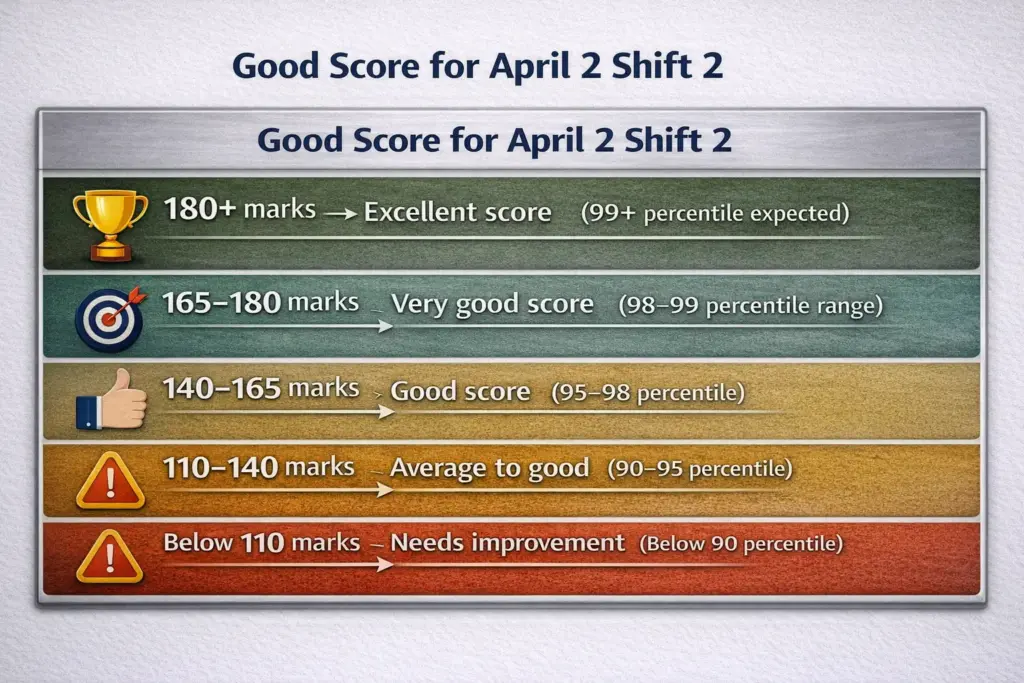
Expected Marks vs Percentile Based on JEE Main Analysis
As Shift 2 was more competitive, the marks for a high percentile may be less than in Shift 1. Experts have estimated that if a student scores between 180 and 195 in Shift 1 and 165 and 180 in Shift 2, they could end up in the 99th percentile. However, the percentile may vary after normalization is done by the NTA.
| Raw Score Out of 300 | Percentile |
| 300 to 291 | 100 to 99.99989 |
| 290 to 281 | 99.99908 to 99.99745 |
| 280 to 271 | 99.99417 to 99.99347 |
| 270 to 261 | 99.99016 to 99.98881 |
| 260 to 251 | 99.97720 to 99.96976 |
| 250 to 241 | 99.95028 to 99.94664 |
| 240 to 231 | 99.91595 to 99.93498 |
| 230 to 221 | 99.86623 to 99.90111 |
| 220 to 211 | 99.80777 to 99.85161 |
| 210 to 201 | 99.73129 to 99.79506 |
| 200 to 191 | 99.62402 to 99.71083 |
| 190 to 181 | 99.48033 to 99.59739 |
| 180 to 171 | 99.29558 to 99.45693 |
| 170 to 161 | 99.06985 to 99.27208 |
| 160 to 151 | 98.77819 to 99.02861 |
| 150 to 141 | 98.40768 to 98.73238 |
| 140 to 131 | 97.94047 to 98.31741 |
| 130 to 121 | 97.35425 to 97.81126 |
| 120 to 111 | 96.60949 to 97.14293 |
| 110 to 101 | 95.64338 to 96.20455 |
| 100 to 91 | 94.39636 to 94.99859 |
| 90 to 81 | 92.76234 to 93.47123 |
| 80 to 71 | 90.41098 to 91.07212 |
| 70 to 61 | 87.06073 to 87.51222 |
| 60 to 51 | 81.57582 to 82.01606 |
| 50 to 41 | 73.08140 to 73.28780 |
| 40 to 31 | 59.84001 to 58.15149 |
| 30 to 21 | 40.34692 to 37.69452 |
| 20 to 10 | 20.95045 to 13.49584 |
| 10 to 0 | 6.59980 to 0.84351 |
Conclusion
The JEE Mains Paper Analysis for Shift 2 of the April 2 examination indicates that the overall question paper was moderate to tough. The Mathematics section was the toughest and most time-consuming for students, whereas the Chemistry section was relatively easier for students. As has been emphasized in the JEE Mains Paper Analysis, conceptually strong students were at an advantage.
As emphasized in the JEE Main Analysis, the marks for a high percentile in Shift 2 may be lower due to the slightly tougher nature of the examination. Overall, the JEE Mains April Analysis indicates that the examination was not only about concepts but also about accuracy and speed.
Frequently Asked Questions
1. How was JEE Mains paper Analysis for Day 1 Shift 2?
As per the JEE Mains Paper Analysis 2026, the overall paper was moderate with a slightly lengthy nature, especially due to Mathematics. Chemistry provided a scoring opportunity, while Physics remained balanced.
2. How many questions are asked in JEE Main Paper 1?
As per the JEE Main Exam Pattern, Paper 1 has three sections, Physics, Chemistry, and Maths, a total of 75 questions (each subject 25).
3. How many Students appeared in JEE Main 2026 April Session?
As per the figures available, approximately 11.23 lakh (1.12 million) candidates registered to appear for the JEE Main 2026 April Session (Session 2)
4. Where can I find the JEE Main Paper Analysis for all shifts?
The JEE Main Paper Analysis for all shifts is available on various online platforms like Collegedost, where the detailed analysis is provided for the respective subjects.
5. How was the JEE Main Analysis for April 2 Shift 2?
As per the JEE Main Analysis, the Shift 2 exam was a bit tougher than Shift 1. The only reason for this is the lengthy Maths problems.
6. What does the JEE Mains Paper Analysis contain?
The JEE Main Paper Analysis contains the difficulty level, detailed analysis for the respective subjects, important topics, student reactions, etc.
7. Is the JEE Mains 2026 Paper Analysis helpful for future preparation?
Yes, the JEE Mains 2 April Shift 2 Analysis is helpful for the future preparation of the students.
8. What is a good score in JEE Mains April 2 Shift 2?
A good score in JEE Mains April 2 Shift 2 is considered to be 140 to 180 marks, taking into consideration the difficulty level, which is moderate to tough.
9. Why is JEE Main Paper Analysis important after the exam?
The JEE Main Paper Analysis is important for the students as they can evaluate their performance, estimate their marks, and predict their percentile before the declaration of the official result.
10. When will NTA release JEE Mains Results for Session 2?
NTA to release the JEE Mains Session 2 Results on April 20, 2026, along with the answer key.