Summarise With AI


The SRMJEEE phase 1 is going to be held from April 24 to 29, 2026 in Remote Proctored Online Mode. The SRMJEEE admit card has now been released, and registered candidates can download the same. Check all the SRMJEEE recent and future events below:
Recent & Upcoming Events:
- Application Form Release: November 3, 2025
- Last Date to Apply (Phase 1): April 16, 2026
- SRMJEEE Phase 1 Exam Dates: April 24 to April 29, 2026
- Last Date to Apply (Phase 2): June 4, 2026
One must make sure that they fulfil the SRMJEEE eligibility criteria before applying. After registration, one must book the SRMJEEE slot for the exam. The SRMJEEE admit card is released after the slot booking process is completed, and one must carry it at the time of the exam. It is beneficial to have an understanding of the SRMJEEE pattern. One can practice through an SRMJEEE sample paper.
Also Check: upGrad School of Technology Fees, Placements & Eligibility Explained
What is SRMJEEE?
The SRMJEEE is a popular university-level entrance test conducted for admission into engineering programs offered by SRM Institute of Science and Technology. SRMJEEE stands for SRM Joint Engineering Entrance Examination.
The purpose of taking this test is to gauge the performance of a candidate in Physics, Chemistry, Mathematics, and English. The SRMJEEE exam is held in several phases throughout the year, thereby allowing candidates to take their test according to their convenience. Candidates must be updated about the SRMJEEE dates for preparation purposes.
SRMJEEE Exam Dates 2026
Check out the SRMJEEE important dates below for the 2026 academic year:
| Particulars | Phase 1 | Phase 2 | Phase 3 |
|---|---|---|---|
| Mode of Exam | Remote Proctored Online Mode | Remote Proctored Online Mode | Remote Proctored Online Mode |
| Exam Dates | 24 April 2026 to 29 April 2026 | 10 June 2026 to 15 June 2026 | 04 July 2026 to 05 July 2026 |
| Application Deadline | 16 April 2026 | 04 June 2026 | 30 June 2026 |
SRMJEEE Slot Booking 2026
SRMJEEE slot booking 2026 will be a mandatory procedure where registered candidates choose the date and time they want to take the test. It takes place online using the official SRM admission portal on a first-come, first-served basis; hence, early booking is advisable. Check out the SRMJEEE phase 1 slot booking dates below:
- Start Date: 18 April 2026 (from 1 PM)
- Last Date: 20 April 2026
How to Book SRMJEEE Slot?
Refer to the following to know the SRMJEEE slot booking portal and steps to complete the procedure:
- Go to the official website of the SRM admissions portal
- Log in with your application number and password/dob
- Click the link for the SRMJEEE slot booking portal that appears in your dashboard
- Choose your desired date of test from the list of dates provided
- Decide on your slot of test timings (morning/afternoon)
- Confirm the details
- Save the confirmation page
SRMJEEE Eligibility Criteria 2026
Check out the SRMJEEE eligibility below:
| Criteria | Details |
|---|---|
| Nationality | Indian, NRI, OCI, PIO, and Foreign Nationals can apply |
| Age Limit | Minimum 16+ years; generally born between July 2001 to June 2006 (approx.) |
| Educational Qualification | Must have passed or be appearing in Class 12 (10+2) |
| Subjects Required | Physics & Mathematics (mandatory) + one of Chemistry/Biology/Biotechnology |
| Minimum Marks | Around 50% to 60% aggregate in PCM/PCB |
| Appearing Candidates | Students appearing in Class 12 are also eligible |
How to fill the SRMJEEE Application Form 2026?
Students must follow all the required steps to fill out the SRMJEEE application form. To know the complete procedure, refer to the following:
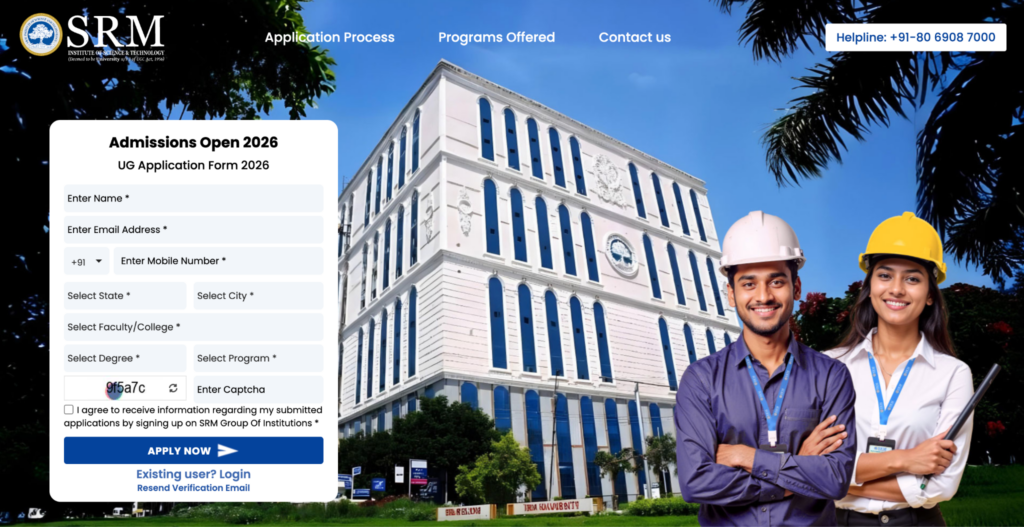
1. Create an account on the Official Website: Access the SRM admission portal and fill out the SRMJEEE application registration form with your email ID and mobile number.
2. Verify Email ID: Check your inbox and ensure your email by the link that SRM will send you to activate your account.
3. Fill Personal Details: Complete simple information like name, date of birth, gender and contact information with caution.
4. Enter Academic Information: Enter your Class 10 and Class 12 information, board, marks and subjects.
5. Select Course and Campus: Choose B.Elective tech course and SRM campus of your choice.
6. Upload Required Documents: Fax scanned signature and photograph according to the specified requirements.
7. Pay Application Fee: Make the full payment using methods such as debit card, credit card and net banking.
8. Review the Application Form: Always go through everything and submit it only after reviewing.
9. Download Confirmation Page: Once submitted, download and save the confirmation page to refer to in future.
10. Check for Updates: Continuously visit the portal to know the current SRMJEEE slot booking, admit card and examination schedule.
Required Documents for SRMJEEE Application Form
Check out the required documents for the SRMJEEE application below:
| Document | Details |
|---|---|
| Photograph | Recent passport-size photo in prescribed format (JPEG/JPG) |
| Signature | Scanned signature on white paper |
| Class 10 Marksheet | For the date of birth and basic qualification proof |
| Class 12 Marksheet | Required if already passed |
| Class 12 Admit Card | For appearing candidates |
| ID Proof | Aadhaar Card / Passport / Driving License (any one) |
| Category Certificate | Required for reserved category candidates (if applicable) |
| Email ID & Mobile Number | Active contact details for registration and updates |
SRM Exam Pattern
The SRMJEEE pattern is a presentation of the test format, including subjects, questions, and the marking scheme. Knowing the SRM exam pattern can help candidates manage the time they take during the exam.
| Particulars | Details |
|---|---|
| Mode of Exam | Online (Remotely Proctored) |
| Duration | 2 hours 30 Minutes |
| Medium of Exam | English |
| Question Type | Multiple Choice Questions (MCQs) |
| Total Questions | 130 |
| Total Marks | 130 |
SRMJEEE Mock Test 2026
One of the most intelligent strategies to prepare and feel confident during the SRMJEEE exam is to practice using an SRMJEEE mock test 2026. Mock tests are the practice that mimics the real exams and enables you to handle time wisely and familiarise yourself with the question format.
To facilitate a close match to the format of the SRMJEEE exam, our CollegeDost mock test tool will also have quality questions, immediate feedback, and performance feedback. Training on our site will enable you to know which areas you are weak in, become more accurate and develop a good strategy to do well in the final exam. Practice free SRMJEEE mock test below:
SRMJEEE Syllabus
The SRM syllabus is released by the SRM authorities. It is necessary to know the syllabus to prepare well for the SRMJEEE exam.
SRMJEEE 2026 Physics Syllabus
Check out the SRMJEEE syllabus for Physics below:
| Unit | Chapters |
|---|---|
| Unit 1: Units and Measurement, Mechanics | Units for measurement, system of units-S.I., fundamental and derived units, measurements – measurement errors – significant figures, dimensions – dimensional analysis – applications. Laws of Motion: Newton’s laws of motion – force and inertia – impulse and momentum – law of conservation of linear momentum – applications – projectile motion-uniform circular motion -friction – laws of friction – applications – centripetal force. Work, Energy and Power: Work – energy- potential energy and kinetic energy – power – collision-elastic and inelastic collisions. |
| Unit 2: Gravitation, Mechanics of Solids and Fluids | Gravitation: The universal law of gravitation, acceleration due to gravity – variation of ‘g’ with altitude, latitude and depth – gravitation potential – escape velocity and orbital velocity – geostationary satellites – Kepler’s laws of planetary motion. Mechanics of solids and fluids: Solids – elastic behaviour, stress-strain – Hooke’s law – Modulus of elasticity – relation between them – surface tension, capillarity – applications – viscosity – Poiseuille’s formula – Stokes law applications – streamline and turbulent flow – Reynolds number – Bernoulli’s theorem – applications. |
| Unit 3: Electrostatics | Electric charge – Conservation laws – Coulomb’s law-principle of superposition – continuous charge distribution – electric field – electric field lines – electric dipole -electric field due to a dipole – torque on a dipole in a uniform electric field – Electric flux – Gauss’s theorem – field due to an infinitely long straight wire – uniformly charged infinite plane sheet and uniformly charged thin spherical shell. Electric potential – potential difference – equipotential surfaces – electrical potential energy – Dielectrics and electric polarisation – capacitors and capacitance – combination of capacitors in series and in parallel – capacitance of a parallel plate capacitor with and without dielectric medium – energy stored in a capacitor |
| Unit 4: Current Electricity | Electric current – drift velocity – mobility – Ohm’s law -V-I characteristics – electrical energy and power – electrical resistivity and conductivity – Carbon resistors – series and parallel combinations of resistors – temperature dependence – Internal resistance of a cell – potential difference and emf of a cell – combination of cells in series and in parallel – Kirchhoff’s laws – applications – Wheatstone bridge – Metre bridge – Potentiometer – comparison of EMF of two cells – measurement of internal resistance of a cell. |
| Unit 5: Magnetism and Magnetic effects of current | Earth’s magnetic field and magnetic elements -magnetic field due to a magnetic dipole – torque on a magnetic dipole – tangent law, tangent galvanometer deflection magnetometer – magnetic properties of a material – dia, para and ferromagnetic materials – applications. Magnetic effects of electric current – Biot-Savart’s law – force on a moving charge in a uniform magnetic field – moving coil galvanometer – conversion of a galvanometer into a voltmeter and an ammeter. |
| Unit 6: Electromagnetic Induction, Alternating Currents and Electromagnetic Waves | Electromagnetic induction – Faraday’s laws, induced EMF and current – Lenz’s Law – Eddy currents – Self and mutual induction – Alternating currents, peak and RMS value of alternating current/voltage – reactance and impedance – LC oscillations – LCR series circuit – resonance – power in AC circuits – power factor – wattless current – AC generator and transformer – Electromagnetic waves – characteristics – Electromagnetic spectrum. |
| Unit 7: Optics | Reflection of light – spherical mirrors – mirror formula – refraction of light -total internal reflection- optical fibres – refraction at spherical surfaces – lenses – thin lens formula – lensmaker’s formula – magnification – power of a lens – combination of thin lenses in contact – refraction of light through a prism – Scattering of light -Microscopes and astronomical telescopes. Wave front and Huygen’s principle – reflection and refraction of a plane wave at a plane surface- laws of reflection and refraction using Huygen’s principle – Interference – Young’s double slit experiment and expression for fringe width – diffraction due to a single slit -width of central maximum – polarisation – plane polarised light – Brewster’s law. |
| Unit 8: Dual Nature of Radiation and Matter&Atomic Physics | Dual nature of radiation – Photoelectric effect – Hertz and Lenard’s observations – Einstein’s photoelectric equation-particle nature of light.Matter waves-wave nature of particles – de-Broglie relation – Davisson-Germer experiment – Alpha-particle scattering experiment – Rutherford’s model of atom – Bohr model – hydrogen spectrum. |
| Unit 9: Nuclear Physics | Nuclear radius, mass, binding energy, density, isotopes, mass defect- Bainbridge mass spectrometer-nuclear forces neutron discovery – radioactivity-α, β and γ decay-half life – mean life-artificial radioactivity-radio isotopes-radio carbon dating-radiation hazards. Nuclear fission, nuclear reactor, nuclear fusion, hydrogen bomb, cosmic rays-elementary particles. |
| Unit 10: Electronic Devices | Semiconductors-doping-types-PN junction diode – biasing-diode as a Rectifier – Special purpose PN junction diodes – LED – photodiode – solar cell and zener diode – characteristics – zener diode as a voltage regulator- transistors-transistor characteristics – amplifier – gain-feedback in amplifiers-logic gates-basic logic gates-NOT, OR, AND, NOR, NAND-universal gates-De Morgan’s theorems. |
SRMJEEE Chemistry Syllabus 2026
Check out the SRMJEEE syllabus for Physics below:
| Units | Topics Covered |
|---|---|
| Solutions | Types of solutions, expression of concentration of solutions of solids in liquids, solubility of gases in liquids, solid solutions, colligative properties – relative lowering of vapour pressure, Raoult’s law, elevation of boiling point, depression of freezing point, osmotic pressure, determination of molecular masses using colligative properties, abnormal molecular mass, Van’t Hoff factor. |
| Electrochemistry | Redox reactions, conductance in electrolytic solutions, specific and molar conductivity, variations of conductivity with concentration, Kohlrausch’s Law, electrolysis and law of electrolysis (elementary idea), dry cell-electrolytic cells and Galvanic cells, EMF of a cell, standard electrode potential, Nernst equation and its application to chemical cells, Relation between Gibbs energy change and EMF of a cell, fuel cells, corrosion. |
| Chemical Kinetics | Rate of a reaction (Average and instantaneous), factors affecting rate of reaction: concentration, temperature, catalyst; order and molecularity of a reaction, rate law and specific rate constant, integrated rate equations and half-life (only for zero and first order reactions), concept of collision theory (elementary idea, no mathematical treatment). Activation energy, Arrhenius equation. |
| Surface Chemistry | Adsorption – physisorption and chemisorption, factors affecting adsorption of gases on solids, catalysis, homogeneous and heterogeneous activity and selectivity; enzyme catalysis, colloidal state distinction between true solutions, colloids and suspension; lyophilic, lyophobic multi-molecular and macromolecular colloids; properties of colloids; Tyndall effect, Brownian movement, electrophoresis, coagulation, emulsion – types of emulsions. |
| P -Block Elements | Group 16 Elements: General introduction, electronic configuration, oxidation states, occurrence, trends in physical and chemical properties, dioxygen: Preparation, Properties and uses, classification of Oxides, Ozone, Sulphur – allotropic forms; compounds of Sulphur: Preparation, Properties and uses of Sulphur-dioxide, Sulphuric Acid: industrial process of manufacture, properties and uses; Oxoacids of Sulphur (Structures only). Group 17 Elements: General introduction, electronic configuration, oxidation states, occurrence, trends in physical and chemical properties; compounds of halogens, Preparation, properties and uses of Chlorine and Hydrochloric acid, interhalogen compounds, Oxoacids of halogens (structures only). Group 18 Elements: General introduction, electronic configuration, occurrence, trends in physical and chemical properties, uses. |
| :‘D’ and ‘F’ Block Elements | General introduction, electronic configuration, occurrence and characteristics of transition metals, general trends in properties of the first row transition metals – metallic character, ionisation enthalpy, oxidation states, ionic radii, colour, catalytic property, magnetic properties, interstitial compounds, alloy formation, Lanthanoids – Electronic configuration, 13 oxidation states, chemical reactivity and lanthanoid contraction and its consequences. |
| Coordination Compounds | Coordination compounds – Introduction, ligands, coordination number, colour, magnetic properties and shapes, IUPAC nomenclature of mononuclear coordination compounds. Bonding, Werner’s theory, VBT, and CFT; structure and stereoisomerism, importance of coordination compounds (in qualitative inclusion, extraction of metals and biological systems). |
| Haloalkanes And Haloarenes | Haloalkanes: Nomenclature, nature of the C-X bond, physical and chemical properties, mechanism of substitution reactions, optical rotation. Haloarenes: Nature of C-X bond, substitution reactions (Directive influence of halogen in monosubstituted compounds only). Uses and environmental effects of – dichloromethane, trichloromethane, tetrachloromethane, iodoform, freons, DDT. |
| Alcohols, Phenols and Ethers | Alcohols: Nomenclature, methods of preparation, physical and chemical properties (of primary alcohols only), identification of primary, secondary and tertiary alcohols, mechanism of dehydration, uses with special reference to methanol and ethanol.Phenols: Nomenclature, methods of preparation, physical and chemical properties, acidic nature of phenol, electrophilic substitution reactions, uses of phenols.Ethers: Nomenclature, methods of preparation, physical and chemical properties, uses. |
| Aldehydes, Ketones and Carboxylic Acids | Aldehydes and Ketones: Nomenclature, nature of carbonyl group, methods of preparation, physical and chemical properties, mechanism of nucleophilic addition, reactivity of alpha hydrogen in aldehydes, uses.Carboxylic Acids: Nomenclature, acidic nature, methods of preparation, physical and chemical properties; uses. |
| Organic Compounds Containing Nitrogen | Amines: Nomenclature, classification, structure, methods of preparation, physical and chemical properties, uses, identification of primary, secondary and tertiary amines. Cyanides and IsocyanidesDiazonium salts: Preparation, chemical reactions and importance in synthetic organic chemistry |
| Biomolecules | Carbohydrates – Classification (aldoses and ketoses), monosaccharides (glucose and fructose), D-L configuration oligosaccharides (sucrose, lactose, maltose), polysaccharides (starch, cellulose, glycogen); Importance of carbohydrates.Proteins – Elementary idea of – amino acids, peptide bond, polypeptides, proteins, structure of proteins – primary, secondary, tertiary structure and quaternary structures (qualitative idea only), denaturation of proteins; enzymes.Vitamins – Classification and functions. Nucleic Acids: DNA and RNA. |
SRMJEEE Math Syllabus 2026
Check out the SRMJEEE syllabus for Maths below:
| Unit | Topics |
|---|---|
| Unit 1: Sets, Relations and Functions | Sets and their representations, union, intersection and their algebraic properties, relations, equivalence relations, mappings, one-one, into and onto mappings, and the composition of mappings. |
| Unit 2: Complex Numbers and Quadratic Equations | Complex numbers in the form a+ib and their representation in a plane. Quadratic equations in the real and complex number systems and their solutions. Relation between roots and coefficients, nature of roots, formation of quadratic equations with given roots; symmetric functions of roots, and equations reducible to quadratic equations. |
| Unit 3: Matrices, Determinants and their applications | Determinants and matrices of order two and three, minors, cofactors and applications of determinants in finding the area of a triangle, equality, types zero and identity matrix, transpose, symmetric and skew-symmetric. Evaluation of determinants. Addition and multiplication of matrices, simple properties, adjoint and inverse of a matrix, solution of simultaneous linear equations using determinants and matrices using inverses |
| Unit 4: Combinatorics Permutations and Combinations | The fundamental principle of counting, permutation as an arrangement without repetitions and constraint repetitions, no circular permutations. Combination as selection, problems in P(n,r) and C(n,r), factorial, and simple applications. |
| Unit 5: Algebra | Theory of Equations: The relation between the roots and coefficients in an equation. Solving the equations when two or more roots of it are connected by a certain relation. Equation with real coefficients, the occurrence of complex roots in conjugate pairs and its consequences. Transformation of equations – Reciprocal Equations. |
| Unit 6: Differential Calculus and its Applications | Polynomials, rational, trigonometric, logarithmic and exponential functions. Inverse functions. Graphs of simple functions. Limits, continuity, differentiation of the sum, difference, product and quotient of two functions, differentiation of trigonometric, inverse Trigonometric, logarithmic, exponential, composite and implicit functions, up to second-order derivatives. Applications of Differential Calculus: Rate of change of quantities, monotonic-increasing and decreasing functions, maxima and minima of functions of one variable, tangents and normals, Rolle’s and Lagrange’s mean value theorems. Ordinary differential equations, order and degree. Formation of differential equations and solution of differential equations by the method of separation of variables. Solution of homogeneous and linear differential equations and those of the type dy/dx +p(x)y=q(x). |
| Unit 7: Integral Calculus and its Applications | Fundamental integrals involving algebraic, trigonometric, exponential and logarithmic functions. Integration by substitution, integration using trigonometric identities, and properties of definite integrals. Evaluation of definite integrals, excluding the application of definite integrals |
| Unit 8: Analytical Geometry | Straight Lines in Two Dimensions: Straight line – Normal form – Illustrations. Straight line – Symmetric form. Straight line – Reduction into various forms. The intersection of two Straight Lines. The slope of a line, parallel and perpendicular lines, intercepts of a line on the coordinate axes. Family of straight lines, Concurrent lines. Condition for Concurrent lines. Cartesian system of rectangular coordinates in the plane, distance formula, area of a triangle, condition for the collinearity of three points and section formula, Concurrent lines – properties related to a triangle. Centroid and incentre of a triangle, locus and its equation. Circles in Two Dimensions: Standard form of the equation of a circle, general form of the equation of a circle, its radius and centre, equation of a circle in the parametric form, equation of a circle when the endpoints of a diameter are given, points of intersection of a line and a circle with the centre at the origin and condition for a line to be tangent to the circle. Conic Sections in Two Dimensions: Sections of cones, equations of conic sections (parabola, ellipse and hyperbola) in standard form. Problems using their geometrical properties. |
| Unit 9: Vector Algebra | Vectors and scalars, addition of vectors, components of a vector in two dimensions and three-dimensional space, scalar and vector products, scalar and vector triple product. Application of vectors to plane geometry. |
| Unit 10: Statistics and Probability Distribution | Measures of Central Tendency and Dispersion: Calculation of mean, median, and mode of grouped and ungrouped data. Calculation of standard deviation, variance and mean deviation for grouped and ungrouped data. Probability: Probability of an event, addition and multiplication theorems of probability and their applications; Conditional probability; Bayes ’ theorem, probability distribution of a random variable; Binomial, Poisson and Normal distributions and their properties |
| Unit 11: Trigonometry | Trigonometry ratios, compound angles, solution of triangles, Trigonometric identities and equations, Inverse trigonometric functions definition range and domain, Properties of triangles, including incentre, circumcenter and orthocenter, solution of triangles, Problems related to Heights and distances. |
SRMJEEE Admit Card
The SRMJEEE admit card is a compulsory document, which is needed to take the entrance test. The Admit card for SRMJEEE 2026 can be downloaded after the slot booking process. The SRMJEEE phase 1 admit card has been released now, and students can download it with their valid credentials.
How to Download SRMJEEE Admit Card?
Check out the SRMJEEE admit card download procedure below:
- Access the SRM admissions website
- Log in by entering the application number and password/dates of birth
- Select the SRMJEEE admit card link from the homepage
- Make sure to have successfully booked slots for SRMJEEE
- The admit card for SRMJEEE will be displayed on your computer screen
- Check all the information, including name, date of test, and timing
- Download the admit card in PDF format
- Get the admit card printed for the test day
SRMJEEE 2026 Remote Proctored Exam Guidelines
The SRMJEEE remote proctored exam guidelines give instructions on how to take the exam at home. The ability to follow the SRM online entrance exam instructions guarantees a comfortable and equitable exam experience.

- Adhere to all SRMJEEE remote proctored exam instructions during the test.
- Install and download the Safe Exam Browser (SEB) as it is compulsory to begin the exam.
- Should use a laptop/desktop, not mobile phones or tablets.
- Make sure there are minimum system requirements such as webcam, microphone, 4 GB RAM and stable internet (at least 1 Mbps).
- Log in with credentials on the SRMJEEE admit card and verify the photo before beginning the exam.
SRMJEEE Remote Proctored Exam Instructions | Dos and Don’ts:
| Do’s | Don’ts |
|---|---|
| Stay seated and face the screen throughout the exam | Do not use mobile phones, Bluetooth devices, or any unfair means |
| Keep your face visible at all times on the webcam | Do not leave your seat or take breaks during the exam |
| Follow all SRM exam instructions for candidates strictly | Avoid talking, reading questions aloud, or looking away from the screen |
SRMJEEE Preparation Tips 2026
The SRMJEEE exam needs a strategy and practice to prepare. Most students tend to pose the question Is SRMJEEE easy, yet it depends on how one has prepared and what he or she understands.
- Understand the SRMJEEE exam pattern and question paper structure before you begin your preparation.
- Go through the complete SRMJEEE syllabus and create a realistic study plan that you can follow consistently.
- Solve at least one SRMJEEE sample paper regularly to improve both speed and accuracy.
- Practising SRMJEEE previous year question papers will help you identify important topics and recurring trends.
- Keep track of SRMJEEE important exam dates so you don’t miss any deadlines.
- Revise concepts daily instead of depending on last-minute preparation.
- Spend more time on weak areas while maintaining your strengths in other subjects.
- Attempt SRMJEEE mock tests in a timed environment to simulate the actual exam experience.
- Before the exam day, carefully read all instructions to avoid confusion.
- If you are taking the SRMJEEE remote proctored exam, make sure you understand the guidelines to prevent technical issues.
- Book your slot early using the slot booking portal to get your preferred time.
- Stay consistent in your preparation and avoid overthinking questions like whether SRMJEEE is easy or difficult; focus on steady practice instead.
SRMJEEE Sample Papers
The SRMJEEE authorities release the SRMJEEE sample papers or model papers on their official website to help students prepare for the exam. Training with an SRMJEEE sample paper would enable applicants to have an idea of how the exam would be conducted and its level of difficulty. Speed and accuracy can be enhanced by solving the SRMJEEE previous year question papers. There are various benefits of solving the SRMJEEE sample paper, including:
- knowledge of exam pattern and question format
- improvement in speed and accuracy
- identification of important topics
- spotting weak areas for revision
- better time management practice
- increased confidence for the actual exam
SRMJEEE 2026 Best Books
It is significant to select the appropriate study material to crack the SRMJEEE exam. The ideal books must be in correlation with the syllabus and in the SRM question paper pattern.
| Subject | Best Books |
|---|---|
| Physics | NCERT Physics (Class 11 & 12) |
| Concepts of Physics by H.C. Verma | |
| Understanding Physics by D.C. Pandey | |
| Problems in General Physics by I.E. Irodov | |
| Chemistry | NCERT Chemistry (Class 11 & 12) |
| Physical Chemistry by P. Bahadur | |
| Organic Chemistry by O.P. Tandon | |
| Concise Inorganic Chemistry by J.D. Lee | |
| Mathematics | NCERT Mathematics (Class 11 & 12) |
| R.D. Sharma | |
| S.L. Loney (Coordinate Geometry) | |
| Amit M. Agarwal (Arihant) | |
| Aptitude/English | RS Aggarwal (Quantitative Aptitude) |
| Wren & Martin (Grammar) |
SRMJEEE Result 2026
The SRMJEEE result 2026 is released online following the exam. Applicants will be able to access their scores with the help of login information and monitor their SRMJEEE cutoff rank. Refer to the following to know how to download the SRMJEEE result 2026.
- Go to the official SRM admission portal.
- Click on the link SRMJEEE Result 2026.
- Type in the application number and password.
- Enter the logins.
- See your scorecard on-screen.
- Save and download the outcome to use later.
- Print out the result for the SRMJEEE counselling and admission process ahead.
SRMJEEE Counselling 2026
The SRMJEEE counselling 2026 is carried out to allot seats on the basis of rank and preferences. To be admitted, qualified candidates will be required to attend the SRMJEEE counselling. Check out the complete SRMJEEE counselling process below:
Register for the admission portal: Qualified candidates have to log into the official SRM admission portal at applications.srmist.edu.in/btech with their credentials.
Download the rank card: Get your SRMJEEE rank card on the Online Admission Portal (OAP).
Enter academic details: Complete all the necessary academic and personal details.
Selection of programmes (choice filling): Choose your own campus, course, and specialisation at the OAP during the allocated period.
Seat allocation: The institute will assign preferences in terms of rank, eligibility and availability of the campus and programme that will be shown on the portal.
Accept allotment and pay fees: The successful applicants have to confirm their seats by remitting a non-refundable counselling and registration fee by the deadline.
Download the tentative allotment letter: On successful payment, obtain the provisional allotment letter and fee receipt on the portal. Failure to make the payment on time can result in the cancellation.
Pay the remaining fees and enrolment: To confirm admission, pay the balance tuition fee and undergo the online enrolment process.
SRMJEEE Cutoff 2026
The SRMJEEE cutoff 2026 is the minimum rank that a student has to attain to be admitted to various courses. In competitive divisions, the SRMJEEE cut off for CSE is generally higher than in other divisions.
| SRMJEEE Branch | Rank needed for KTR campus | Rank needed for other campuses |
|---|---|---|
| CSE | Upto 2000 | Upto 9000 |
| CSE (S) | Upto 8000 | Upto 15000 |
| ECE | Upto 10,000 | Upto 19,000 |
| IT | Utp 5000 | Upto 12,000 |
| Others | Upto 18,000 | Any rank |
Conclusion
SRMJEEE has an organised process for the engineering entrance exam, and regular preparation is more important than last-minute rush. Keeping in touch with the SRMJEEE pattern and SRMJEEE 2026 syllabus assists in developing a great conceptual clarity in subjects.
The accuracy and temperament of the exam are enhanced by doing regular practice using the SRMJEEE sample paper set and SRMJEEE previous year question papers. Following key dates, SRMJEEE slot booking portal updates, and SRMJEEE admit card release are some of the factors that will help in a hassle-free application process.
It is also important to have a clear understanding of the SRMJEEE criteria, eligibility and SRMJEEE counselling process in order to have final admission. Through rigorous preparation and understanding of SRMJEEE cutoff trends, applicants can be sure to target their branch of choice, such as competitive programs, such as the SRMJEEE CSE cut off.
Also Check: Expert Insights on NIT Calicut