Summarise With AI


The information on SRMJEEE marks vs rank is critical for candidates who wish to find their chances of admission among different campuses and branches of SRMJEEE. This examination is conducted using a specific marking scheme of SRMJEEE, which involves awarding one mark to each right answer, while the SRMJEEE total marks are generally set to be 130 based on the current exam pattern.
There are no penalties for the candidates who answer wrongly; hence, Negative marking in SRMJEEE does not exist; candidates can attempt all questions without any restrictions. The SRMJEEE marks vs rank out of 125 is another common search phrase used by many students based on previous experiences or some form of assumption.
The marks vs rank in SRMJEEE will depend on several factors, including the level of difficulty, the number of candidates involved and the normalisation process. SRMJEEE cut off marks have an impact on admissions opportunities in terms of campuses and branches every year. In relation to rank vs marks in SRMJEEE, candidates need to consider the qualifying marks for SRMJEEE.
Also Check: SRMJEEE Result 2026
SRMJEEE Marks Vs Rank 2026
Candidates can check out the expected SRMJEEE marks vs rank trend below based on the previous year’s analysis:
| SRMJEEE Marks | Expected Rank Range |
|---|---|
| 115+ | 1 to 250 |
| 110+ | 250 to 480 |
| 100+ | 480 to 900 |
| 80+ | 900 to 3,800 |
| 75+ | 3,800 to 6,500 |
| 60+ | 6,500 to 10,000 |
| 50+ | 10,000 to 16,000 |
| 40+ | 16,000 to 24,000 |
SRMJEEE Rank Vs Branch 2026
SRMJEEE 2026 Rank vs Branch analysis allows candidates to know the possible branches that they can get depending on their ranks in the entrance test.
Entry into competitive branches such as Computer Science, Electronics, and Mechanical Engineering highly depends on rank, availability, and college preferences.
| SRMJEEE Branch | Expected Rank |
|---|---|
| CSE | Up to 2,000 |
| IT | Up to 5,000 |
| CSE (Specialization) | Up to 8,000 |
| ECE | Up to 10,000 |
| Other Branches | Up to 18,000 |
What is SRMJEEE Rank?
The SRMJEEE rank is the rank given to a candidate according to his/her performance in the SRM Joint Engineering Entrance Examination. It is computed based on the marks achieved in the test, as well as other factors such as normalisation when administering the test in multiple sessions.
This rank is important during the process of admission since it determines the order through which students are to be considered in the process of allotting the seats to the students throughout the various SRM campuses and engineering branches. A higher rank in SRMJEEE 2026tends to give more chances to acquire the desired courses like Computer Science or Electronics at the best campuses.
The SRMJEEE rank is used by candidates to engage in counselling, fill choices, and secure admission according to availability and cut-off trends. Students must understand the SRMJEEE marks vs rank trends to gain a clear idea of their admission probability.
SRMJEEE Marks Vs Rank 2025
Aspirants can check out the previous year SRMJEEE marks vs rank data to gain a better idea of the upcoming trends.
| Marks Range (Out of 125) | Expected Rank Range |
|---|---|
| 120 – 110 | 1 – 500 |
| 109 – 100 | 501 – 1,000 |
| 99 – 90 | 1,001 – 2,000 |
| 89 – 80 | 2,001 – 3,500 |
| 79 – 70 | 3,501 – 7,000 |
| 69 – 60 | 7,001 – 10,000 |
| 59 – 50 | 10,001 – 15,000 |
| Below 50 | 15,000+ |
SRMJEEE Rank Vs Branch 2025
Students can check out the previous year SRMJEEE rank vs branch data to gain a better idea of the upcoming requirements.
| Branch | Expected Closing Rank |
|---|---|
| Computer Science Engineering | 8,000 – 9,000 |
| Electronics and Communication Engineering | 22,000 – 27,000 |
| Electrical and Electronics Engineering | 25,000 – 34,000 |
| Biotechnology Engineering | 43,000 – 47,000 |
| Aerospace Engineering | 48,000 – 50,500 |
| Biomedical Engineering | 51,000 – 53,500 |
| Automobile Engineering | 53,000 – 54,000 |
| Civil Engineering | 58,000 – 67,000 |
| Chemical Engineering | 62,000 – 67,000 |
| Electronics and Instrumentation Engineering | 60,000 – 61,000 |
What is a Good SRMJEEE Score?
A good score in SRMJEEE depends on the campuses and branches that you are aspiring to join, since every year the competition is different, and this is closely related to marks vs rank in SRMJEEE.
Usually, a good score lands you in the best branches, such as Computer Science at the main campus. A score above 100 is generally regarded as a strong score and may enable you to join popular programs in most of the various campuses, based on SRMJEEE cut off marks.
A score between 80 and 100 is also considered a strong score and may help you secure admission to popular programs in most of the various campuses. With a score ranging between 60 and 80, you can have satisfactory opportunities in mid-level branches or other SRM campuses.
Factors Affecting SRMJEEE Marks Vs Rank 2026
Check out all the factors that affect the SRMJEEE marks vs rank trends directly:
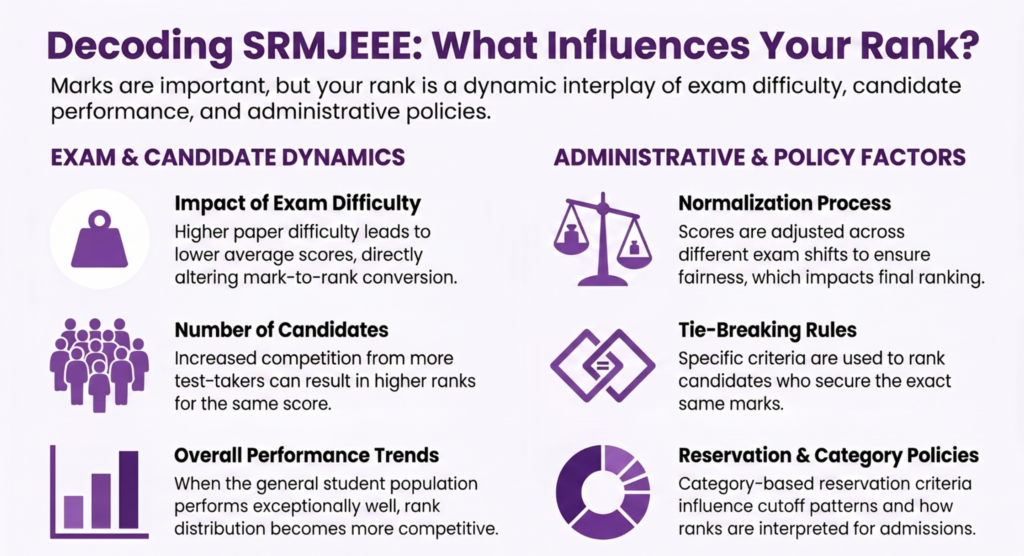
Difficulty Level of the Exam: A paper with more difficulty will cause the average scores to be lower, which has a direct effect on the conversion of marks into ranks.
Number of Candidates Appearing: Once the number of people taking the tests increases, it increases the competition, which may lead to higher positions with the same score.
Normalisation Process: The scores can be manipulated between the various exam shifts in order to achieve fairness, which affects the ultimate rank.
Overall Performance of Candidates: When most students earn good grades, the rank distribution will be more competitive.
Exam Pattern and Marking Scheme: The changes to the structure or marking scheme of the exam can have an effect on the trends of scoring and the calculation of ranks.
Tie-Breaking Rules: If two or more candidates secure an equal number of marks, the tie-breaking criteria are used to rank the candidates.
Seat Availability: The availability of seats indirectly influences the conversion of ranks to admission opportunities.
Reservation or Category Policies: The reservation criteria may affect the cutoff patterns and interpretation of ranks of the various categories.
SRMJEEE Counselling
To ensure that students do not miss deadlines, they must ensure they have a record of the counselling dates for SRMJEEE, since each of the phases of education has a fixed time within which it can be undertaken.
According to the official updates, the SRMJEEE phase 2 counselling is expected to commence in June 2026, while Phase 1 counselling is in May 2026, and the counselling of the SRMJEEE Phase 3 is expected to commence in July 2026.
Some of the elements that would affect the chances of admission after counselling to particular courses would be SRMJEEE cut off marks, seats available and competition. Due to the fact that SRMJEEE does not have negative marking, students would end up attempting many questions.
SRMJEEE Cutoff 2026 (Expected)
The SRMJEEE cutoff may vary for different courses and campuses as well. The following table shows the expected data of SRMJEEE 2026 cutoff ranks.
| SRMJEEE Branch | Rank Needed for KTR Campus | Rank Needed for Other Campuses |
|---|---|---|
| CSE | Upto 2,000 | Upto 9,000 |
| IT | Upto 5,000 | Upto 12,000 |
| CSE (S) | Upto 8,000 | Upto 15,000 |
| ECE | Upto 10,000 | Upto 19,000 |
| Others | Upto 18,000 | Any Rank |
Courses Offered by Different SRM Campuses
Various SRM campuses provide various courses according to specialisation, facilities and demands for particular engineering streams. While most SRM campuses are offering the popular courses such as Computer Science and Electronics, there are other institutes that are also offering new courses such as Artificial Intelligence, Data Science and Biotechnology.
SRM Kattankulathur: Chennai
Check out the SRM Kattankulathur BTech specialisations below:
| BTech Course Specialisations | ||
|---|---|---|
| Aerospace Engineering | Biotechnology with Specialisation in Regenerative Medicine | Electronics And Computer Engineering |
| Automobile Engineering | Chemical Engineering | Electronics And Instrumentation Engineering |
| Automobile Engineering with Specialisation in Vehicle Testing (GARC) | Civil Engineering | Mechanical Engineering |
| Automobile Engineering with Specialisation in Automotive Electronics | Civil Engineering with Computer Applications | Mechanical Engineering (Automation and Robotics) |
| Computer Science And Engineering with Specialisation in Cloud Computing | Computer Science and Engineering | Mechanical Engineering with Specialisation in Artificial Intelligence and Machine Learning |
| Computer Science And Engineering with Specialisation in Computer Networking | Computer Science And Engineering with Specialisation in Artificial Intelligence and Machine Learning | Mechatronics Engineering |
| Computer Science And Engineering with Specialisation in Information Technology | Computer Science And Engineering with Specialisation in Big Data Analytics | Mechatronics Engineering (Autonomous Driving Technology) |
| Computer Science And Engineering with Specialisation in Internet of Things | Computer Science And Engineering with Specialisation in Blockchain Technology | Mechatronics Engineering (Immersive Technologies) |
| Nanotechnology | Computer Science And Engineering with Specialisation in Gaming Technology | Mechatronics Engineering (Industrial IoT and Systems Engineering) |
| Computer Science And Engineering with Specialisation in Cyber Security | Computer Science And Engineering with Specialisation in Software Engineering | Mechatronics Engineering with Specialisation in Robotics |
| Biomedical Engineering | Electrical & Electronics Engineering | B.Tech. Computer Science And Engineering (Data Science) |
| Biomedical Engineering with Specialisation in Machine Intelligence | Electronics & Communication Engineering | B.Tech. Electronics Engineering (VLSI Design and Technology) |
| Biotechnology | Electronics And Communication And Engineering with Specialisation in Data Sciences | Automation & Robotics |
| Biotechnology with Specialisation in Food Technology | Electronics And Communication Engineering with Specialisation in Cyber Physical Systems | Biotechnology with Specialisation in Genetic Engineering |
Courses Offered in SRM AP
Check out the SRM Andhra Pradesh BTech specialisations below:
| BTech Course Specialisations | |
|---|---|
| Artificial Intelligence | Computer Science and Engineering with Specialisation in Gaming Technology |
| Civil Engineering | Computer Science and Engineering with Specialisation in Cloud Computing |
| Computer Science & Engineering | Biotechnology |
| Computer Science & Engineering with Specialisation in Artificial Intelligence & Machine Learning | Biomedical Engineering |
| Computer Science & Engineering with Specialisation in Big Data Analytics | Electrical & Electronics Engineering |
| Computer Science & Engineering with Specialisation in Internet of Things | Electronics & Communication Engineering |
| Computer Science & Engineering with Specialisation in Cyber Security | Electronics & Communications with Specialisation in Data Science |
| Computer Science & Business Systems | Information Technology |
| Mechanical Engineering | |
Courses Offered in SRM Vadapalani
Check out the SRM Vadapalani BTech specialisations below:
| BTech Course Specialisations | |
|---|---|
| Computer Science & Engineering | Electronics and Communication Engineering |
| Computer Science & Engineering with Specialisation in Artificial Intelligence & Machine Learning | Electronics and Communication Engineering with Specialisation in Data Science |
| Computer Science & Business System | Electronics Engineering (VLSI Design and Technology) |
| Computer Science & Engineering with Specialisation in Big Data Analytics | Mechanical Engineering |
| Computer Science & Engineering with Specialisation in Cyber Security | Mechanical Engineering with Specialisation in Artificial Intelligence & Machine Learning |
Courses Offered in SRM Trichy
Check out the SRM Trichy BTech specialisations below:
| BTech Course Specialisations | |
|---|---|
| Computer Science And Engineering | Computer Science and Business Systems (In Collaboration with TCS) |
| Electronics and Communication Engineering | Computer Science and Engineering (Data Science) |
| CSE with Specialisation in Artificial Intelligence & Machine Learning | Biotechnology with Specialisation in Food Technology |
| CSE with Cyber Security | Biomedical Engineering |
| Information Technology | Electronics and Communication Engineering with Specialisation in Data Sciences |
| CSE with Big Data Analytics | Computer Science and Engineering with Specialisation in Medical Engineering |
| Biotechnology | Computer Science And Engineering with Specialisation in Internet of Things |
| Electrical and Electronics Engineering | CSE with Specialisation in Blockchain Technology |
| Artificial Intelligence | |
Courses Offered in SRM Delhi NCR
Check out the SRM Delhi NCR BTech specialisations below:
| BTech Course Specialisations | |
|---|---|
| Computer Science & Engineering | Computer Science and Engineering (CSE) with Specialisation in Cloud Computing |
| Computer Science and Engineering (CSE) with Specialisation in Data Science | Electronics & Communication Engineering |
| Electrical and Electronics Engineering | Mechanical Engineering |
| Computer Science and Engineering (CSE) with Specialisation in Artificial Intelligence & Machine Learning | Electronics & Communication Engineering with Specialisation in Data Science |
| Computer Science and Engineering (CSE) with Specialisation in Cyber Security | Automobile Engineering |
| Computer Science and Business Systems (in collaboration with TCS) | |
Conclusion
To summarise, the best of your SRMJEEE performance is not only about scoring well, but it also involves knowing how your performance compares with your expectations. Having a clear conception of the marking scheme ofSRMJEEE 2026 will help you to approach the exam strategically, whilst an understanding of the SRMJEEE total marks will help you set realistic goals.
There is no Negative marking in SRMJEEE, and, as a result, a candidate should make the most of all the attempts he/she makes with accuracy to maximize his/her total score. Lastly, by monitoring SRMJEEE cutoff marks and trends, you will make wiser decisions during counselling, by ensuring you select the best possible branch and campus based on your performance.
Frequently Asked Questions
1. Does SRMJEEE have negative marking?
No, there is no negative marking in SRMJEEE. There is no deduction for incorrect responses.
2. I have 120 marks in SRMJEEE, can I get Mechatronics?
Yes, scoring 120 marks can help you secure a seat in Mechatronics, depending on the campus and competition level.
3. How many marks are required in SRMJEEE?
The required marks vary each year, but scoring above 80 to 100 marks is generally considered a good score.
4. What is the total marks in SRMJEEE?
The total marks in SRMJEEE are usually 130 as per the latest exam pattern.
5. What is the marking scheme of SRMJEEE?
Each correct answer carries one mark, and there is no negative marking for wrong answers.
6. What are the qualifying marks for SRMJEEE?
The qualifying marks vary every year depending on factors like exam difficulty and number of candidates.
7. How does rank vs marks in SRMJEEE work?
The rank vs marks relationship depends on exam difficulty, normalization, and overall candidate performance.
8. What are the SRMJEEE cutoff marks for the top branches?
Cutoff marks vary by branch and campus, with higher marks required for competitive streams like CSE.
9. Is 80 marks a good score in SRMJEEE?
Yes, scoring 80 marks is considered a good score and can help secure admission in various branches.
10. What factors affect SRMJEEE marks vs rank?
Factors include exam difficulty, number of candidates, normalization process, and overall performance trends.