Summarise With AI



The National Testing Agency has successfully concluded the last day of the JEE Mains 2026 Session 2 on 8th April (Wednesday). As per the given schedule, the exam shift was run from 3:00 to 6:00 P.M. As the exam is now over, students can now check the JEE Mains Paper Analysis 2026 8 April Shift 2 and expected marks vs percentile discussed on this page.
As per the JEE Mains 8 April shift 2 Paper analysis, the overall JEE Mains Question paper was moderate and lengthy. Mathematics was difficult because the calculations were lengthy. Physics was formula-based with moderate-level problems, whereas chemistry was straightforward with a few challenging questions.
Where to Get JEE Mains Paper Analysis for Past Shifts?
Students looking for JEE Mains paper analysis for previous shifts can refer to CollegeDost, which offers an in-depth and comprehensive analysis of the previous papers for different shifts, covering various aspects like difficulty levels, weightage in each subject, memory-based questions, etc., and thus, becomes very helpful for the students.
Students appearing for JEE Mains 2027 must review the JEE Mains Paper Analysis for the purpose of being familiar with the current examination pattern, knowing which topics hold more weightage, managing time effectively, predicting difficulty levels, and much more.
JEE Main 2026 Exam Difficulty Level Analysis (April 8)
For April 8, 2026, there is only one shift, which is scheduled in the evening shift. Take a look at the overall as well as the section-wise JEE Main 2026 Exam Difficulty level analysis for the April 8 shift in the following table.
| Subject | Difficulty Level | Remarks |
| Physics | Moderate | Concept-based with a mix of numerical and application questions |
| Chemistry | Moderate to Tough | Calculation-heavy, with tricky Physical and NCERT-based Inorganic questions |
| Mathematics | Tough (Lengthy) | Conceptually easier, but very time-consuming and multi-step |
| Overall | Moderate | Balanced paper with time pressure, mainly due to Maths |
Subject-wise JEE Mains 8 April Shift 2 Paper Analysis
In consideration of feedback from both students and experts, the JEE Mains 8 April shift 2 paper analysis can be said to be moderately difficult, where Mathematics was long and time-consuming, whereas Chemistry was a little tricky, while Physics had an even distribution of questions and was scoring too. Let’s now go through subject-wise JEE Mains April 8 paper analysis and key topics below.
JEE Mains Paper Analysis for Chemistry Section
The Chemistry section involved many statement-based questions (sometimes having as many as 5-7 statements per question), making it time-consuming and prone to silly mistakes. Take a look at the key topics asked in the JEE Mains Chemistry Question Paper.
- Inorganic Chemistry: There has been an increase in Salt Analysis, Coordination Compounds, and p-blocks, which together can carry around 35-40% of the total marks in the entire portion.
- Organic Chemistry: GOC (General Organic Chemistry), Biomolecules, and Naming are important topics; however, students find that these questions have become somewhat difficult now.
- Physical Chemistry: Most questions from Physical Chemistry are found in the Numerical Value Type (NVT) portion of the paper and can often be numerical in nature rather than theoretical.
JEE Mains 2026 Analysis for Maths Section
In the JEE Mains 8 April shift 2 analysis, Mathematics is often termed as the ‘hardest’ section due to its difficult calculation-based nature. The pattern seen in Mathematics, as was expected, was that it was extremely lengthy, with very few candidates attempting more than 12-13 questions. Take a look at the key topics from where questions are asked in the JEE Mains Maths Section.
- Vectors & 3D Geometry: These are regarded as the most important concepts for the 2026 sessions, holding considerable weightage in almost all shifts.
- Calculus: This topic is highly focused upon and contains topics like Integration (Definite and Indefinite), Differential Equations, Limits, Functions, and Application of Derivatives.
- Algebra: Important topics to be aware of are Matrices & Determinants, Sequence and Series (AP/GP), Quadratic Equations, and Binomial Theorem.
- Coordinate Geometry: Important sub-topics include Conic Sections (Ellipse, Parabola, and Hyperbola), Circle, and Straight Lines.
JEE Mains Paper Analysis for Physics Section
The Physics section is rated moderate and heavily formula-based, allowing students with solid fundamentals to score rapidly. Physics was known for its great uniformity, meaning no particular chapter dominated, forcing students to have a broad knowledge base.
- Modern Physics: Units such as the Photoelectric Effect, Dual Nature of Matter, need special attention as they are of high priority
- Electromagnetism: This covers weightage on topics like Electrostatics, Current Electricity, Magnetic Effects of Current, and Capacitors
- Mechanics: Important chapters include Laws of Motion, Work, Energy, and Power, and Rotational Motion
- Other Topics: Other important topics covered in JEE Main analysis include Thermodynamics, Units and Dimensions, Ray Optics, and Semiconductors.
JEE Mains April 8 Paper Analysis by Students
After the completion of the shift, we talked to the test takers coming out of the exam center. When we talked about the difficulty level of this shift, they said it was moderate for most of them. There were some mixed reactions when we asked for the chemistry section’s difficulty level.
- Taniya Singh rated the JEE Mains 8 April Shift 2 paper as moderate and said that even though physics was easy and consisted only of concepts, maths was rather long and difficult to answer due to a lack of time.
- Bipul Rajput rates the JEE Mains Question paper as moderate and pointed out that chemistry was not an easy subject, as there were both types of questions, theoretical and numerical. The hardest part, though, was mathematics.
- Rahul Lutera rates the paper moderately and stated that physics was easy and scoring, and that maths was just calculations that were hard because there were too many steps to be taken to solve them.
- Nabin Pal also rated the paper moderately and said that even though maths was not very difficult, it took the most time in the paper, whereas Chemistry had questions from all parts of chemistry.
- Priya Gupta rated the paper moderately and said that she did not have much time during the entire paper, mostly because of math. She had some trouble understanding some of the questions in chemistry.
JEE Mains Marks vs Percentile-Based on JEE Mains Paper Analysis
The difficulty level of the JEE Main 2026 8 April shift 2 exam paper can be described as moderately difficult but extremely long, which greatly impacted the expected mark-to-percentile ratio and attempts made by students.
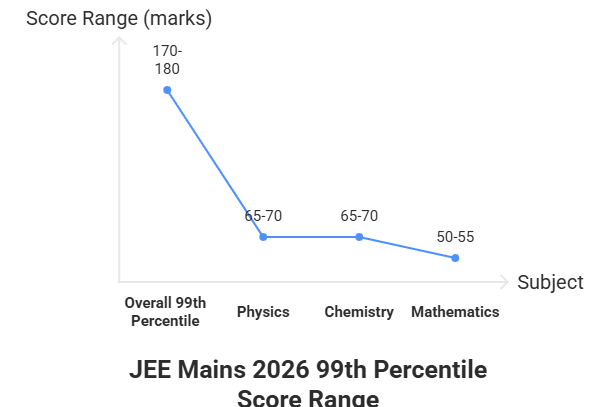
According to the JEE Mains paper analysis 2026, the overall 99th percentile score for this shift would range from 170 to 180 marks. Due to the length of the paper, the cutoff will probably not exceed 190. The marks needed for the 99th percentile in each subject are projected as follows:
NTA JEE Mains Answer Key 2026 Session 2
As per the tentative schedule, the JEE Mains 2026 Answer Key and OMR sheet are expected to be made on March 11, 2026 after completion of the exam. The final JEE Mains answer key will be announced once the process of objections is over, along with the result of JEE Mains 2026 (expected date – April 20).
Follow the instructions mentioned below to download the JEE Mains 2026 answer key PDF:
Step 1: Visit the official JEE Main website: jeemain.nta.nic.in
Step 2: Locate and click on the ‘JEE Mains Answer Key’ link on the home page.
Step 3: Fill in your application number and password/DOB to log in.
Step 4: On clicking the submit button, your answer key, along with your response sheet, will appear on the screen.
Step 5: Download and save the official JEE Main 2026 answer key PDF file to your device.
In addition to the JEE Mains Paper Analysis, students can use the answer key to double-check their answers and gain an early estimate of their scores before the official JEE Mains Result 2026 is published. Using the JEE Mains answer keys offered by CollegeDost, aspirants can rapidly determine their projected marks and performance.
Access the JEE Mains 2026 Answer key by CollegeDost
Comparative JEE Mains Paper Analysis January vs April Session
The JEE Mains paper analysis 2026 undoubtedly reveals that, although the January session paper is easier and scoring than the other, the April session requires better conceptual understanding, precision, and time management. Have a look at the comparative analysis of the JEE Mains Paper analysis 2026- January vs April Session
| Parameter | January Session (Session 1) | April Session (Session 2) |
| Overall Difficulty | Easy to Moderate | Moderate |
| Physics | Moderate, sometimes formula-based | Moderate, more conceptual & application-based |
| Chemistry | Easy to Moderate, NCERT-based | Moderate, slightly tricky with numericals |
| Mathematics | Moderate to Tough, lengthy | Moderate but very lengthy and time-consuming |
| Question Pattern | Balanced with some direct questions | More application-based and multi-step |
| Time Pressure | High due to Maths | Very High due to lengthy Maths |
| Student Experience | Some shifts are easier, and scoring is possible | More consistent moderate difficulty across shifts |
| Trend Observation | Easier compared to previous years in some shifts | Focus on conceptual clarity and time management |
JEE Mains 2026 Analysis and Minimum Cutoff Marks for JEE Adv
Considering the trends based on the JEE Mains Paper analysis, it is clear that the cut-off of JEE Main 2026 will be higher than the previous years’ cut-offs. The predicted qualifying percentile for JEE Advanced for the General category is 93–95, with OBC/EWS likely around 80–82, and SC/ST around 47–62. A safe raw score to qualify for JEE Advanced is roughly 90–100+. Take a look at the expected JEE Mains Cut off based on the JEE Mains Paper analysis.
| Category | JEE Mains Cut off 2026 |
| Unreserved (UR) | 93.3045326 |
| Gen-EWS | 81.4387917 |
| OBC-NCL | 80.7456432 |
| SC | 61.3526948 |
| ST | 48.2456783 |
| UR-PwD | 0.0082349 |
JEE Mains 2027 Preparation Strategy – Tips from Experts
JEE Mains preparation is not only about efforts but also about having the proper strategy and consistent efforts to score well in the test. JEE Mains Paper Analysis can help the aspirants know the most important topics, difficulty levels, and time management tips for the upcoming exam.
1. Be Aware of the JEE Mains Paper Analysis: Know about the exam pattern and topics that were covered in the JEE Mains paper analysis to prepare for the exam in the right way.
2. Focus on High Weightage Chapters: With the help of the paper analysis 2026, know about the chapters carrying higher weightages in Physics, Chemistry, and Math subjects to score better marks.
3. Build Strong Conceptual Knowledge: As per the JEE Mains Paper Analysis, the difficulty level has increased, and therefore, students must concentrate on their concepts.
4. Enhance Time Management Abilities: From the JEE Mains Paper analysis, it is clear that Math questions are quite lengthy; thus, work on solving problems under a time constraint.
5. Practice Previous Year Questions (PYQs): Practice PYQs from time to time to get a sense of how the questions are presented and their difficulty levels in JEE Main paper analysis.
6. Take Mock Tests and Analyze Results: Take complete JEE Mains mock tests and evaluate yourself based on insights from the JEE Mains paper analysis 2026.
7. Monitor Cutoffs and Determine Targets: Use insights from the JEE Mains 2026 analysis and the minimum cutoff marks to set targets for your scores.
Conclusion
The JEE Mains 8 April shift 2 paper analysis is of a moderate level of difficulty and has a good combination of concept and calculative-type questions. Based on the JEE Mains 2026 analysis, the physics and chemistry sections are quite manageable, but the Mathematics section of the JEE Mains has seen a pattern wherein it is generally regarded as the toughest section.
JEE Mains paper analysis of April attempts shows that to do well in this shift of examination, proper time management and question selection were key factors. The students, who had their concepts clear along with quickness in solving the problems, succeeded in doing well in spite of the lengthy nature of the paper
Frequently Asked Questions
1. How was the JEE Mains April 8 Shift 2 Paper?
The JEE Mains April 8 paper analysis shows the presence of questions that required both concepts and calculations, but it is important to remember the need for time management since the Maths section was lengthy.
2. Which section was tough in the JEE Main 2026 exam difficulty level analysis?
According to the JEE Main 2026 exam difficulty level analysis, the mathematics section was the toughest in the examination since there were lengthy questions.
3. How difficult was the physics in JEE Mains paper analysis April 8 shift 2?
According to the JEE main paper analysis, Physics was moderate and formula-based, thus making it relatively scoring.
4. How tough was chemistry in the JEE Mains April 8 Paper?
According to the JEE Mains April 8 paper analysis, Chemistry was moderate and tricky to slightly tough.
5. What would be the marks for the 99th percentile in JEE Mains 2026 April 8 Shift 2?
According to the analysis of JEE Mains 8 April shift 2, the marks for the 99th percentile may range between 170 and 180, depending on normalization.
6. Where can I get the JEE Main paper analysis for all shifts?
JEE Mains 2026 paper analysis for all shifts can be seen on various reliable websites, such as College Dost, where subject-wise analysis is provided.
8. How can you calculate the JEE Mains score using the Response Sheet?
To find out your score in JEE Mains 2026 using the Answer Key Response Sheet, the candidates should tally their answer responses with the correct ones, compute total scores, and subtract negative markings.