Summarise With AI


Table of Contents
KEA has released KCET Exam Pattern 2026 on cetonline.karnataka.gov.in/kea. Following the exam pattern, KEA will conduct the exam in offline mode. Candidates will have a total of 3 hours and 20 minutes to complete the paper. There will be 3 papers, i.e., Physics, Chemistry, Math/Biology. Each paper will have 60 Marks. The exam authority will conduct the exam in 4 sessions. Candidates will have a total duration of 3 hours and 20 minutes to complete all the papers. On the first day, the Mathematics and Biology papers will be held in two separate sessions, while on the second day, the Physics and Chemistry exams will be conducted in two sessions.
KCET Exam Pattern 2026: Highlights
As per KCET 2026 exam pattern, the exam will be conducted in PBT mode. Each paper will last for 1 hour and 20 minutes. Several important details related to KCET Exam Pattern 2026 have been shared below:
| Particulars | Details |
|---|---|
| Conducting Authority | Karnataka Examination Authority (KEA) |
| Mode of Examination | Offline (Pen & Paper Based) |
| Type of Questions | Objective (MCQs) |
| Number of Papers | 3 (Physics, Chemistry, Mathematics/Biology) |
| Duration | 80 minutes per paper except Kannada (60 Minutes) |
| Total Questions | 180 Questions |
| Questions per Subject | 60 Questions each |
| Total Marks | 180 Marks |
| Marking Scheme | 1 mark for each correct answer |
| Negative Marking | No Negative Marking |
| Medium of Exam | English / Kannada |
KCET Exam Pattern 2026 (Subject-Wise Pattern)
KCET exam is conducted over multiple sessions. Each subject is held separately for 80 minutes. Every subject carries equal weightage in terms of marks and number of questions. A detailed breakdown of KCET Exam Pattern 2026 has been presented below in tabular format:
| Subject | Number of Questions | Duration | Marks |
|---|---|---|---|
| Physics | 60 | 80 Minutes | 60 |
| Chemistry | 60 | 80 Minutes | 60 |
| Mathematics (For Engineering) | 60 | 80 Minutes | 60 |
| Biology (For Pharmacy/Agriculture) | 60 | 80 Minutes | 60 |
KCET Total Marks 2026
Understanding the KCET total marks is important for setting a preparation target. Each subject carries 60 marks, and the total marks for the exam are calculated accordingly. Let’s have a look:
| Course Stream | Subjects Considered | Total Marks |
|---|---|---|
| Engineering (B.E./B.Tech) | Physics + Chemistry + Mathematics | 180 |
| Pharmacy/Agriculture | Physics + Chemistry + Biology | 180 |
KCET Exam Pattern 2026: Marking Scheme
Candidates appearing for KCET 2026 exam pattern must be aware of the marking scheme. For more details related to KCET Marking scheme, you can refer to the section below:
- Each correct answer carries 1 mark.
- There is no negative marking.
- No marks are awarded for unanswered questions.
- If multiple answers are marked for one question, no marks will be given.
KCET 2026 Exam Pattern: Kannada Language Test
Candidates claiming eligibility under the Horanadu and Gadinadu Kannadiga categories must appear for a separate Kannada Language Test. Let’s take a look:
| Particulars | Details |
|---|---|
| Test Type | Language Proficiency Test |
| Duration | 60 Minutes |
| Total Marks | 50 Marks |
| Mode | Offline |
KCET Exam Pattern 2026: Subject-Wise Expected Questions
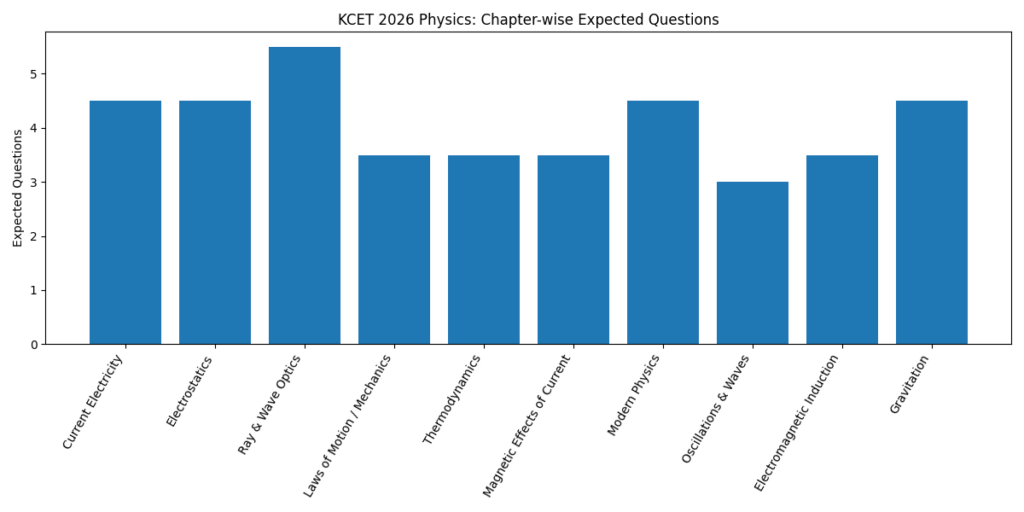
Knowing the subject-wise expected questions in KCET 2026 helps candidates focus on the most important chapters during preparation. Each subject in the KCET exam includes 60 questions, and some topics usually appear more frequently based on previous exam trends. The sections below show the important chapters and the expected number of questions from each subject:
Physics
The table below highlights the important Physics chapters along with the expected number of questions that may appear in the KCET exam:
| Chapter | Expected Questions |
|---|---|
| Current Electricity | 4–5 |
| Electrostatics | 4–5 |
| Ray & Wave Optics | 5–6 |
| Laws of Motion / Mechanics | 3–4 |
| Thermodynamics | 3–4 |
| Magnetic Effects of Current | 3–4 |
| Modern Physics | 4–5 |
| Oscillations & Waves | 3 |
| Electromagnetic Induction | 3–4 |
| Gravitation | 4–5 |
Chemistry
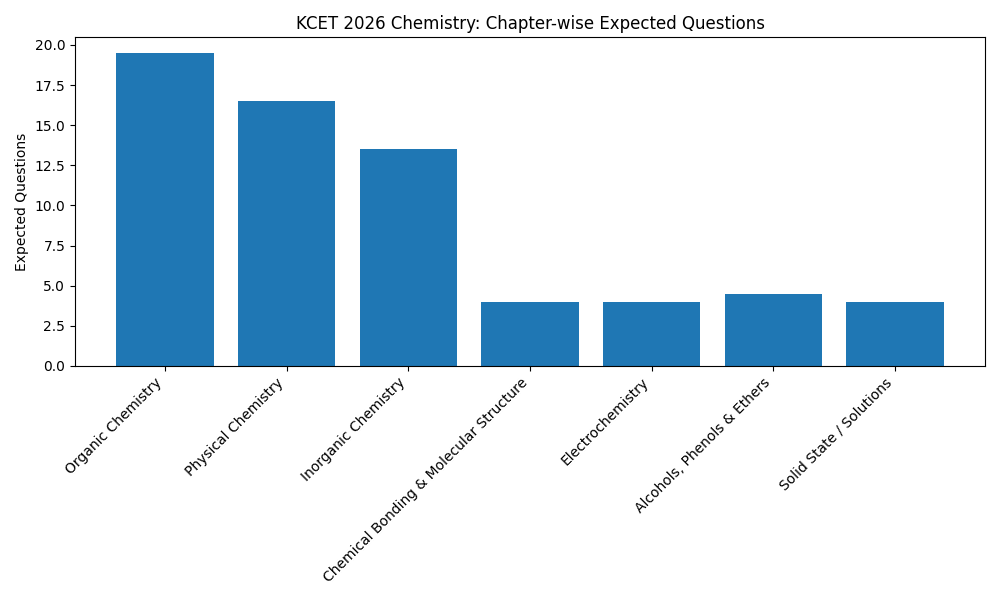
Chemistry section generally includes questions from Organic, Physical, and Inorganic Chemistry. The table below provides an overview of important Chemistry chapters along with their expected question count in the exam:
| Chapter | Expected Questions |
|---|---|
| Organic Chemistry (Hydrocarbons, Functional Groups, Biomolecules) | 18–21 |
| Physical Chemistry (Thermodynamics, Kinetics, Solutions) | 15–18 |
| Inorganic Chemistry (Periodic Table, Bonding, Coordination) | 12–15 |
| Chemical Bonding & Molecular Structure | 4 |
| Electrochemistry | 4 |
| Alcohols, Phenols & Ethers | 4–5 |
| Solid State / Solutions | 4 |
Mathematics
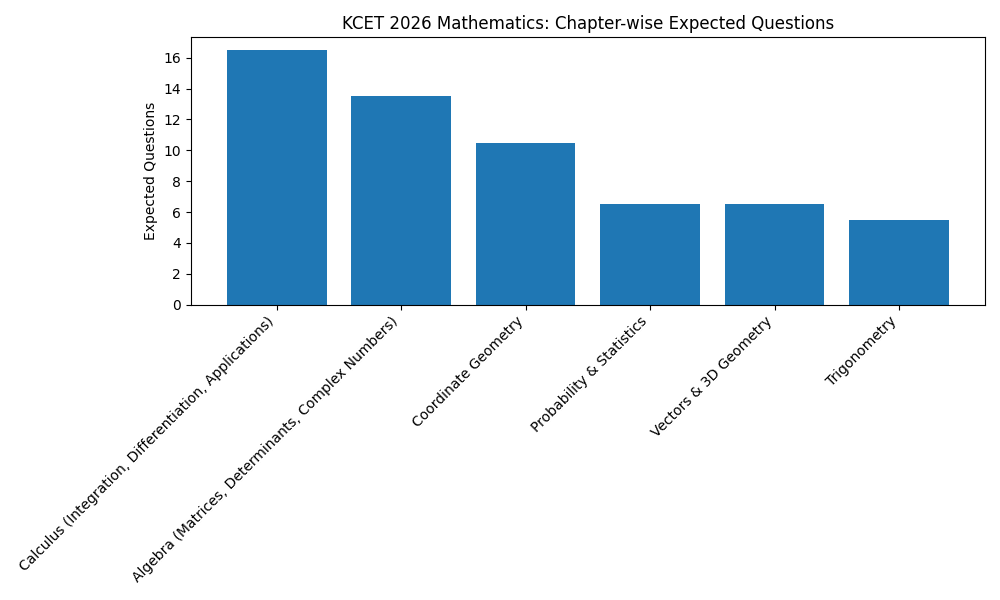
KCET Mathematics, topics from Calculus, Algebra, and Coordinate Geometry often dominate the question paper. The table below highlights the important Mathematics chapters and the expected number of questions from each topic:
| Chapter | Expected Questions |
|---|---|
| Calculus (Integration, Differentiation, Applications) | 15–18 |
| Algebra (Matrices, Determinants, Complex Numbers) | 12–15 |
| Coordinate Geometry | 9–12 |
| Probability & Statistics | 6–7 |
| Vectors & 3D Geometry | 6–7 |
| Trigonometry | 5–6 |
Biology
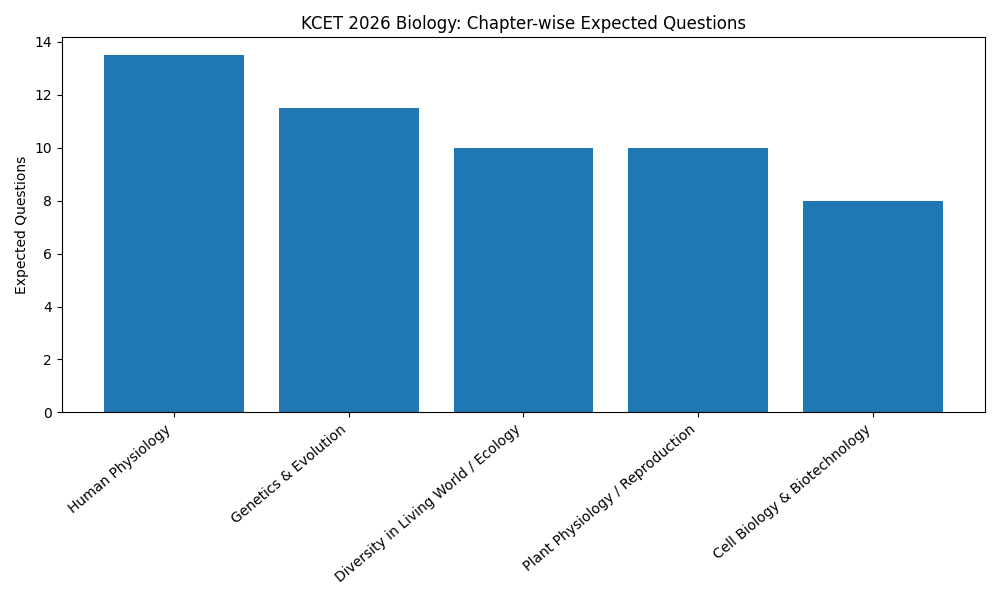
In Biology, Human Physiology, Genetics & Evolution are given more weightage compared to other chapters. Apart from this, candidates can refer to the section below for detailed information about the expected questions from Biology.
| Chapter | Expected Questions |
|---|---|
| Human Physiology | 12–15 |
| Genetics & Evolution | 11–12 |
| Diversity in Living World / Ecology | 9–11 |
| Plant Physiology / Reproduction | 9–11 |
| Cell Biology & Biotechnology | 7–9 |
KCET Syllabus 2026
The KCET exam pattern is closely linked with the syllabus prescribed by KEA. The syllabus is based on the First and Second PUC curriculum of Karnataka. Subjects included in KCET 2026 are:
- Physics
- Chemistry
- Mathematics
- Biology
A detailed insight intoKCET Syllabus 2026 has been presented through the table below:
| Physics | Chemistry | Mathematics | Biology |
|---|---|---|---|
| Physical World | Some Basic Concepts of Chemistry | Sets, Relations, and Functions | The Living World |
| Units and Measurements | Structure of an Atom | Trigonometric Functions | Biological Classification |
| Motion in a Straight Line | Classification of Elements and Periodicity in Properties | Principle of Mathematical Induction | Morphology of Flowering Plants |
| Motion in a Plane | Chemical Bonding and Molecular Structure | Complex Numbers and Quadratic Equations | Anatomy of Flowering Plants |
| Laws of Motion | States of Matter: Gases and Liquids | Linear Inequalities | Structural Organisation in Animals |
| Work, Energy and Power | Thermodynamics | Permutations and Combinations | Cell – The Unit of Life |
| System of Particles and Rotational Motion | Equilibrium | Binomial Theorem | Biomolecules |
| Gravitation | Redox Reactions | Sequences and Series | Cell Cycle and Cell Division |
| Mechanical Properties of Solids | Hydrogen | Straight Lines | Transport in Plants |
| Mechanical Properties of Fluids | s-Block Elements | Conic Sections | Mineral Nutrition |
| Thermal Properties of Matter | Some p-Block Elements | Introduction to Three-Dimensional Geometry | Photosynthesis in Higher Plants |
| Thermodynamics | Organic Chemistry: Some Basic Principles and Techniques | Limits and Derivatives | Respiration in Plants |
| Kinetic Theory of Gases | Hydrocarbons | Relations and Functions | Plant Growth and Development |
| Electric Charges and Fields | Solid State | Inverse Trigonometric Functions | Digestion and Absorption |
| Electrostatic Potential and Capacitance | Solutions | Matrices | Breathing and Exchange of Gases |
| Current Electricity | Electrochemistry | Determinants | Body Fluids and Circulation |
| Moving Charges and Magnetism | Chemical Kinetics | Continuity and Differentiability | Excretory Products and Their Elimination |
| Magnetism and Matter | Surface Chemistry | Applications of Derivatives | Locomotion and Movement |
| Electromagnetic Induction | General Principles and Processes of Isolation of Elements | Integrals | Neural Control and Coordination |
| Alternating Current | p-Block Elements | Applications of Integrals | Chemical Coordination and Integration |
| Electromagnetic Waves | d- and f-Block Elements | Differential Equations | Animal Kingdom |
| Ray Optics and Optical Instruments | Coordination Compounds | Vector Algebra | Plant Kingdom |
| Wave Optics | Haloalkanes and Haloarenes | Three-Dimensional Geometry | – |
| Dual Nature of Radiation and Matter | Alcohols, Phenols and Ethers | Linear Programming | – |
| Atoms | Aldehydes, Ketones and Carboxylic Acids | Mathematical Reasoning | – |
| Nuclei | Organic Compounds Containing Nitrogen | Probability | – |
| – | Biomolecules | – | – |
| – | Polymers | – | – |
| – | Chemistry in Everyday Life | – | – |
| – | Environmental Chemistry | – | – |
KCET Exam Pattern 2026: Important Points to Remember
For KCET 2026 aspirants, understanding a few important insights about the exam pattern and recent trends can help in preparing more effectively. Based on previous years’ analysis, the following key points should be kept in mind:
- The KCET exam is conducted in offline (pen-and-paper) mode using an OMR answer sheet.
- Each subject paper is conducted for 80 minutes.
- There are 60 questions in each subject, making a total of 180 questions in the exam.
- The total marks for KCET are 180, with 1 mark awarded for each correct answer.
- There is no negative marking, which leads to a higher attempt rate of around 90–95% per paper, compared to exams like JEE where the attempt rate is lower.
- Questions from 1st PUC syllabus are generally straightforward, while 2nd PUC questions are usually more application-based.
- In Physics, topics like Gravitation have appeared frequently in recent papers.
- In Mathematics, topics such as Vectors and 3D Geometry often show higher error rates among candidates.
Conclusion
KCET Exam Pattern 2026 is simple and student-friendly. The exam includes three papers i) Physics, ii) Chemistry, and iii) Mathematics or Biology, with 60 questions in each subject and a total of 180 marks. Since there is no negative marking, candidates can attempt more questions without worrying about losing marks.
To perform well in KCET 2026, students should clearly understand the exam pattern, marking scheme, and important chapters. Regular practice, focusing on high-weightage topics, and solving previous year papers can help improve both speed and accuracy in the exam
Frequently Asked Questions
1. What is the KCET exam pattern 2026?
The KCET Exam Pattern 2026 includes three papers: Physics, Chemistry, and Mathematics/Biology. Each paper has 60 multiple-choice questions and carries 60 marks. The exam is conducted in offline (pen-and-paper) mode, and each paper lasts for 80 minutes.
2. Is there negative marking in KCET 2026?
No, there is no negative marking in KCET 2026. Candidates receive 1 mark for each correct answer, and no marks are deducted for incorrect responses.
3. What are the total marks in KCET 2026?
The total marks in KCET 2026 are 180. Each subject carries 60 marks, and the total score is calculated based on the combination of subjects relevant to the course stream.
4. What is the duration of the KCET exam?
Each paper in the KCET exam is conducted for 1 hour 20 minutes (80 minutes). Since there are three papers, the total exam duration is 3 hours and 20 minutes.
5. What is the KCET exam pattern and syllabus?
The KCET exam pattern and syllabus are based on the First-Year and Second-Year PUC curriculum of Karnataka. The exam covers topics from Physics, Chemistry, Mathematics, and Biology.
6. What is the official website for KCET exam pattern 2026?
The official website for checking the KCET exam pattern 2026 is cetonline.karnataka.gov.in/kea, where candidates can also find updates on syllabus, admit card, and exam dates.
7. When will KCET 2026 be conducted?
According to the latest schedule, the KCET 2026 exam will be conducted on April 23 and April 24, 2026 in multiple sessions.
8. What is the subject-wise paper pattern in KCET 2026?
In KCET 2026, each subject paper includes 60 objective questions, each carrying 1 mark. The subjects include Physics, Chemistry, Mathematics (for engineering aspirants), and Biology (for pharmacy/agriculture aspirants).