
Summarise With AI



Table of Contents
The Kerala Engineering Architecture Medical Entrance Examination (KEAM) is a major state-level entrance test for students aiming to secure admission to leading engineering colleges in Kerala. Candidates from the engineering stream can review the overall difficulty level, subject-wise analysis, expected marks, and safe score through the KEAM Paper Analysis 2026 for 17th April.
KEAM 2026 for the Engineering stream is scheduled from 2:00 PM to 5:00 PM on 17th April 2026. Students are advised to reach their allotted exam centres by 12:00 PM to complete entry procedures smoothly and avoid any last-minute inconvenience. Entry to the examination hall will not be permitted once the test begins.
The KEAM 2026 exam analysis for 19th April is now available for students in CollegeDost who appeared in the afternoon shift. This detailed KEAM paper analysis covers subject-wise difficulty, student reactions, and memory-based questions. Candidates can use this analysis to estimate their KEAM 2026 expected marks and compare their performance before the official result is declared.
You can check all the KEAM Paper Analysis of the previous shifts here:
KEAM Paper Analysis 2026 Highlights
Here is a quick overview of the KEAM 2026 exam held on 19th April. The table below summarises the key details of the paper for candidates’ reference.
| Particulars | Details |
|---|---|
| Exam Name | Kerala Engineering Architecture Medical Entrance Examination |
| Conducting Body | CEE Kerala |
| Exam Shift Date | 19th April 2026 |
| Exam Time | 2 PM to 5 PM |
| Mode of Exam | Computer-Based Test |
| Medium of Language | English |
| Subjects | Physics, Chemistry, Mathematics |
| Duration | 3 hours (180 mins) |
| Total no. of questions per paper | 150 |
| Total marks per paper | 600 |
| Marking Scheme | +4 for correct –1 for incorrect |
| Questions Per Subjects (Engineering) | Mathematics: 75 Physics: 45 Chemistry: 30 |
| Official Website | CEE Kerala |
KEAM 2026 Paper Analysis: Subject-wise Analysis
The subject-wise KEAM 2026 exam analysis gives candidates a clear picture of how each section was structured and what topics carried more weight. Based on student feedback and memory-based inputs, here is the difficulty level and topic distribution across all three subjects of the KEAM question paper 2026. Based on the KEAM Paper Analysis, 19th April 2026, students can check the most asked topics.
| Subject | Difficulty Level | Topics Asked |
|---|---|---|
| Physics | Difficult | Modern Physics and Dual Nature of Matter, Kinematics and Mechanics, Current Electricity and Circuits |
| Chemistry | Moderate | Organic Chemistry Reactions and Conversions, Coordination Compounds and d-block Elements, Solutions and Colligative Properties |
| Mathematics | Easy But Lengthy | Integration and Calculus, Permutations, Combinations, and Probability, Inverse Trigonometric Functions |
| Overall Difficulty | Moderate | |
What Were the Most Important Topics Mentioned for Each Subject?
Understanding which topics carry more weight in the KEAM exam question paper can help future candidates plan their preparation better. Here is a subject-wise breakdown of high-weightage and low-weightage areas observed in the 19th April paper.
| Subjects | Prominent Topics or High Weightage | Fewer Questions |
|---|---|---|
| Mathematics | Integration 3D Geometry | Functions Sets and Relations |
| Physics | Mechanics Gravitation (Note: Topic distribution feedback was mixed; some found it balanced, while others felt it leaned heavily towards first-year or second-year topics.) | None specifically mentioned |
| Chemistry | Inorganic Chemistry Physical Chemistry (a few questions) | Organic Chemistry Complex, mechanism-based questions |
Memory-Based Questions For KEAM Paper Analysis 2026, 19th April
The following are memory-based questions from the KEAM 2026 exam held on 19th April, as recalled by students who appeared for the test. These questions are part of the KEAM paper analysis and cover the Chemistry and Physics sections. Candidates can get a better understanding of the KEAM 2026 difficulty level and question pattern.
Chemistry
Q1. Which of the following is a didentate ligand?
A) en
B) cyanido
C) Ammine
D) EDTA
E) Chloro
Answer: A) en
Q2. Glucose reacts with conc. HNO₃ (Nitric acid) to give:
A) Gluconic Acid
B) Saccharic Acid
C) Sorbitol
D) Fructose
Answer: B) Saccharic Acid
Q3. Oxidation state of C and H in CH₄ are respectively:
A) +4, -1
B) -4, +1
C) 0, +1
D) -2, 0
Answer: B) -4, +1
Q4. Hybridisation of [Ni(CN)₄]²⁻ is:
A) dsp³
B) sp³d
C) dsp²
D) d²sp³
Answer: C) dsp²
Q5. The common name of propanedioic acid is:
A) Saccharic acid
B) Adipic acid
C) Malic acid
D) Glutaric acid
E) Malonic acid
Answer: E) Malonic acid
Q6. Bond order of NO⁺ is:
A) 1
B) 3
C) 2
D) 0
Answer: B) 3
Physics
Q1. If the orbital radius of a geostationary satellite decreases, the gravitational potential energy:
A) Increases
B) Decreases
C) Remains same
Answer: B) Decreases
Q2. A ball falls from a height of 20 m and then bounces back up to 17 m height. What is the loss of energy?
Answer: Loss of energy = mg(20−17)=3mgmg(20 – 17) = 3mgmg(20−17)=3mg joules
Q3. A body of mass ‘m’ is acted upon by two perpendicular forces 4 N and 3 N. Find the mass ‘m’ if the acceleration of the body is 2 m/s².
Answer: m=2.5kg
Q4. Potential difference between two points in a region having a uniform electric field of 800 N/C is 16 V. Find the distance between the two points.
Answer:
Distance = 2 cm
Q5. In Young’s double slit experiment with a wavelength of 500 nm, a slit separation of 0.2 mm, and a distance between the slit and the screen of 2 m. Find fringe width.
Answer: Fringe width = 5 mm
What are the Students’ Reactions of KEAM 2026 19th April Exam?
As per students who appeared for the KEAM 2026 exam on 19th April, the overall paper was a mixed experience across the three sections. While Physics and Chemistry came as a relief with their straightforward and NCERT-based questions, Mathematics once again proved to be the biggest challenge of the day. As reported by many candidates, the KEAM 2026 difficulty level for Maths was high, not necessarily because the questions were conceptually tough, but due to the sheer volume of calculations involved.
This is consistent with the feedback received from students on the previous days of the exam. Overall, as per students, the paper followed a similar pattern to earlier sessions, with Mathematics continuing to be the most time-consuming section of the KEAM 2026 question paper.
Mathematics
- Students consistently reported that the Mathematics section was lengthy and highly time-consuming, which continued the trend observed in the first two days of the exam.
- The questions required a lot of calculations and were not as quick to solve as in previous years.
- Because of the time constraints, some students mentioned they were unable to even read the last 5 to 6 questions.
- A significant number of questions came from topics like Integration and 3D Geometry.
- Conversely, there were fewer questions from areas like Functions, Sets, and Relations.
Physics
- The Physics section was generally considered easy and quick to complete.
- Most questions were straightforward and could be solved just by directly applying standard equations.
- Students had mixed feedback regarding the topic distribution. Some felt the questions were well-balanced between first-year and second-year topics.
- Others felt there was a heavier focus on first-year topics like Gravitation, Mechanics, or specifically second-year topics.
Chemistry
- Chemistry was widely perceived as easy and strictly based on the NCERT syllabus.
- Students noted a clear reduction in Organic Chemistry questions, and there were no complex mechanism-based questions.
- The section heavily featured Inorganic Chemistry, along with a few questions from Physical Chemistry.
KEAM 2026 Answer Key and Response Sheet
The KEAM 2026 Answer Key will be released by the Commissioner for Entrance Examinations (CEE), Kerala. It will be published on the official website after the exam ends. Students who took the KEAM entrance exam can download the provisional answer key. This helps them check their responses and estimate their scores early.
The KEAM question paper will have multiple sets. The answer key will cover all sets. Along with this, the KEAM 2026 response sheet will also be available. It shows the answers each candidate marked during the exam. By comparing both, students can calculate their expected marks in KEAM and understand how they performed.
Check the KEAM Answer Key 2026
If a student spots any error in the provisional key, they can raise an objection. This must be done within the given deadline. Students need to submit supporting documents and pay the required fee.
After reviewing all objections, CEE will release the final KEAM 2026 answer key. This final key is used to prepare the official result.
KEAM Exam Pattern 2026
The KEAM exam pattern plays a key role in how candidates plan their time and preparation strategy. Knowing the number of questions, the marks distribution, and the subject weightage helps students approach the KEAM exam model question paper more effectively.
| Subjects | No. of Questions | Marks Per Question | Total Marks | Weightage (%) |
|---|---|---|---|---|
| Mathematics | 75 | 4 | 300 | 50% |
| Physics | 45 | 4 | 180 | 30% |
| Chemistry | 30 | 4 | 120 | 20% |
| Total | 150 | — | 600 | 100% |
How is the KEAM Rank Calculated?
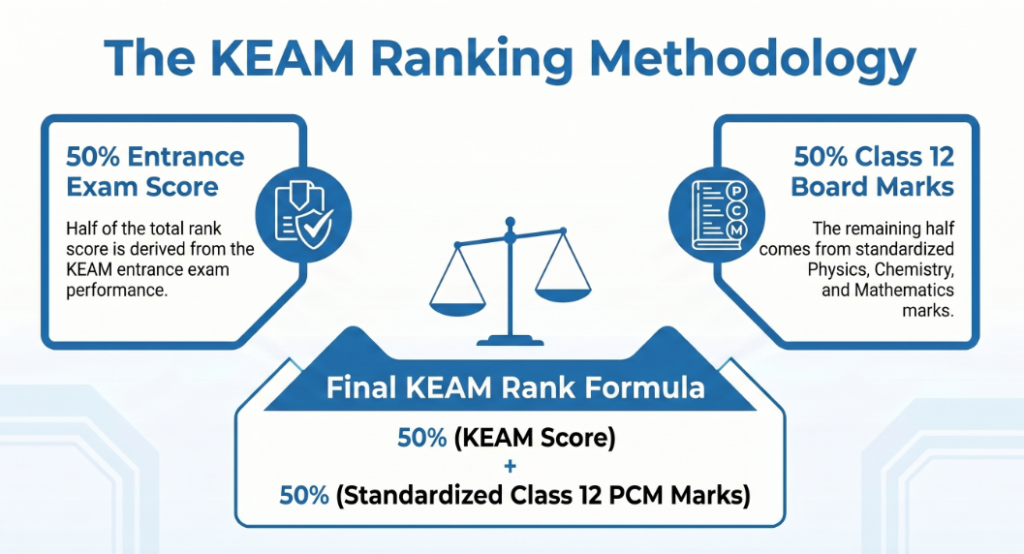
The KEAM rank analysis is based on two key components, the entrance exam score and Class 12 board marks. To prepare the final rank, equal weightage is given to both. This means 50% of the score comes from the KEAM entrance exam performance, and the remaining 50% comes from board marks in Physics, Chemistry, and Mathematics (after standardisation). Students must keep this formula in mind when calculating their KEAM expected marks and predicting where they might stand in the KEAM result analysis.
Final KEAM Rank = 50% (KEAM Score) + 50% (Standardised Class 12 PCM Marks)
Expected KEAM 2026 Marks v/s Ranks
The table below gives a rough estimate to help students understand the safe score for KEAM 2026 and where they may stand in the KEAM rank analysis. These figures are based on past trends, including KEAM 2025 cut-offs, and are indicative in nature.
| KEAM Score (Boards + KEAM exam) after standardisation | KEAM 2026 Ranks expected |
|---|---|
| 550+ | 1 to 5000 |
| 450+ | 5001 to 20000 |
| 350+ | 20001 to 50000 |
| 250 and below | 50000+ |
How did the KEAM 2026 exam compare to previous years’ papers?
Students had varying but largely consistent views when comparing the KEAM 2026 exam to previous years’ papers, with the biggest difference noted in the time required to complete the test.
The most significant change was in the Mathematics section, which students found to be much longer and more time-consuming than in previous years. While previous years’ math questions were generally simpler and could be solved very quickly, this year’s questions required significantly more time for calculations. Some students noted that they did not expect such lengthy questions to appear in the KEAM exam.
When it came to the overall difficulty of the exam, student opinions were slightly mixed:
- Many students felt the exam was tougher and required more time compared to last year’s relatively simple paper.
- Some students felt that the exam generally maintained the same level of difficulty as previous years.
- A few students actually found this year’s exam to be easier than previous years’ papers and their practice modules.
According to the KEAM paper analysis of 2026, as the length of the math section is increased, students recommended that candidates relying on previous years’ papers for practice should adjust their strategy by practising higher-level, more time-consuming questions to better manage their time.
How To Prepare For Upcoming KEAM Exams?
Preparing effectively for the KEAM entrance exam requires a focused and structured approach. Here are some practical tips based on this year’s paper trends:
- Prioritise Mathematics: Since it holds 50% weightage in the exam pattern, and also according to the KEAM paper analysis 2026, students are facing difficulty in Maths. Focus on Integration, 3D Geometry, and Calculus.
- Solve KEAM previous year question papers: Practising the KEAM previous year question papers helps you understand the question style and manage time better.
- Follow NCERT for Chemistry: As seen in this year’s KEAM exam question paper, Chemistry was largely NCERT-based. A thorough reading of the NCERT is sufficient for scoring well.
- Revise Physics formulas daily: Most Physics questions can be solved by direct application of standard equations. Build a formula sheet and revise it regularly.
- Take timed mock tests: Use the KEAM exam model question paper to simulate real exam conditions and improve speed and accuracy. Candidates can practice the Collegedost KEAM mock test.
KEAM 2026 Exam Day Guidelines
Being well-prepared on exam day is just as important as academic preparation. Here are the key guidelines for candidates appearing in the KEAM 2026 exam:
- Carry a valid admit card and government-issued photo ID to the exam centre.
- Report to the centre at least 30–45 minutes before the scheduled exam time.
- Electronic devices, calculators, and smartwatches are strictly prohibited inside the exam hall.
- Read all instructions on the screen carefully before beginning the KEAM question paper.
- Manage your time wisely, given that the KEAM maths question paper tends to be lengthy; avoid spending too long on a single question.
- Attempt all questions you are confident about first, then return to the difficult ones.
- Do not leave questions unattempted if you have a reasonable guess, but be cautious of the 1 negative marking.
Conclusion
The KEAM paper analysis 2026 for 19th April reflects a moderately challenging paper overall, with Mathematics being the toughest section due to its length and calculation-heavy questions. Physics and Chemistry were manageable and largely straightforward. Candidates can use the memory-based questions, expected marks vs rank table, and subject-wise analysis provided here to estimate their performance. Staying updated with the KEAM 2026 answer key and KEAM result analysis will help students plan their next steps effectively.
Frequently Asked Questions
1. Did the students find the questions strictly NCERT-based?
Yes, students explicitly stated that the questions were deeply rooted in the NCERT syllabus.
Specifically for Physics and Chemistry, students noted that there were many strictly NCERT-based questions and found them highly manageable to solve. The presence of NCERT concepts was so prominent that one student even suggested that preparing just by studying the NCERT textbook along with previous years’ questions would be sufficient.
2. What are the qualifying marks for the Engineering stream of KEAM 2026?
Candidates who do not attempt at least one question will be disqualified and will not be included in the Engineering Rank List. To be eligible for the rank list, a candidate must score a minimum normalised score of 10 in the KEAM Engineering Entrance Examination.
Exemption: SC/ST candidates are not required to secure a minimum score. However, they must attempt at least one question to avoid disqualification.
3. What is the overall difficulty level of the KEAM Paper Analysis 2026 on 19th April?
As per the students, the KEAM 2026 difficulty level was moderate overall. Physics and Chemistry were easy to moderate, while Mathematics was lengthy and time-consuming.
4. Which section was the toughest in the KEAM 2026 paper?
Mathematics was considered the most challenging section, not due to concept difficulty but because of the lengthy calculations involved in the KEAM maths question paper.
5. What is the safe score for KEAM 2026 to get into a government college?
Based on KEAM 2025 cut-offs, a combined score (entrance + board) of around 450 and above is generally considered a safe score for government engineering colleges in Kerala.
6. Can I raise an objection against the KEAM 2026 provisional answer key?
Yes. If a candidate finds any discrepancy in the provisional answer key, they can raise a formal objection within the deadline by submitting supporting documents and paying the required fee.