
Summarise With AI



The KEAM syllabus 2026 is one of the most crucial factors to analyse before applying for the KEAM 2026, while the KEAM syllabus 2025 acts as an important reference point for students who are soon going to appear for the Kerala Engineering Architecture Medical (KEAM) entrance exam.
The KEAM 2026 syllabus clearly defines the subjects and topics from which the questions are going to be asked in the exam. Prescribed by the Office of the Commissioner for Entrance Examinations (CEE), the KEAM syllabus 2026 follows a well-defined and standardised structure.
The KEAM exam syllabus is based on the Class 11 and 12 curriculum of Kerala Higher Secondary Education and remains aligned with NCERT guidelines followed across India. The KEAM syllabus 2026 for engineering is divided into three major subjects: Physics, Chemistry, and Mathematics. Students may refer to the following to go through the complete KEAM syllabus 2026.
Also Read: How to Prepare for KEAM? Subject-Wise Tips Here
KEAM Syllabus 2026 Overview
Check out the following table to get a brief overview of the KEAM 2026 syllabus.
| Subject | Key Topics Covered |
|---|---|
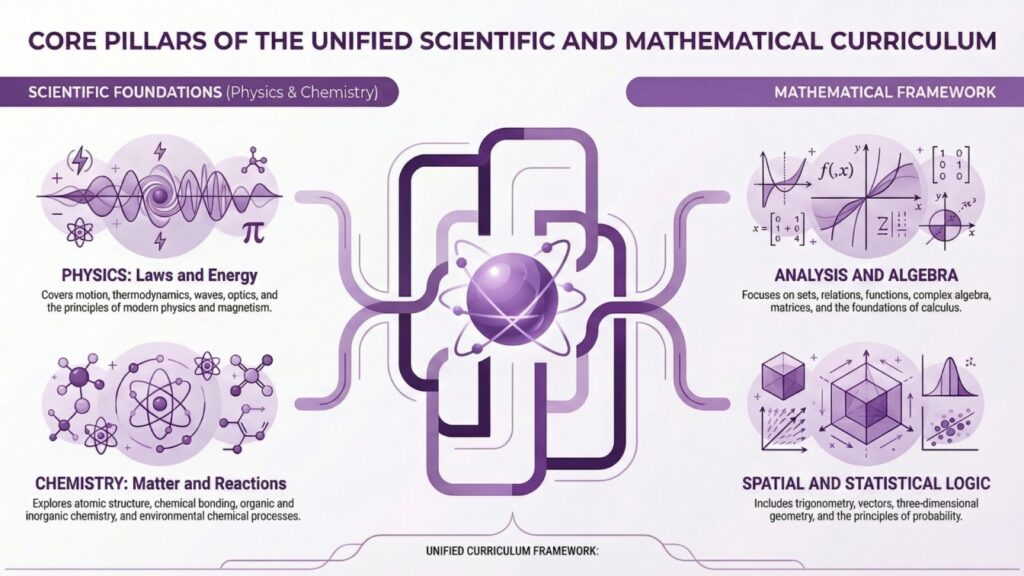
| Physics | Units & Measurements, Motion, Laws of Motion, Work Energy & Power, Thermodynamics, Waves, Optics, Electrostatics, Current Electricity, Magnetism, Modern Physics |
| Chemistry | Atomic Structure, Periodic Table, Chemical Bonding, Thermodynamics, Electrochemistry, Organic Chemistry (Hydrocarbons, Alcohols, Aldehydes), Inorganic Chemistry, Polymers, Environmental Chemistry |
| Mathematics | Sets & Relations, Functions, Trigonometry, Algebra, Matrices & Determinants, Calculus, Vectors, Three-Dimensional Geometry, Probability |
KEAM Syllabus | Detailed Engineering Syllabus 2026
Students can go through the detailed KEAM syllabus 2026 for each subject of the Engineering paper below. Students are provided with the topics and their respective units as well to make things clear.
Physics:
Check out the KEAM syllabus 2026 for phsyics below:
- Units & Measurement: Need for measurement, systems of units, SI units, fundamental and derived units, significant figures, dimensional analysis and its applications.
- Kinematics: Motion in a straight line, velocity and acceleration, graphical representation of motion, uniformly accelerated motion, vectors, and projectile motion.
- Laws of Motion: Force and inertia, Newton’s laws of motion, momentum and impulse, equilibrium of forces, friction, and circular motion.
- Work, Energy & Power: Work done by constant and variable forces, different forms of energy, conservation of energy, and power.
- Motion of System of Particles & Rigid Body: Centre of mass, torque, angular momentum, rotational motion, and moments of inertia.
- Gravitation: Universal law of gravitation, Kepler’s laws, gravitational field and potential, escape velocity, and motion of satellites.
- Properties of Matter: Stress and strain, elastic behaviour of materials, elastic moduli, pressure in fluids, viscosity, and surface tension.
- Heat & Thermal Physics: Temperature and heat, modes of heat transfer, thermal expansion, calorimetry, and laws of thermodynamics.
- Oscillations & Waves: Simple harmonic motion and basic characteristics of wave motion.
- Electrostatics: Electric charges, electric field and potential, and basic concepts of capacitors.
- Current Electricity: Electric current, resistance, Ohm’s law, and basic electrical circuit concepts.
- Magnetism & Electromagnetic Induction: Magnetic effects of electric current, electromagnetic induction, and basic concepts of alternating current.
- Optics: Laws of reflection and refraction, and basic concepts of mirrors and lenses.
- Modern Physics: Dual nature of matter, atoms and nuclei, and basic electronic devices.
Mathematics:
Check out the KEAM Maths syllabus below:
- Algebra: Sets, relations and functions, complex numbers, quadratic equations, sequences and series, permutations and combinations, and the binomial theorem.
- Matrices & Determinants: Matrix operations, determinants, inverse of a matrix, and solving systems of linear equations (up to 3×3).
- Linear Inequalities: Solutions of linear inequalities and their graphical representation.
- Coordinate Geometry: Straight lines, distance formula, and section formula.
- Conic Sections: Basic concepts of circle, parabola, ellipse, and hyperbola.
- Vectors: Vector addition, scalar and vector products, and their applications.
- Three-Dimensional Geometry: Coordinates in three dimensions, distances, equations of lines and planes, and skew lines.
- Trigonometry: Trigonometric functions, identities, and inverse trigonometric functions.
- Functions, Limits & Continuity: Concept of functions, limits, and continuity of standard functions.
- Differentiation & Applications: Derivative concepts, rates of change, and applications such as maxima and minima.
- Integration: Indefinite and definite integrals, area under curves, and methods of substitution and integration by parts.
- Differential Equations: First-order differential equations and separable equations.
- Linear Programming: Constraints, objective functions, and graphical solutions.
- Statistics & Probability: Mean deviation, variance, standard deviation, basic probability rules, and Bayes’ theorem.
Chemistry:
Check out the KEAM Chemistry syllabus below:
- Basic Concepts of Chemistry: Importance and scope of chemistry, laws of chemical combination, atomic and molecular masses, mole concept, and stoichiometry.
- Structure of an Atom: Subatomic particles, atomic models, quantum numbers, and electronic configuration of atoms.
- Classification of Elements & Periodicity: Development of the periodic table and periodic trends in physical and chemical properties.
- Chemical Bonding & Molecular Structure: Ionic and covalent bonding, Lewis structures, and concepts of hybridisation.
- Thermodynamics: System and surroundings, heat and work, laws of thermodynamics, and enthalpy changes.
- Equilibrium: Chemical and physical equilibrium, Le Chatelier’s principle, ionic equilibrium, and buffer solutions.
- Redox Reactions & Electrochemistry: Oxidation–reduction reactions, electrochemical cells, Faraday’s laws, and basic concepts of corrosion.
- Solutions: Types of solutions, concentration terms, and colligative properties.
- Chemical Kinetics: Rate of reaction, order and molecularity, and collision theory.
- D-Block & F-Block Elements: Basic properties of transition metals, lanthanoids, and actinoids.
- Coordination Compounds: Ligands, coordination number, and basic rules of nomenclature.
- Organic Chemistry – Fundamentals: Basic principles of organic chemistry and classification of organic reactions.
- Hydrocarbons: Structure, properties, and reactions of alkanes, alkenes, and alkynes.
- Haloalkanes & Haloarenes: Structure and reactions of haloalkanes and haloarenes.
- Alcohols, Phenols & Ethers: Properties and reactions of alcohols, phenols, and ethers.
- Aldehydes, Ketones & Carboxylic Acids: Chemistry of carbonyl compounds and carboxylic acids.
- Organic Compounds with Nitrogen: Amines and other nitrogen-containing organic compounds.
- Biomolecules: Basic concepts of carbohydrates, proteins, and vitamins.
KEAM Important Topics 2026
Students can go through the highest-weightage and important KEAM syllabus 2026 topics below for each section of the exam, including Physics, Math & Chemistry.
KEAM Physics Important Topics
Refer to the following table to check out all the highest-weightage and important physics units and topics as per the KEAM entrance exam syllabus.
| Unit | Key Topics |
|---|---|
| Mechanics | Motion, work, energy, power |
| Laws of Motion | Newton’s laws, friction, circular motion |
| Gravitation | Universal law, satellites, Kepler’s laws |
| Properties of Matter | Elasticity, viscosity, surface tension |
| Thermodynamics & Kinetic Theory | Laws of thermodynamics, kinetic theory of gases |
| Oscillations & Waves | Simple harmonic motion, sound waves |
| Electrostatics | Electric charges, electric field, potential |
| Current Electricity | Ohm’s law, electrical circuits, resistance |
| Magnetism & EM Induction | Magnetic effects, electromagnetic induction |
| Optics | Reflection, refraction, lenses, mirrors |
| Modern Physics | Atomic structure, nuclei, photoelectric effect |
KEAM Math Important Topics
The following table contains all the important topics for the Math section of the exam as per the KEAM syllabus 2026.
| Unit | Key Topics |
|---|---|
| Algebra | Sets, relations, functions |
| Complex Numbers & Quadratics | Complex numbers, quadratic equations |
| Sequences & Series | Arithmetic and geometric progression |
| Permutations & Combinations | Fundamental counting principles |
| Matrices & Determinants | Matrix operations, determinants |
| Linear Inequalities | Graphical solutions |
| Coordinate Geometry | Lines, circle, parabola, ellipse, hyperbola |
| Trigonometry | Functions, identities, inverse functions |
| Vectors & 3D Geometry | Vector algebra, three-dimensional geometry |
| Calculus | Limits, continuity, differentiation, applications |
| Integration | Indefinite and definite integrals, area under curves |
| Differential Equations | First-order differential equations |
| Probability & Statistics | Mean, variance, standard deviation |
| Linear Programming | Graphical solutions |
KEAM Chemistry Important Topics
Check out the following table to go through all the highest-weightage and important chemistry units and topics as per the KEAM engineering syllabus.
| Unit | Key Topics |
|---|---|
| Atomic Structure | Atomic models, quantum numbers, electron configuration |
| Periodic Table & Periodicity | Periodic trends in properties |
| Chemical Bonding | Bonding theories, molecular structure |
| Equilibrium | Chemical and ionic equilibrium |
| Thermodynamics | Thermodynamics and energetics |
| Electrochemistry | Electrochemical cells, conductivity, redox reactions |
| Solutions | Colligative properties and concentration terms |
| Chemical Kinetics | Rate laws, molecularity |
| D-Block & F-Block Elements | Transition and inner transition elements |
| Coordination Compounds | Ligands, coordination number, nomenclature |
| Organic Chemistry Basics | General principles, hydrocarbons |
| Haloalkanes & Haloarenes | Structure and reactions |
| Alcohols, Phenols & Ethers | Properties and reactions |
| Aldehydes, Ketones & Acids | Carbonyl compounds and acids |
| Organic Nitrogen Compounds | Amines |
| Biomolecules | Carbohydrates, proteins, vitamins |
KEAM Exam Pattern 2026
Along with the KEAM syllabus 2026, applicants must check out the latest KEAM exam pattern 2026 to stay updated regarding the question paper design and prepare accordingly. Refer to the following to know the complete KEAM 2026 exam pattern.
- Exam mode: Pen and paper (offline)
- Total papers: 2
- Paper 1: Physics and Chemistry
- Paper 2: Mathematics
- Question type: Multiple Choice Questions (MCQs)
- Total questions: 180
- Marks per question: 4
- Negative marking: No
- Total marks: 480
- Duration: 2 hours and 30 minutes for each paper
- Medium of examination: English and Malayalam
KEAM Mock Test
A mock test in KEAM is a crucial step in exam preparation because it allows candidates to know the actual pattern of the exam, the level of difficulty of questions and the time management of time that they will need during the actual exam.
By attempting the KEAM mock tests on a regular basis, this enables the students to know how well they are prepared and to understand their strengths and weaknesses in Physics, Chemistry, and Mathematics and to become more accurate.
KEAM Mock tests are also used to reduce the tension on examination day since it introduces candidates to the examination environment, marking scheme and distribution of questions in the KEAM exam.
Advantages of KEAM Mock Test.
- Helps students learn the proper KEAM syllabus 2026
- Introduces the students to the pattern and structure of the KEAM exam.
- Enhances efficiency, precision and time management.
- Helps determine areas of weakness and strengths subject-wise.
- Improves question-selection and problem-solving.
- Develops self-esteem and lowers stress on examinations.
- Helps in proper revision and strategy of the examination.
Note: After the exam is over, students can analyse their performance with the KEAM rank predictor with the help of their estimated scores.
How to Prepare for KEAM 2026?
Check out the KEAM preparation tips below:
Learn the Syllabus Primarily
To start with the preparation, it is important to review the KEAM syllabus 2026 to understand which specific matters require preparation before you set up a new studying plan.
The KEAM syllabus 2025 can also assist you in grasping the continuity of topics and the repetitive patterns of concepts from previous exams.
Examine the Subject-Wise Structure
The KEAM 2026 syllabus has a clear presentation of how topics are separated in Physics, Chemistry, and Mathematics. An effective understanding of the KEAM syllabus 2026 will help you save time by avoiding irrelevant or out-of-scope exercises.
Plan Engineering-Specific Preparation
The KEAM exam syllabus is designed in a way that examines clarity of concepts and application-based problem-solving abilities. Engineering aspirants are required to adhere strictly to the KEAM syllabus 2026 for engineering to remain aligned with the exam pattern.
Strengthen Core Concepts
The KEAM engineering syllabus places high emphasis on numerical aptitude and analytical ability. Regular revision of the KEAM entrance exam syllabus helps improve retention and boosts confidence during the exam.
Plan According to Weightage
Knowing the KEAM syllabus weightage helps in prioritising high-scoring topics and managing preparation time effectively. Correlation with the KTU syllabus KEAM BTech may also provide an added advantage to students seeking admission to engineering colleges in Kerala.
Focus on Main Subjects
Clarity of concepts and numerical practice is essential during the study of the KEAM physics syllabus. Regular practice and formula revision are necessary to master the KEAM math syllabus. Equal attention to theory and reactions is required to score well in the KEAM chemistry syllabus.
KEAM Previous Year Questions
Aspirants can practice for the exam with the KEAM question papers below. KEAM previous year question papers will help students enhance their speed and accuracy for the examination.
| Question Paper Name | Download URL |
|---|---|
| KEAM 2025 Question Paper | Click Here |
| KEAM 2024 Question Paper | Click Here |
| KEAM 2023 Question Paper | Click Here |
| KEAM 2022 Question Paper | Click Here |
| KEAM 2021 Question Paper | Click Here |
Top Colleges Accepting KEAM Scores
Refer to the following to know some of the top colleges in Kerala accepting the KEAM scores.
- Government Engineering College, Thrissur (GEC Thrissur)
- Government Engineering College, Barton Hill
- Government Engineering College, Kozhikode
- TKM College of Engineering, Kollam
- Model Engineering College, Thrikkakara
- Rajiv Gandhi Institute of Technology (RIT), Kottayam
- Federal Institute of Science and Technology (FISAT), Angamaly
- Saintgits College of Engineering, Kottayam
- Mar Baselios College of Engineering and Technology, Thiruvananthapuram
- SCMS School of Engineering and Technology, Ernakulam
- LBS Institute of Technology for Women, Thiruvananthapuram
Conclusion
To sum it up, knowing the KEAM syllabus 2026 is the key to effective and dedicated preparation for the exam. A clear perception of the topic at the subject level can make the students plan better study, get rid of irrelevant material, and focus on the relevant ones.
Because the exam will be based on the concepts of Class 11 and 12, regular revision, periodic KEAM mock tests, and focus on high-weightage subjects can significantly enhance the performance.
The right strategy, good time management, and clear conceptual understanding of Physics, Chemistry and Mathematics can ensure that the candidates are well prepared to take the KEAM exam and maximise their chances of getting a good rank.
Frequently Asked Questions
Q1. Is the KEAM syllabus released officially every year?
Yes, the KEAM syllabus is stipulated by CEE and revised as necessary.
Q2. Are NCERT books enough to cover the KEAM syllabus 2026?
NCERT books are solid in foundation and are quite advisable to prepare.
Q3. Does the KEAM exam syllabus include deleted board topics?
In most cases, the syllabus is based on the Class 11 and 12 curriculum in place at the moment.
Q4. Is Mathematics compulsory for all KEAM candidates?
Yes, Mathematics is compulsory for those wishing to pursue engineering.
Q5. How important is syllabus weightage in KEAM preparation?
It assists candidates in focusing on high-scoring topics effectively.
Q6. Are numerical questions more common in the KEAM engineering syllabus?
Yes, the major focus is on numerical and application-based questions.
Q7. Can mock tests help in covering the KEAM entrance exam syllabus?
Yes, mock tests are useful in putting syllabus concepts to good use.
Q8. Does the KEAM syllabus 2026 for engineering change mid-year?
No, once released, the syllabus generally remains the same during the exam cycle.
Q9. Is the KEAM chemistry syllabus more theory-based or numerical?
It involves a balanced mix of theory, reactions, and conceptual questions.
Q10. Should students preparing for BTech focus on KTU-aligned topics?
Yes, focusing on KTU-oriented concepts is useful for engineering aspirants.