Summarise With AI


Table of Contents
WBJEE Exam Pattern 2026 has been released by the West Bengal Joint Entrance Examinations Board (WBJEEB) at wbjeeb.nic.in. WBJEE 2026 will be conducted in offline mode using an OMR sheet. The examination consists of two papers, i.e., Paper I for Mathematics and Paper II for Physics and Chemistry. The total duration of the exam is 4 hours, with 2 hours allocated to each paper. The question paper includes 155 multiple-choice questions, divided across three subjects. Each subject contains three categories of questions, and each category follows a different marking scheme. This article on WBJEE Exam Pattern 2026 will explore the subject-wise marking scheme, total marks, and more
WBJEE Exam Pattern 2026: Highlights
WBJEEB will administer WBJEE 2026 exam in PBT Mode. The exam will be conducted in two slots. For more details related to WBJEE Exam Pattern, candidates can refer to the table below:
| Particulars | Details |
|---|---|
| Exam Name | West Bengal Joint Entrance Examination (WBJEE) 2026 |
| Conducting Authority | West Bengal Joint Entrance Examinations Board (WBJEEB) |
| Exam Level | State-Level Entrance Exam |
| Mode of Exam | Offline (OMR-Based) |
| Papers | Paper I – Mathematics (11:00 AM – 1:00 PM)Paper II – Physics & Chemistry (2:00 PM – 4:00 PM) |
| Type of Questions | Multiple Choice Questions (MCQs) |
| Total Questions | 155 |
| Total Marks | 200 |
| Duration | 4 Hours (2 Hours per Paper) |
| Medium of Exam | English and Bengali |
| Mode of Evaluation | Optical Mark Recognition (OMR) |
WBJEE Exam Pattern 2026: Subject-Wise Breakdown
WBJEE 2026 question paper is divided into three subjects: Mathematics, Physics, and Chemistry. Each subject contains questions grouped into three categories (Category I, II, and III), with different marking schemes and levels of difficulty. Mathematics carries the highest weightage in the exam, while Physics and Chemistry have equal weightage. For a detailed subject-wise WBJEE Exam Pattern, candidates can refer to the section below:
Physics
Physics carries 40 questions and 50 marks in the WBJEE exam. The physics paper is divided into three categories based on the marking scheme.
| Category | No. of Questions | Marks per Question | Total Marks |
|---|---|---|---|
| Category I | 30 | 1 | 30 |
| Category II | 5 | 2 | 10 |
| Category III | 5 | 2 | 10 |
| Total | 40 | – | 50 |
Chemistry
Chemistry section in WBJEE follows a similar pattern to Physics. It contains 40 questions with a total weightage of 50 marks, divided into three categories with different marking rules.
| Category | No. of Questions | Marks per Question | Total Marks |
|---|---|---|---|
| Category I | 30 | 1 | 30 |
| Category II | 5 | 2 | 10 |
| Category III | 5 | 2 | 10 |
| Total | 40 | – | 50 |
Mathematics
Mathematics section has the highest weightage in the WBJEE exam, consisting of 75 questions carrying a total of 100 marks. Similar to other subjects, the questions are divided into three categories.
| Category | No. of Questions | Marks per Question | Total Marks |
|---|---|---|---|
| Category I | 50 | 1 | 50 |
| Category II | 15 | 2 | 30 |
| Category III | 10 | 2 | 20 |
| Total | 75 | – | 100 |
Check: WBJEE 2026 Registration
WBJEE Marking Scheme 2026
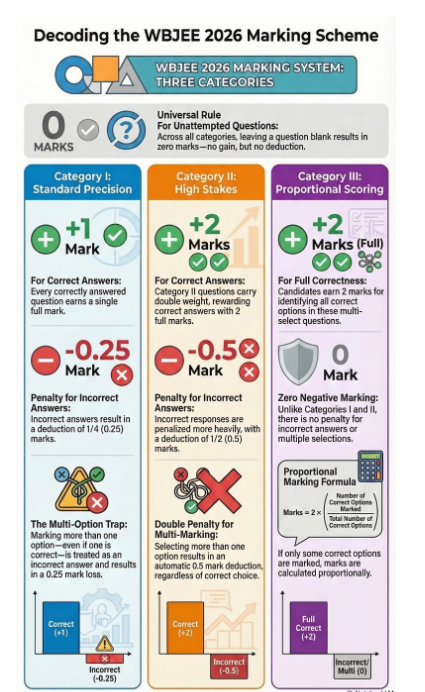
WBJEE follows a category-based marking system. Each category follows a different marking rule for correct and incorrect answers. Candidates should be aware of the negative marking rules while attempting the questions to avoid unnecessary loss of marks. Let’s have a look:
| Category | Correct Answer | Incorrect Answer | Unattempted | Special Case |
|---|---|---|---|---|
| Category I | +1 mark | -0.25 mark | 0 | If a question has more than one option marked, even if one of them is correct, the candidate will lose ¼ mark. |
| Category II | +2 marks | −0.5 mark | 0 | If a candidate marks more than one option, even if one of them is correct, ½ mark will be deducted. |
| Category III | +2 marks | No negative marking | 0 | If a candidate selects some of the correct options but not all, marks will be awarded proportionally. The marks are calculated as 2 × (number of correct options marked ÷ total number of correct options). There is no negative marking for these questions. |
WBJEE OMR Sheet Instructions
WBJEE is conducted as an OMR-based test, and candidates must carefully follow the instructions while marking answers.
- Answers must be marked on the OMR sheet provided in the exam hall.
- Candidates should darken the appropriate circle completely using a blue or black ballpoint pen.
- Tick marks, cross marks, or incomplete circles may lead to incorrect reading of answers.
- Responses cannot be changed once marked on the OMR sheet.
Practising with sample OMR sheets before the exam can help improve speed and accuracy.
Also Check: WBJEE Exam Date
WBJEE Exam Pattern 2026: Syllabus
The WBJEE 2026 syllabus includes topics from Class 11 and Class 12 NCERT in Mathematics, Physics, and Chemistry. The exam focuses on conceptual understanding and application-based questions.
| Subject | Topics |
|---|---|
| Physics | Physical World, Measurements, Units & Dimensions; Kinematics; Laws of Motion; Gravitation; Friction; Surface Tension; Bulk Properties of Matter; Viscosity; Kinetic Theory of Gases; Thermodynamics; Current Electricity; Oscillations & Waves; Electrostatics; Magnetic Effect of Current; Electromagnetic Induction & Alternating Current; Magnetics; Electromagnetic Waves; Nuclear Physics; Solid State Electronics; Optics I (Ray Optics); Optics II (Wave Optics) |
| Chemistry | Atomic Structure; Periodic Table and Chemical Families; Radioactivity and Nuclear Chemistry; Coordination Compounds; Chemical Bonding and Molecular Structure; Solid State; Liquid State; Gaseous State; Chemical Energetics and Chemical Dynamics; Physical Chemistry of Solutions; Ionic and Redox Equilibria; Hydrogen; Chemistry of Non-Metallic Elements and Their Compounds; Chemistry of Metals; Chemistry in Industry; Polymers; Surface Chemistry; Chemistry of Carbon Compounds; Environmental Chemistry; Compounds; Alcohols; Aromatic Compounds; Application-Oriented Chemistry; Principles of Qualitative Analysis |
| Mathematics | Algebra: AP, GP, HP, Sets, Relations & Mappings, Logarithms, Complex Numbers, Permutations & Combinations, Polynomial Equations, Mathematical Induction, Matrices, Binomial Theorem, Statistics, Probability, Equivalence Relation. Trigonometry: Trigonometric Ratios, Identities, Equations, Inverse Trigonometric Functions, Heights & Distances. Coordinate Geometry (2D): Straight Line, Circle, Parabola, Ellipse, Hyperbola. Coordinate Geometry (3D): Direction Cosines, Direction Ratios, Equation of Line & Plane, Angle Between Two Lines/Planes. Calculus: Limits, Continuity, Differentiation, Integration, Definite Integrals, Area Under Curve, Tangents & Normals, Maxima & Minima, Differential Equations. Vectors: Vector Algebra, Dot & Cross Product, Scalar & Vector Triple Product, Applications in Geometry |
WBJEE Books 2026
Along with the exam pattern, it is important for the candidates to pay special attention to the resources as well. Subject-wise WBJEE books have been shared below:
| Subject | Book | Author |
|---|---|---|
| Physics | Concepts of Physics | H.C. Verma |
| Physics | Problems in General Physics | I.E. Irodov |
| Chemistry | Organic Chemistry | O.P. Tandon |
| Chemistry | NCERT Chemistry | NCERT |
| Mathematics | Mathematics | R.D. Sharma |
| Mathematics | Quantitative Aptitude | R.S. Aggarwal |
WBJEE Preparation Tips
Preparing for WBJEE 2026 requires a strategic approach that focuses on conceptual clarity, consistent practice, and effective time management. Candidates should first understand the syllabus and exam pattern so that they can plan their preparation efficiently. It is important to allocate sufficient time to all three subjects, i.e., Mathematics, Physics, and Chemistry, while paying extra attention to topics that carry higher weightage. To perform well in the exam, aspirants should follow a structured preparation strategy:
- Understand the syllabus and exam pattern: Start by reviewing the complete WBJEE syllabus and exam structure to know the subject-wise weightage and types of questions asked.
- Create a study schedule: Prepare a realistic timetable that covers all subjects and allows enough time for revision and practice.
- Solve previous years’ papers: Practising WBJEE question papers from previous years helps in understanding the difficulty level and improves problem-solving speed.
- Attempt mock tests regularly: Taking full-length mock tests helps candidates evaluate their preparation level and manage time effectively during the exam.
- Focus on conceptual clarity: Instead of relying on memorization, candidates should aim to understand the underlying concepts and formulas.
- Revise regularly: Preparing short notes and revising important formulas, reactions, and concepts frequently can help retain information better.
Conclusion
WBJEE 2026 exam has two papers covering Mathematics, Physics, and Chemistry. The questions are divided into different categories, and each category has a separate marking scheme. Knowing the exam pattern and subject-wise question distribution can help candidates manage their time better during the exam.
To score well, candidates should complete the syllabus on time and practice regularly. Solving previous years’ papers and taking mock tests can help improve speed and accuracy. Regular revision and clear understanding of concepts can also help candidates perform better in WBJEE 2026.
Frequently Asked Questions
1. How many papers are there in the WBJEE exam?
WBJEE consists of two papers conducted on the same day. Paper I includes Mathematics, while Paper II includes Physics and Chemistry. Candidates who want admission to engineering courses must appear for both papers.
2. How many questions are asked in WBJEE 2026?
The WBJEE exam includes a total of 155 multiple-choice questions. Out of these, 75 questions are from Mathematics, while Physics and Chemistry contain 40 questions each. All questions are objective type and must be answered on an OMR sheet.
3. Which subject has the highest weightage in WBJEE?
Among all subjects, Mathematics carries the highest weightage in the WBJEE exam. It includes 75 questions with a total of 100 marks, making it the most important section for scoring well. Physics and Chemistry each contribute 50 marks.
4. What subjects are included in the WBJEE syllabus?
The WBJEE syllabus mainly covers Mathematics, Physics, and Chemistry topics from Class 11 and Class 12. Most concepts are based on the NCERT curriculum, along with some application-based problems. Candidates should thoroughly revise these subjects for better performance.
5. Is there negative marking in WBJEE 2026?
Yes, negative marking is applied in WBJEE, but it depends on the question category. Category I questions deduct 0.25 marks, while Category II questions deduct 0.5 marks for incorrect answers. However, Category III questions do not have negative marking.
6. What is the duration of the WBJEE exam?
The total duration of the WBJEE exam is 4 hours. The exam is divided into two sessions of 2 hours each, one for Mathematics and the other for Physics and Chemistry. Candidates must complete each paper within the allotted time.