
Summarise With AI



Table of Contents
The KEAM 2026 April 21 exam has concluded, and students are now looking for the latest KEAM paper analysis, expected marks, difficulty level, and rank trends. As per initial reactions, the paper was moderate overall, with Mathematics being lengthy, Physics slightly time-consuming, and Chemistry comparatively easier. Candidates preparing for the next shifts can also review the KEAM exam pattern, topic-wise weightage, and memory-based trends from this paper to improve performance in the remaining sessions of the Kerala Engineering Architecture Medical Entrance Examination.
The KEAM Paper Analysis for the April 21 2026 session is now available at CollegeDost for candidates who appeared in the exam. Candidates can get subject-wise difficulty levels, topic-wise weightage, student reactions, expected marks vs ranks, and anticipated cutoffs from this blog. It will help them in evaluating their performance and plan their next steps in the Kerala engineering admissions process.
You can check all the KEAM Paper Analysis 2026 of the previous shifts here:
- KEAM Paper Analysis April 17 2026
- KEAM Paper Analysis April 18 2026
- KEAM Paper Analysis April 19 2026
- KEAM Paper Analysis April 20 2026
You Know Your KEAM Score, But What About Rank? Use the predictor for Free to know where you stand before the results are out.

KEAM Paper Analysis 2026 Highlights
Check the quick overview of the KEAM 2026 exam held on 21st April. The table below summarises the key details of the paper for students to refer to.
| Particulars | Details |
| Exam Name | Kerala Engineering Architecture Medical Entrance Examination |
| Conducting Body | CEE Kerala |
| Exam Shift Date | 21st April 2026 |
| Exam Time | 2 PM to 5 PM |
| Mode of Exam | Computer-Based Test |
| Medium of Language | English |
| Subjects | Physics, Chemistry, Mathematics |
| Duration | 3 hours (180 mins) |
| Total no. of questions per paper | 150 |
| Total marks per paper | 600 |
| Marking Scheme | +4 for correct –1 for incorrect |
| Questions Per Subjects (Engineering) | Mathematics: 75 Physics: 45 Chemistry: 30 |
| Official Website | CEE Kerala |
KEAM 2026 Paper Analysis: Subject-wise Analysis
The KEAM 2026 examination held on April 21 was overall rated moderate in difficulty, according to initial student reactions. A student who appeared for the exam reported that Physics felt “moderate but a little time-consuming,” with questions heavily drawn from Mechanics, Electromagnetism, and Optics. Another candidate noted that Chemistry came as a relief, describing it as “balanced and straightforward.” However, Mathematics was the section that caught many aspirants off guard; students reported it as “quite lengthy.” Overall, those who appeared for the paper felt the exam was manageable but required strong time management, particularly in the Mathematics section.
| Subject | Difficulty Level | Topics Asked |
| Physics | Moderate to slightly lengthy | Mechanics (Waves/Strings), Electromagnetism (Current, Electrostatics, Magnetism), Optics (Wave/Light) |
| Chemistry | Moderate | Organic Chemistry, Physical Chemistry, Inorganic Chemistry |
| Mathematics | Lengthy | Calculus (Integrals/Differentiation), Coordinate Geometry, Algebra (Matrices, Perm/Comb) |
| Overall Difficulty | Moderate | |
Memory-Based Chemistry Question For KEAM 2026
The Mathematics section of the KEAM 2026 question paper was largely aligned with NCERT concepts, making it accessible for well-prepared candidates. These memory-based questions from the KEAM exam question paper serve as valuable reference material for candidates appearing in upcoming shifts and for those studying from KEAM previous year question papers.
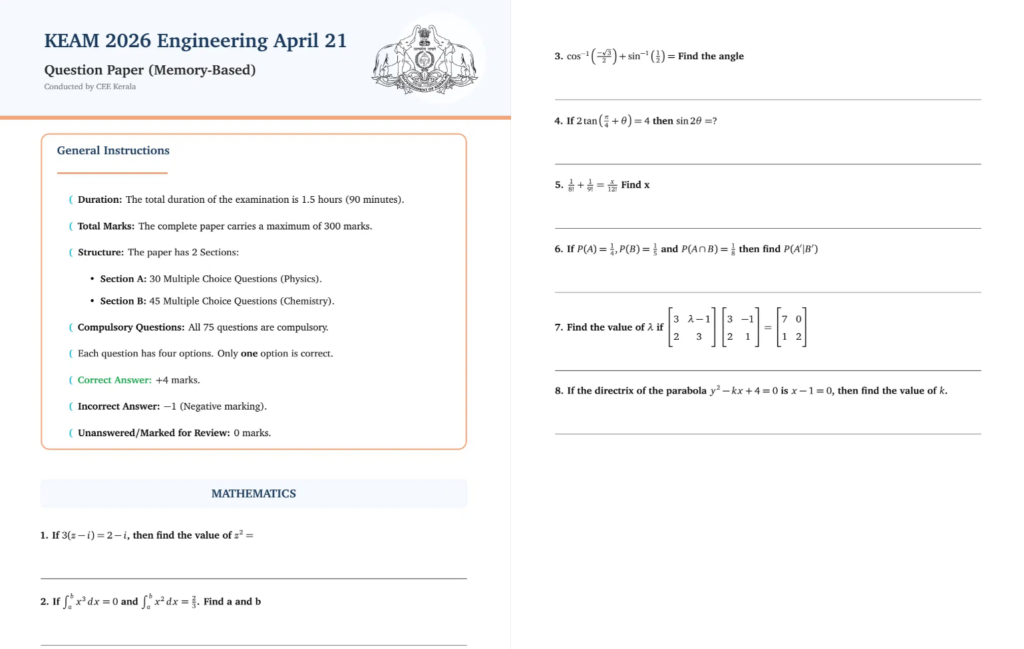
What are the Students’ Reactions of KEAM 2026 April 21 Exam?
Overall, the KEAM 2026 April 21 session was seen as “manageable but very long”, requiring strong speed and accuracy. Students reported that having effective time management, like solving easy questions first, was the key. Check subject-wise students’ reactions for KEAM Paper Analysis 2026 April 21.
Many Students praised Chemistry for being relatively easy and NCERT-based. They said it “improved overall performance” and gave confidence. In Physics, quick formula-based questions allowed fast attempts. Overall exam pattern was as expected, so no surprises.
According to the Students, Mathematics was time-consuming. Students repeatedly mentioned that math questions were long and “calculation-based”, making time management crucial. Several noted they had to rush “the remaining few questions” at the end. Accuracy under time pressure was critical, as one student said minor mistakes could hurt the score.
“Mathematics was the longest since it has lengthy and multi-step problems,” and “Physics was fairly challenging with a combination of conceptual and numerical problems”. A student added that Chemistry “served as a way of improving overall performance”.
KEAM 2026 Answer Key and Response Sheet
The Commissioner for Entrance Examinations (CEE), Kerala, is expected to publish the KEAM 2026 Answer Key along with the Response Sheet soon after the examination concludes. Candidates can use the provisional answer key to cross-check their attempted responses and get an early estimate of their likely scores, well ahead of the official result declaration.
The Response Sheet will give students a detailed view of the choices they marked during the test, making it easier to identify any errors or mismatches. Where discrepancies are noticed, candidates will have a defined window to submit formal objections before the deadline closes. Going through the KEAM 2026 Answer Key is a crucial step for aspirants to gauge their exam performance and plan accordingly for the upcoming rounds of the Kerala engineering and pharmacy admissions process.
Check the KEAM Answer Key 2026
How to Download the KEAM 2026 Answer Key?
Follow these simple steps to access and download the KEAM answer key 2026:
- Visit the official CEE Kerala website at cee.kerala.gov.in.
- On the homepage, locate and click the “KEAM 2026 Answer Key” link.
- Enter your registered Email ID and Password to log in.
- The KEAM 2026 provisional answer key will appear on your screen.
- Review the answers carefully against your responses.
- Click Download and save the PDF for future reference and comparison.
How to Challenge the KEAM 2026 Answer Key?
If you believe any answer in the provisional key is incorrect, you can submit a formal objection through the official portal. Here’s how to challenge the KEAM 2026 answer key:
- Visit the official CEE Kerala website (cee.kerala.gov.in).
- Click on the “KEAM 2026 Answer Key Objection” or challenge window link.
- Log in using your registered Email ID and Password.
- The provisional answer key will be displayed on screen.
- Select the question(s) you wish to challenge and provide a valid justification with supporting documents or proof.
- Pay the objection fee of INR 200 per question through the online payment portal.
- Submit your objection before the deadline.
KEAM 2026 Chapter-Wise Weightage
The following weightage analysis is based on memory-based student reports and historical trends from KEAM previous year question papers. Candidates can use this data to prioritise high-weightage topics for any upcoming preparation.
Important Topics and Weightage For Physics
According to the KEAM Paper Analysis 2026 for the Physics paper, check the topics and the weightage percentage.
| Physics Topics | Questions | % Weight |
| Mechanics (Waves/Strings) | 8 | 18% |
| Electromagnetism (Current, Electrostatics, Magnetism) | 12 | 27% |
| Optics (Wave/Light) | 6 | 13% |
| Modern Physics | 6 | 13% |
| Thermodynamics/Heat | 4 | 9% |
| Others (Rotational, etc.) | 9 | 20% |
Important Topics and Weightage For Chemistry
According to the KEAM Paper Analysis 2026 for the Chemistry paper, check the topics and the weightage percentage.
| Chemistry Topics | Questions | % Weight |
| Organic Chemistry | 12 | 40% |
| Physical Chemistry | 10 | 33% |
| Inorganic Chemistry | 8 | 27% |
Important Topics and Weightage For Maths
According to the KEAM Paper Analysis 2026 for the Maths paper, check the topics and the weightage percentage.
| Mathematics Topics | Questions | % Weight |
| Calculus (Integrals/Differentiation) | 25 | 33% |
| Coordinate Geometry | 15 | 20% |
| Algebra (Matrices, Perm/Comb) | 15 | 20% |
| Probability & Statistics | 10 | 13% |
| Trigonometry/Complex Nums | 10 | 13% |
KEAM Exam Pattern 2026
Understanding the KEAM question paper pattern is essential for effective preparation. The KEAM entrance exam follows a fixed structure across all shifts, with Mathematics carrying the highest weightage at 50%, followed by Physics at 30% and Chemistry at 20%.
| Subjects | No. of Questions | Marks Per Question | Total Marks | Weightage (%) |
| Mathematics | 75 | 4 | 300 | 50% |
| Physics | 45 | 4 | 180 | 30% |
| Chemistry | 30 | 4 | 120 | 20% |
| Total | 150 | — | 600 | 100% |
Expected KEAM 2026 Marks v/s Ranks
The table below provides an estimated KEAM rank analysis based on combined scores after board marks standardisation. These projections are based on KEAM 2025 cut-offs and historical admission data, and are intended to help candidates assess their standing before the official results.
| KEAM Score (Boards + KEAM exam) after standardisation | KEAM 2026 Ranks expected |
| 550+ | 1 to 5000 |
| 450+ | 5001 to 20000 |
| 350+ | 20001 to 50000 |
| 250 and below | 50000+ |
KEAM Cutoff 2026 (Expected)
Based on KEAM 2025 cut-offs and previous admission trends, the table below outlines the expected KEAM cutoff for government colleges across popular engineering branches. These are approximate figures and may vary based on seat availability and applicant pool.
| Course | College | General |
| Computer Science Engineering (CSE) | College of Engineering, Thiruvananthapuram (CET) | ≤ 300 |
| Government Engineering College, Thrissur | ≤ 550 | |
| Govt. Model Engineering College, Kochi (MEC) | ≤ 1,000 | |
| TKM College of Engineering, Kollam | ≤ 1,100 | |
| Electronics & Communication Engineering (ECE) | CET, Thiruvananthapuram | ≤ 800 |
| GEC Thrissur | ≤ 1,200 | |
| TKM College of Engineering | ≤ 2,000 | |
| MEC, Kochi | ≤ 1,500 | |
| Electrical & Electronics Engineering (EEE) | CET, Thiruvananthapuram | ≤ 1,800 |
| GEC Thrissur | ≤ 2,500 | |
| TKM College of Engineering | ≤ 3,200 |
List of Colleges Accepting KEAM Scores
Candidates who clear the KEAM entrance exam are eligible for admission to a wide range of government and private engineering institutions across Kerala. Some of the prominent colleges accepting KEAM 2026 scores include College of Engineering Trivandrum (CET), TKM College of Engineering Kollam, Cochin University of Science and Technology (CUSAT), etc. Candidates are advised to check the eligibility criteria and branch-wise cutoffs on the CEE Kerala official website before the counselling rounds begin.
- College of Engineering Trivandrum (CET)
- TKM College of Engineering, Kollam
- Cochin University of Science and Technology (CUSAT), School of Engineering
- Government Engineering College, Thrissur (GEC Thrissur)
- Model Engineering College, Thrikkakara
- Government Engineering College, Barton Hill
- College of Engineering, Chengannur
- Rajagiri School of Engineering & Technology, Kochi
- Mar Athanasius College of Engineering, Kothamangalam
- College of Engineering & Management, Punnapra
How to Prepare For The Last KEAM 2026 Exam?
With the final KEAM 2026 shifts just around the corner, this is the time to sharpen your strategy rather than start anything new. Based on the KEAM 2026 difficulty level seen in the April 21 paper, particularly the lengthy Mathematics section and moderate Physics, candidates must focus on high-weightage topics, speed, and accuracy. Here are the key preparation tips to make the most of the time left:
- Prioritise Calculus and Algebra in Mathematics; these two topics together account for over 50% of the Maths section and are the biggest scoring opportunity in the KEAM Maths question paper.
- Revise Electromagnetism for Physics: it carried the highest weightage in Physics at around 27%, covering Current Electricity, Electrostatics, and Magnetism.
- Consolidate NCERT for Chemistry: Chemistry is the most accessible section of the KEAM entrance exam; a strong command of Organic, Physical, and Inorganic Chemistry from NCERT can give your overall score a meaningful boost.
- Practice from KEAM model question papers: solving KEAM previous year question papers under timed conditions will help you identify weak areas and improve your accuracy before the final shift.
- Attempt full-length CBT mock tests: since the KEAM exam pattern is computer-based, practising in CBT mode helps simulate real exam conditions and reduces last-minute anxiety.
- Work on time management: students who appeared on the KEAM 2026 April 21 exam have consistently flagged time as the biggest challenge, especially in Mathematics. Train yourself to attempt easier questions first and return to lengthy ones later.
Conclusion
The KEAM 2026 Paper Analysis for April 21 confirms that the overall paper was moderate in difficulty, with Mathematics standing out as the most time-intensive section. Candidates who managed their time well and leveraged Chemistry for quick scoring are likely to post competitive scores. With the KEAM 2026 answer key and response sheet expected to be released soon, aspirants can begin estimating their scores using the expected marks vs rank data provided above. Keep checking the official CEE Kerala website and this page for the latest KEAM entrance exam news and updates on results and counselling.
Frequently Asked Questions
1. What is a safe score for KEAM 2026?
Based on previous years’ trends, a score above 550 is considered excellent and improves your chances of securing a seat in top government colleges. Scoring around 470 or above is generally viewed as good for reputed institutions, while 400 and above keeps candidates competitive for many private colleges. Those scoring around 350 may still have moderate admission prospects depending on category and branch preferences.
2. Is 470 a good score in KEAM?
Yes, 470 is widely considered an above-average score in KEAM for engineering aspirants. It typically corresponds to an approximate rank between 5,000 and 10,000, which opens doors to several reputed private engineering colleges in Kerala and, in certain cases, selected government colleges depending on the chosen branch and reservation category.
3. How many questions were there in the KEAM 2026 April 21 paper?
The KEAM 2026 April 21 paper is designed for engineering aspirants and consists of a total of 150 questions. The paper is divided across three subjects: 75 questions from Mathematics, 45 from Physics, and 30 from Chemistry.
4. What are KEAM 2026 exam day guidelines?
Candidates appearing for the remaining KEAM 2026 exam shifts should keep the following guidelines in mind. Carry your admit card and a valid photo ID to the exam centre without fail. Report at least 30 minutes before the scheduled start time to avoid last-minute complications. Do not carry electronic devices, calculators, or study materials inside the examination hall. Read each question carefully before marking, as the KEAM exam pattern includes a negative marking of 1 for every incorrect response. Prioritise accuracy alongside speed, particularly in the Mathematics section, where calculation errors can be costly.
5. What was the difficulty level of KEAM 2026 on April 21?
According to the KEAM Paper Analysis, the difficulty level for the April 21 exam was rated overall moderate by students. Chemistry was the easiest section, Physics was moderate to slightly lengthy, and Mathematics was the most challenging due to its lengthy, multi-step, calculation-based problems.
6. Is KEAM 2026 tough or easy?
Based on the KEAM 2026 exam analysis conducted across multiple shifts, the overall difficulty level has been rated moderate. Chemistry has been consistently manageable and NCERT-based, Physics has been moderate with a mix of conceptual and numerical questions, while Mathematics has been the most demanding section due to its lengthy and calculation-intensive nature.
7. How is the KEAM rank calculated?
The KEAM rank analysis is based on a combined score derived from the candidate’s KEAM entrance exam marks and Class 12 board examination marks, after a standardisation process. The weightage given to the entrance exam score plays a significant role in the final rank, which is then used for seat allotment during the Kerala engineering admissions counselling process.try, and Mathematics.
8. Is there negative marking in KEAM 2026?
Yes, the KEAM entrance exam 2026 follows a negative marking scheme. Candidates receive +4 marks for every correct answer and lose 1 mark for every incorrect response. Unattempted questions carry no penalty, so strategic skipping of uncertain questions is advisable to protect your overall score.
9. What is the validity of KEAM 2026 score?
The KEAM 2026 score and rank are valid only for the current academic year’s admission cycle. Candidates cannot carry forward their rank or score to the following year, making it essential to participate in all rounds of counselling conducted by CEE Kerala to maximise their chances of securing a preferred college and branch.